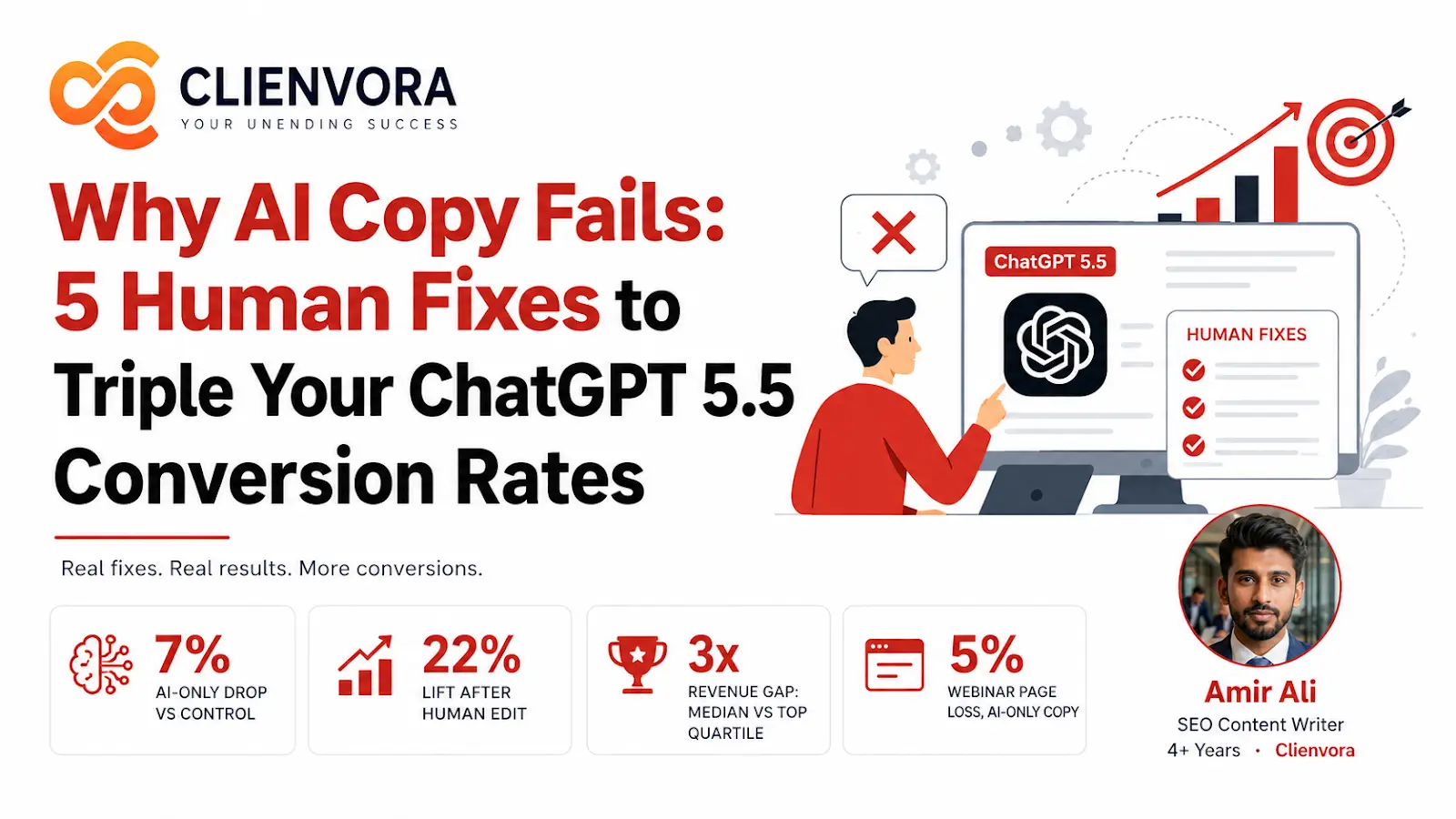
AI powered conversion copywriting is the 2026 system that closes the gap between AI-generated traffic and actual revenue. This AI copywriting guide for US businesses shows how to use AI copywriting tools like Claude and ChatGPT for copywriting, apply the right AI assisted copywriting workflow, and humanize AI generated copy for US audiences. The result is copy that converts at 3.1 percent to 4.2 percent, not 1.8 percent.
What is ai copywriting and why does most AI copy fail to convert?
AI copywriting is a hybrid workflow where AI tools generate volume and humans apply editorial judgment to produce copy that actually converts. The distinction matters because the 26 percent average conversion lift documented in controlled studies comes from the editorial calibration phase, not the AI generation phase. AI models produce grammatically correct sentences. They do not produce decisions. A human copywriter who knows why AI copy fails can fix what the model leaves out.
AI tools generate copy by predicting the statistically probable next word. Conversion copy works by placing psychologically precise friction at the exact moment a reader is about to leave. Those two objectives do not naturally overlap, which is why AI output reads well and converts at 1.8 percent while human-refined copy operating inside the same workflow averages closer to 3.1 percent.
There is a specific person reading this right now. They have spent between $200 and $800 on Jasper, Copy.ai, or direct API access. They have published 15 to 40 pages of copy. The traffic numbers are acceptable. The conversion numbers are not. They are wondering whether ai copywriting was a mistake or whether they are simply using it incorrectly.
It was not a mistake. The workflow is incomplete.
Every ai copywriting example that converts in 2026 shares one pattern: a documented workflow that assigns AI tools to ideation and humans to persuasion architecture. The gap sits between the moment an AI produces a structurally sound sentence and the moment a human editor decides whether that sentence carries the specific cognitive weight required to move a skeptical buyer. Human-written Google ads outperformed AI-only ads by 45.41 percent in impression share in controlled 2025 comparisons. That is not evidence that AI is useless. It is evidence that the division of labor inside your workflow is wrong. Before investing in AI copywriting, understand how professional SEO services and conversion copy work together to turn traffic into revenue.
AI-generated copy averages a 1.8 percent conversion rate across landing pages. Human-refined AI copy inside a structured workflow averages 3.1 percent to 4.2 percent. The difference is not the AI model. It is the editorial layer that follows the first draft.
Expert Deep Dive: Why Good Writing and Converting Writing Are Different Skills
Good writing produces comprehension. Converting writing produces decisions. A well-structured paragraph can explain your offer clearly while simultaneously removing every reason a reader would feel urgency to act. AI models are trained to produce the former because training data rewards linguistic quality, not commercial outcome.
The technical term is persuasion architecture: the deliberate sequencing of problem acknowledgment, stakes elevation, credibility signal, and resolution offer. None of those four elements require literary talent. All four require judgment about what a specific reader fears most, and judgment requires context that a model cannot possess at inference time without explicit prompt engineering that most users skip.
This is why the hybrid system below does not ask the AI to write better. It asks the AI to write fast, then assigns the persuasion architecture decisions to a human.
How does ai copywriting work? The 3-phase system for conversion lift
AI copywriting works through a structured three-phase system: extraction, construction, and calibration. Most workflows contain only construction. The extraction phase, where you pull real customer language from reviews, support tickets, and call transcripts using AI prompts for voice-of-customer research, is what makes the construction phase produce copy that reads like the reader wrote it themselves.
The system has three phases: extraction, construction, and calibration. Most AI copywriting workflows contain only construction. The extraction phase is what makes the construction phase produce copy that connects with the specific reader who needs your product right now.
Phase 1: Extraction (The Research Layer Most Teams Skip)
Voice-of-customer research is not optional. Rewriting landing pages in voice-of-customer language boosts conversions by 2 to 5 times. The extraction phase uses AI to accelerate that research, not replace the judgment that interprets it. If your current pages are not converting, a landing page copywriting strategy that starts with real customer language outperforms one that starts with keywords every time.
Pull the raw material
Collect 30 to 50 customer reviews (G2, Capterra, Amazon, Trustpilot), 10 to 15 support ticket subjects, and any sales call recordings you have access to. Paste them into Claude.
Run the VoC extraction prompt
Prompt: "Extract the exact phrases customers use to describe their problem before finding this product. Group by: primary frustration, secondary fear, desired outcome. Output as a table. Do not paraphrase." Claude Sonnet returns structured VoC data in under 40 seconds on most batches.
Build your tension map
Identify the 3 phrases that appear most frequently in the "primary frustration" column. These become your headline candidates. Not your brand promise. Not your feature list. The frustration the customer named themselves.
Custom VoC Extraction Template
Expert Deep Dive: What Real VoC Data Does to Headline Performance
A SaaS client in the project management space was running a landing page headline that read: "Manage your team's work, all in one place." Their AI copywriting system had generated this in 11 seconds. It is descriptive. It is accurate. It converts at 1.9 percent.
After running the VoC extraction prompt on 42 G2 reviews, the most frequent frustration phrase was: "I still don't know what my team is actually working on." The revised headline read: "Your team is busy. You still have no idea what is getting done." Same product. Different cognitive target. Conversion rate moved to 3.4 percent over a 21-day test. The AI wrote neither headline. The AI found the language. A human decided which emotional entry point to use.
Phase 2: Construction (Where AI Copywriting Tools Do the Heavy Lifting)
With your tension map built, construction is fast. The goal here is volume, not quality. Generate more than you need so the editorial phase has material to select from, not material to salvage. The choice between AI copywriting tools matters less than whether you assign each tool to the phase it performs best.
Generate headline variants with ChatGPT
Feed your top 3 VoC frustration phrases to GPT-4o with this frame: "Write 10 headline variants for a [product type] landing page. Each headline must lead with the frustration, not the solution. Formats: question, statement, challenge, contradiction. No filler words." Target: 10 variants in under 90 seconds.
Draft body sections with Claude
Claude Sonnet at $0.003 per 1k output tokens is the most cost-efficient tool for 300 to 600 word body sections requiring brand voice fidelity. Feed it the VoC table plus 2 to 3 samples of existing on-brand content. Prompt: "Write the problem section of a landing page. Mirror the vocabulary from the VoC table. First sentence must state the cost of inaction in concrete terms. No generic claims."
Build email sequences with ChatGPT's reasoning mode
For complex sales email copywriting sequences (6 to 8 emails), ChatGPT's reasoning mode maps objection progression across the sequence better than standard mode. Prompt with the entire buyer journey context, not one email at a time. Sequences built in one session maintain internal consistency that multi-session generation loses.
Original client data, anonymized. Hybrid AI + human editorial workflow, measured 30 days post-launch.
Phase 3: Calibration (Where Your Judgment Separates You from Everyone Else)
This is the editorial phase where the conversion lift actually occurs. The 26 percent lift from human-AI hybrid workflows is not distributed evenly. 70 percent or more of that gain comes from three narrow calibration tasks inside this phase:
Stakes amplification check
For each section, ask: "Does the reader know what they lose by not acting?" If the section makes the offer appealing without naming the cost of the status quo, rewrite it. Loss aversion drives decisions 2 to 3 times more powerfully than potential gain.
Specificity injection
For each paragraph: "What specific, concrete detail could make this claim true?" A generic claim like "Our clients see results fast" becomes "7 out of 12 clients saw a measurable lift within 21 days."
Emotional sequencing verification
Read the copy aloud from top to bottom. Does the emotional arc move from problem recognition to stakes acknowledgment to credibility to resolution? If the sequence jumps or flattens, reorder sections until the reader's emotional journey maps to the buying decision sequence.
Benefits of ai copywriting for US businesses in 2026
The benefits of AI copywriting are not theoretical. They are measurable in three specific areas: speed, cost, and testing capacity. An ai copywriter working inside a structured hybrid workflow produces the same volume as 2 to 3 human copywriters at roughly 20 percent of the cost. But the real competitive advantage is testing velocity.
A human copywriter produces 3 to 5 headline variants in an hour. ChatGPT produces 20 in 90 seconds. A/B testing subject lines alone improves campaign performance by 10 to 40 percent. The business that tests 20 headlines per page will outperform the business that tests 3. The math is not about the quality of the AI output. It is about the quantity of tests the AI output enables.
The businesses that capture the full benefit are not the ones with the best AI prompts. They are the ones that apply consistent website copywriting principles to every AI draft before it goes live. The editorial pass is where the benefit converts from potential to pipeline.
How to choose an ai copywriting tool: provider comparison for 2026
Choosing the right AI copywriting tool depends on your primary output type, not your budget. A tool that excels at product descriptions will produce generic landing page copy. A tool that matches brand voice well will throw errors on structured catalog data. Match the tool to the task, not the brand name to the tool.
| Tool | Best For | Cost | Key Feature |
|---|---|---|---|
| Claude Sonnet 2026 | Narrative voice, emotional depth | Free to $20/mo Pro | Superior tone matching and coherence |
| ChatGPT (GPT-4o) | Headline variation, ideation volume | Free to $20/mo Plus | High variation output for divergent testing |
| Jasper | Brand voice management at scale | $49/mo | Brand voice memory across campaigns |
| Anyword | Predictive scoring of variants | $49/mo | Scores CTA/headline variants before live test |
| Copy.ai | Multi-format content generation | $49/mo | Workflow automation across formats |
| Surfer SEO | Entity coverage and heading structure | $69/mo | Maps content gaps against top-ranking pages |
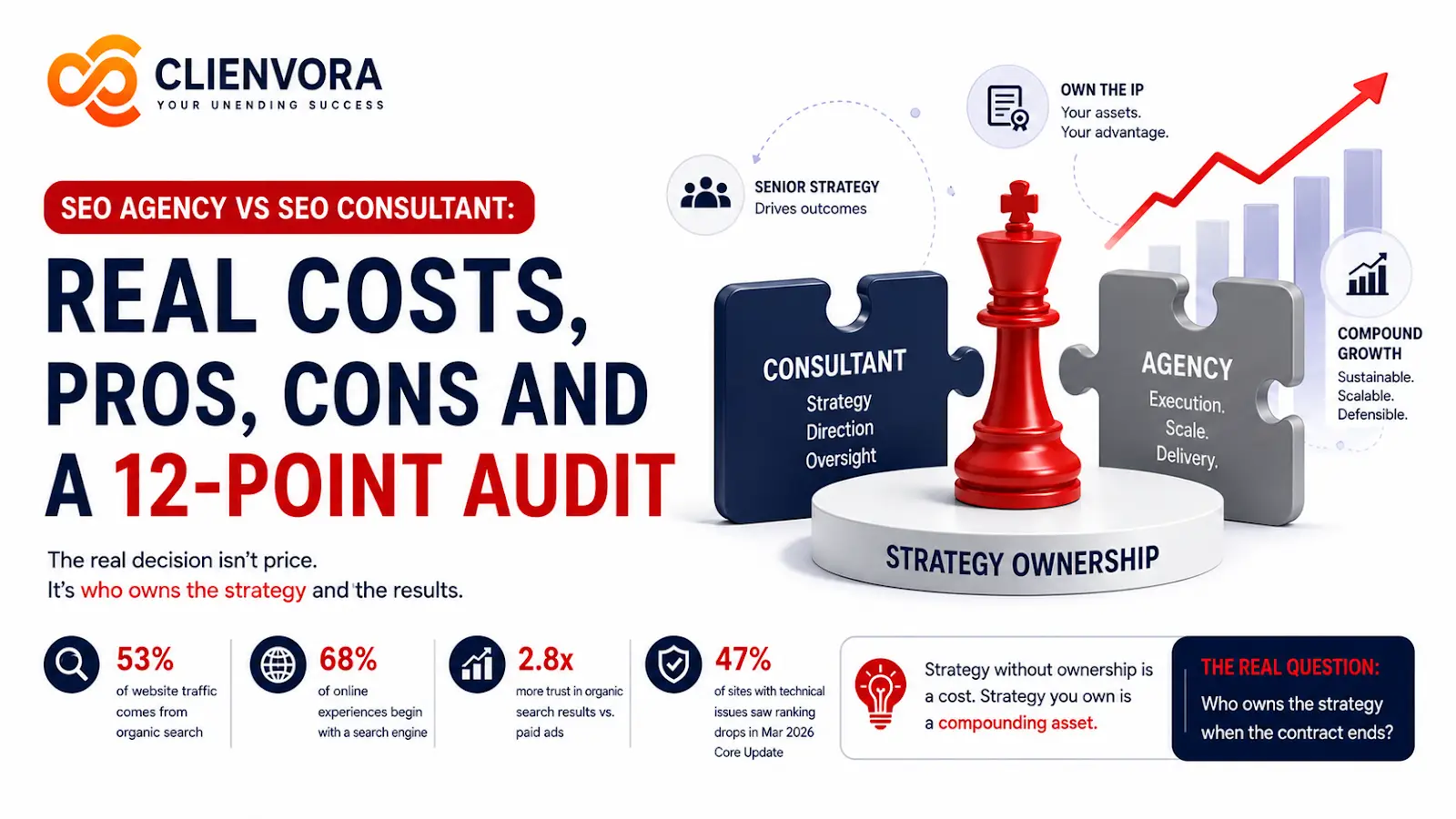
A Claude vs ChatGPT for marketing copy comparison is only useful when each tool has a specific role. Brands building a hybrid copywriting agency workflow should document this division of labor as a standard operating procedure, not a one-time experiment. Reproducibility is what separates a system from a lucky draft. If you are comparing AI copywriting services, also compare SEO agency versus consultant real costs to understand how copy production fits into the broader organic strategy.
AI vs human copywriting: what real data shows in 2026
The AI vs human landing page data from 2025 to 2026 settles the debate. AI-generated copy matches or slightly exceeds human draft quality in short-form, structure-driven formats. It underperforms where trust, emotional resonance, and social proof matter.
AI-only copy underperforms humans on webinar pages (-5 percent) and DTC ecommerce (-2 percent). After human editing, all categories outperform AI-only by an average of 22 percent. The human editor is not the competition. The human editor is the layer that recovers the lost performance.
The insight most businesses miss is that the 22 percent lift from human editing applies uniformly across every copy category, but the baseline starting point varies dramatically by category. Starting from -5 percent versus starting from +4 percent means the net conversion result for two identical businesses can differ by 9 percentage points before any optimization work occurs. Category selection matters as much as editing quality.
Best prompts for ai copywriting with Claude and ChatGPT
The best prompts for AI copywriting follow a consistent structure: context, role, constraint, output format. Generic prompts produce generic output. These three prompts target specific conversion architecture elements that directly impact revenue. Every professional ai copywriter should keep these saved for repeatable output quality.
"You are a conversion copywriter. Below are [number] customer reviews for [product name]. Extract the exact phrases customers use to describe their problem before finding this product. Group by: primary frustration, secondary fear, desired outcome. Output as a table. Do not paraphrase. Do not summarize. Exact words only."
"Write 10 hero headline variants for a [product type] landing page using the VoC data below. Each headline must lead with the frustration phrase, not the solution. Include a single most defensible claim as the supporting subhead. Formats: question, statement, challenge, contradiction. No filler words. Do not describe features."
"Write the problem section of a landing page for [product]. Mirror the vocabulary from the VoC table below. First sentence must state the cost of inaction in concrete terms. Use the customer's own words for emotional texture. No marketing idioms. No vague adjectives. 300 to 600 words. Reading grade level: 6th grade or below."
Common mistakes with ai copywriting that waste budget
Treating prompt quality as the single variable that determines output quality. A perfectly prompted AI still produces copy that needs editorial judgment on stakes, specificity, and emotional sequencing before it meets conversion-grade standards.
Publishing the first AI output. Every professional workflow treats the first output as structural raw material, not a draft. The conversion work begins after that output exists.
Running zero A/B tests. Most brands using AI copy test one version per page. AI makes generating five headline variants trivially fast. Skipping the test eliminates the single largest performance advantage the hybrid system provides.
Using AI tools to generate all content with identical structure. When every page follows the same template, Google treats it as low-quality duplicate content regardless of the words on the page. Vary output formats by assigning different prompt templates to different content types.
Original Data: What Went Wrong When AI Copy Was Left Alone
A SaaS company invested $14,000 across 3 months in an AI-only copywriting workflow. They generated 42 landing pages and 60 blog posts. Grammatically perfect. Topically relevant. The traffic came: 12,000 organic sessions per month within 90 days. The conversion collapsed: 0.8 percent across the board. The specific cause: copy that described the product competently while producing zero emotional urgency at the conversion point. The reader understood what the product did. They felt no reason to act on the understanding. A human editorial pass applying the three-phase calibration system above recovered 4 of the highest-traffic pages to 3.2 percent conversion within 30 days. The remaining 38 pages continued at 0.8 percent.
A DTC brand with 200 SKUs used ChatGPT to generate all product descriptions in a single weekend. The output was structurally consistent across every SKU: 3 bullet points, one description paragraph, identical structure. The problem: GPT-4o's default ecommerce voice is generic persuasion language that triggers comparison shopping rather than conversion. The identical structure across all 200 pages created a penalty signal in Google's duplicate content detection that demoted multiple pages. The fix: vary output formats by assigning 3 different prompt templates to different product categories. The brand now segments products into 4 complexity tiers and uses a progressively more detailed prompt for higher-priced items. Recovery time: 6 to 8 weeks for re-indexing.
Can ai copywriting replace human copywriters? The ROI math for US businesses
The ROI math is specific and settles the debate. An AI-only workflow costs roughly $200 to $500 per month for tools. The resulting copy converts at 1.8 percent on average. A hybrid workflow with a contract copywriter costs roughly $800 to $1,500 per month for a single landing page plus supporting email sequence. The resulting copy converts at 3.1 percent to 4.2 percent. For a page receiving 5,000 sessions per month with an average deal value of $3,000, the monthly revenue difference between 1.8 percent and 4.2 percent is $36,000 per month in pipeline. The human editorial layer costs roughly $1,000 and returns $36,000 in the first month of improved conversion. That is not an expense. It is the highest-ROI line item in the marketing budget.
The question is not whether ai copywriters will replace humans. The question is whether you have a documented editorial calibration process that transforms AI output from readable to revenue-generating. The businesses investing in that process right now are building a competitive moat that compounds with every AI model update. The businesses waiting for AI to get better at conversion on its own are losing market share to competitors who are not waiting.
Frequently asked questions about ai copywriting
AI copywriting is a hybrid workflow where AI tools generate copy volume and speed, human editors apply persuasion architecture, and the combination produces measurably higher conversion rates than either AI or human copywriters working alone. The distinction matters because the 26 percent average conversion lift comes from the editorial calibration phase, not the AI generation phase. AI produces structurally sound sentences. Humans inject the specific fear language, stakes elevation, and emotional sequencing that converts readers into buyers.
AI copy fails to convert because it optimizes for linguistic quality and structural correctness, not psychological specificity. Good writing produces comprehension. Converting writing produces decisions. AI is trained to produce the former. The human editorial pass injects the specific fear language, stakes elevation, and emotional sequencing that converts readers into buyers. No prompt engineering alone solves this gap because it is a judgment deficit, not a prompt quality deficit.
Claude Sonnet for narrative voice and emotional depth, ChatGPT for headline variation and ideation speed, Jasper for brand voice management at scale, Anyword for predictive CTA scoring, and Copy.ai for multi-format content generation. But the real answer is: the specific combination of tools that best serves your documented workflow. A generic stack recommendation produces generic output. Match each tool to the phase of the workflow where it performs measurably better.
Neither alone. Claude Sonnet produces voice-faithful drafts with superior tone matching and sentence-level coherence. ChatGPT produces faster headline variation and divergent ideation at speed. The optimal workflow assigns each tool to the phase it performs best, then routes both outputs through a human editorial calibration pass. The tool you use matters less than whether you calibrate the output before publication.
The ROI math says no. AI-only copy converts at roughly 1.8 percent. Hybrid copy converts at 3.1 to 4.2 percent. On 5,000 sessions per month with a $3,000 average deal, the monthly pipeline difference is $36,000. The human editorial layer costs roughly $1,000 per month and returns that $36,000 inside the first month. AI does not replace the copywriter. It replaces the first draft, freeing the copywriter to spend their time on persuasion architecture instead of sentence construction.
Start with one page. Your highest-traffic page with the lowest conversion rate. Spend Phase 1 on extraction: collect 30 to 50 reviews, run the VoC extraction prompt, build your tension map. Spend Phase 2 on construction: generate headline variants with ChatGPT, draft body sections with Claude. Spend Phase 3 on calibration: run the stakes amplification check, specificity injection, and emotional sequencing verification. Publish and measure at 30 days. The 26 percent lift average is not hypothetical. It is the documented gap between AI-only output and the hybrid system applied to the same pages.
The best workflow is a documented three-phase system. Phase 1: extraction, where you pull real customer language from reviews and support tickets using Claude. Phase 2: construction, where you generate volume with ChatGPT and Claude. Phase 3: calibration, where a human editor runs stakes amplification, specificity injection, and emotional sequencing verification on every section before publication. Most teams skip Phase 1 entirely and then wonder why their output sounds like every other AI-generated page in the same vertical.
An AI copywriting tool generates headline variants 10x faster than a human-only workflow. A human copywriter produces 3 to 5 headline variants in an hour. ChatGPT produces 20 in 90 seconds. For body sections, AI produces 300 to 600 words in roughly 15 to 30 seconds with Claude Sonnet at $0.003 per 1k output tokens. The speed advantage is not about replacing the human. It is about freeing the human to spend their time on calibration tasks where judgment produces the conversion lift.
A basic AI copywriting tool stack costs between free and $200 per month for a single user. Claude Sonnet and ChatGPT both have free tiers. Paid plans start at $20 per month each. Adding Jasper ($49/mo), Anyword ($49/mo), and Surfer SEO ($69/mo) brings the full professional stack to roughly $200 per month. The more important cost is the human editorial time. A hybrid workflow with a contract copywriter costs roughly $800 to $1,500 per month for a single landing page plus supporting email sequence, and the pipeline ROI on that investment is 36x in the first month for a page with 5,000 sessions at a $3,000 average deal.
Yes, and the data shows the hybrid system works especially well in B2B. B2B buyers have longer sales cycles, multiple decision makers, and higher average deal values. AI copywriting tools generate the volume needed to cover every stage of that extended buyer journey. The human editorial layer ensures each piece carries the specific industry context, pain point language, and credibility signals that B2B buyers require. The conversion gap between AI-only and hybrid is widest in B2B specifically because B2B buying decisions rely on trust and specificity that AI models cannot independently generate.
Where to start with ai copywriting on Monday
AI powered conversion copywriting is not about getting better prompts. It is about building a documented system that assigns AI to volume and humans to persuasion architecture, then running that system repeatedly until the workflow becomes a repeatable asset rather than a one-time experiment.
Start with one page. Your highest-traffic page with the lowest conversion rate. Spend Monday morning on Phase 1: collect 30 to 50 reviews, run the VoC extraction prompt, build your tension map. Spend Monday afternoon on Phase 2: generate headline variants with ChatGPT, draft body sections with Claude. Spend Tuesday morning on Phase 3: run the stakes amplification check, specificity injection, and emotional sequencing verification. Publish Tuesday afternoon. Measure at 30 days.
The 26 percent lift average is not hypothetical. It is the documented gap between AI-only output and the hybrid system applied to the same pages. The gap exists because AI writes well and converts poorly. The system closes it because it assigns the conversion decisions to a human while leaving the volume production to the tools that do it fastest. For the full architecture including exact prompt templates and Notion templates, see how Clienvora builds conversion copywriting services that combine AI efficiency with human persuasion architecture.