Ecommerce copywriting rewrites product pages around customer language pulled from reviews, not manufacturer specs. The median Shopify store converts 1.4 percent of sessions while the top 20 percent clear 2.7 percent, across 426 stores benchmarked by Littledata. This guide covers the rewrite process, published 2026 rates, and the conversion benchmarks that define a fair test.
What Is Ecommerce Copywriting?
Ecommerce copywriting is the practice of rewriting product and category pages around customer language so more of your existing traffic completes a purchase.
It is not more description volume. It is conversion architecture applied to the page a buyer reads right before tapping Add to Cart.
Manufacturers write specs. Customers write outcomes. The gap between those two languages is where your conversion rate lives.
The same editorial calibration sits behind AI conversion copywriting: the rewrite phase, not the generation phase, produces the lift.
Clienvora runs this process for stores that already pay for traffic. Every deliverable maps to a metric. Nothing ships without one.
Revenue equals sessions multiplied by conversion rate multiplied by average order value. Copywriting moves the middle variable. Take 10,000 monthly sessions at an $85 order value: climbing from the Littledata median of 1.4 percent conversion to the top-quintile mark of 2.7 percent adds $11,050 in revenue every month, with no extra ad spend.
What ecommerce copywriting services deliver
- Product page rewrites: review-mined headlines, objection-handling blocks, and social proof placed next to the Add to Cart button
- Category page copy: benefit-led headers that move browsers into product pages instead of back to search results
- Cart and checkout copy: plain-language cost and delivery expectations, tied to the top fixable reason carts get abandoned
- Recovery and retention emails: abandonment and win-back sequences written in the customer's own hesitations
- Homepage and landing copy: one trust message that confirms the ad promise for returning visitors
How Does Ecommerce Copywriting Work?
It works by mining verified purchase reviews for the exact phrases buyers use, then rebuilding the page so each objection gets answered in order.
The process is repeatable. Four steps run on every page. The order matters more than the prose.
The 4-step rewrite process
Review mining and VoC extraction
Collect 50 or more verified purchase reviews for the product. Extract the phrases buyers use for the outcome they wanted and the hesitations they had. Those phrases become the headline and the objection blocks.
Competitor copy audit
Read the top three competing product pages. If you cannot name the dimension you own, buyers default to price comparison. Claim the dimension competitors ignore.
Architecture rewrite
Rebuild the page in this order: review-mined headline, problem recognition, emotional bridge, benefits as outcomes, social proof block, objection section, risk reversal, call to action. Each element answers a specific hesitation from the reviews.
Test and measure
Ship the rewrite as an A/B test against the original. Watch conversion rate, revenue per session, and order value. Keep the winner as the new baseline, then move to the next page.
What a Shopify copywriter needs to know
Littledata benchmarks 426 Shopify stores through Google Analytics 4. The median store converts 1.4 percent of sessions over a 90-day window. The top quintile clears 2.7 percent.
That spread is not explained by traffic quality. Two stores buying the same ads convert differently because one page removes doubt faster.
Platform details frame the product page: collection structure, cart flow, and the email automations that follow the purchase. The same architecture logic applies to website copywriting for small businesses.
The online store copywriting ecosystem
One page never decides alone. Product pages, category pages, the homepage, cart emails, and ad copy form one message system.
A shopper who clicks an ad about one pain, lands on a generic page, and receives a generic recovery email hits two trust breaks. Each break lowers the odds of an order.
Consistency is the actual job.
What Conversion Rates Should You Expect?
Benchmark your store against the median before judging your copy: half of 426 Shopify stores converted at 1.4 percent or lower over a 90-day window.
Use the table as your baseline. It covers Shopify stores sending GA4 data between July and October 2026.
| Basis | What it means | Conversion rate |
|---|---|---|
| Median store | Half the field sits at or below this mark | 1.4% |
| Mean (average) | Skewed upward by a minority of very large stores | 1.9% |
| Middle 60% | The typical operating band for most stores | 0.5% to 2.7% |
| Top 20% | The tier solid copy architecture helps you reach | 2.7% or higher |
| Top 10% | Elite tier, usually strong traffic plus strong copy | 3.5% or higher |
| Bottom 20% | Diagnosis territory before any rewrite budget | Below 0.5% |
Two other datasets point in the same direction. Dynamic Yield's benchmark of 400-plus brands puts the global average at 2.66 percent, and Statista counted 1.4 percent of global ecommerce visits converting in the first quarter of 2026.
The methods differ. The takeaway does not: most stores sit near 1.5 percent, and the strongest quintile roughly doubles that.
Where abandoned carts go
Baymard Institute tracks cart abandonment across 50 studies. The average rate is 70.22 percent. That number has barely moved in 13 years.
Among fixable reasons, unexpected costs like shipping and tax lead at 40 percent. Long or complicated checkouts follow at 17 percent.
Copy fixes the first one. State shipping thresholds, delivery windows, and return terms on the product page, where the hesitation starts.
Expectations prevent abandonment. Plain words do that.
What Does Ecommerce Copywriting Improve?
Four things move when the copy improves: conversion rate on existing traffic, cart completion, order value, and the retention emails that raise lifetime value.
None of them require new ad spend. The traffic you already bought simply converts harder.
- Conversion rate: the primary metric, judged against the median and quintile benchmarks above instead of against your last campaign
- Cart completion: expectation-setting copy addresses the 40 percent of abandonments tied to surprise costs
- Order value: cross-sell language beside the buy button raises basket size without training customers to wait for discounts
- Lifetime value: post-purchase and win-back sequences written in customer language keep buyers returning
Where the lift comes from: proof placement
Spiegel Research Center at Northwestern analyzed review data across retailers, including 111,460 SKUs and 15.5 million page views. The findings map directly onto product page layout.
Five reviews on a product lift purchase likelihood 270 percent compared with no reviews. Higher-priced items gain 380 percent; lower-priced items gain 190 percent.
The first five reviews carry most of that jump. Ratings between 4.0 and 4.7 stars convert better than a perfect 5.0, because shoppers distrust flawless scores.
- 95 percent of shoppers read online reviews before buying (PowerReviews and Spiegel)
- 82 percent specifically seek out negative reviews (PowerReviews)
- 15 percent higher purchase odds when a verified buyer badge is shown (Spiegel)
- 4.0 to 4.7 stars is where purchase likelihood peaks, not 5.0 (Spiegel)
Two layout rules follow. Put reviews above the fold next to Add to Cart, then quote the negative-review language inside your objection section.
Placement changes conversion. The words matter too.
One engagement, with limits
A skincare brand came to us converting at 1.4 percent on 12,000 monthly sessions, with a $68 order value. Its pages listed ingredients and usage instructions. Nothing handled doubt.
The rewrite pulled language from 68 verified reviews, named the outcome customers reported most often, and added risk reversal beside the buy button. Ninety days later conversion sat at 2.7 percent. Monthly revenue moved from about $11,400 to $22,032.
Treat this as one anonymized engagement, not a controlled experiment. Traffic, product, and season all move the number. Your baseline decides your ceiling.
How to Choose an Ecommerce Copywriter
Ask one question first: can they show a before-and-after conversion metric from a product page rewrite they shipped in the last year?
If the answer is no, they measure activity, not outcome. Keep interviewing.
Before you brief anyone, check the buyer intent keywords driving traffic to your product pages. Non-buying traffic makes any rewrite look weak.
Structure also decides crawl. Keep filter pages out of the index with the ecommerce faceted navigation checklist.
For B2B catalogs, the same product copy has to survive AI answer engines, which is where research starts. See B2B copywriting for that committee dynamic.
| Factor | Generic freelancer | Ecommerce specialist |
|---|---|---|
| Research layer | Reads the product brief, writes from the brief | Mines reviews, competitor pages, and support tickets before writing |
| Objection handling | Assumes the product sells itself | Extracts objections from reviews and answers them in copy |
| Reading level | Writes at grade 10 to 12 | Writes at grade 6 to 8 for maximum comprehension |
| Page architecture | Feature list plus a description block | Problem, emotional bridge, outcomes, proof, objection, CTA |
| Measured outcome | Word count delivered | Conversion rate, revenue per session, order value |
Whichever route you take, ask for a past before-and-after metric. If they cannot name one, they have not done this work.
Rates vary. Proof does not.
Common Ecommerce Copywriting Mistakes
Five mistakes show up on product pages thousands of times a week, and each one quietly costs you purchases you already paid for.
None of them require bad writing. They require blind spots. Both cost you orders.
A supplement brand ran a single description format across 40 products, so every page read like a clone. The rewrite gave each SKU the outcome its own buyers named most often. Pages started earning their traffic again.
Reviews buried under 600 words of technical detail never get read. Spiegel's research shows the conversion jump happens on the first five reviews. Place them near the buy button, where the hesitation lives.
A bullet list of specifications makes the reader translate features into benefits alone. Most readers will not do that work. Write the outcome in their language instead.
Your three-star reviews contain the exact objections buyers raise. PowerReviews found 82 percent of shoppers hunt for negative reviews on purpose. Quote those objections in the copy, then answer them.
Desire and action have a gap between them. Free returns, delivery guarantees, and a plain satisfaction promise close it. Put that sentence beside the button, not in the footer.
The bleed compounds. Fix them in order.
How Much Do Ecommerce Copywriting Services Cost?
Published 2026 rate charts put product page copy between roughly $80 and $219 per 250 words, or $65 to $75 per hour for freelancers.
Price depends on scope. Research depth is what you are buying. The published numbers below set a floor for negotiations.
| Source and level | Published rate |
|---|---|
| Editors' Freelance Association 2026, per word | $0.32 to $0.88 |
| Editors' Freelance Association, per 250-word web page | $80 to $219 |
| Editors' Freelance Association, hourly | $65 to $75 |
| AWAI average per word | About $0.70 |
| Landing or sales page, junior writer | $300 to $750 |
| Landing or sales page, mid-level writer | $750 to $2,000 |
| Landing or sales page, senior specialist | $2,000 to $5,000 |
| FreelanceDesk median landing page | $3,500 (range $1,500 to $8,000) |
Do the math on a catalog. A 400-word product page at published per-word rates lands between $128 and $350. A 50-page store rewrite at 20,000 words runs about $6,400 to $17,500 before revisions.
Retainers sit higher. Ahrefs measured agency retainers averaging $3,209 per month against $1,349 for freelancers, with strategy and testing included on the agency side.
Compare engagement models in SEO agency versus consultant costs. Copy fits inside the same budget conversation.
Cheap pages cost more later.
Ecommerce Copy for AI Answer Engines
AI engines now quote product descriptions directly, so product copy has to read as a citable answer, not a marketing paragraph.
Google's AI Overviews appear on 48 percent of searches, per Ahrefs data from March 2026. Shopping questions flow through ChatGPT and Perplexity the same way.
Three habits help a product page get quoted. State facts plainly: dimensions, compatibility, materials, and fit.
Attach a source or a number to every claim. Keep each answer self-contained in one block.
This is what the KDD 2024 GEO study found lifts citations: telling models to cite sources and to add statistics. Your description should already contain both.
Product pages also feed ecommerce SEO traffic, so the same copy works twice. For the technical layer, pair it with the product page SEO guide.
B2B stores feel it first: 6sense and Forrester count 94 percent of B2B buyers researching with AI assistants before contacting a vendor. See AI conversion copywriting for the calibration workflow.
Be the source. Be quotable. Models pick clean facts.
Ecommerce Copy ROI Calculator
Enter your current sessions, conversion rate, target rate, and order value to see what a realistic lift is worth each month.
Defaults use the Littledata median as the starting point. Results update as you type. Run it before you budget for the rewrite.
Math is simple. Money is the gap.
Ecommerce Copy ROI Calculator
Estimate the monthly revenue impact of improving your product page conversion rate.
Estimated additional monthly revenue
Frequently Asked Questions About Ecommerce Copywriting
What are ecommerce copywriting services?
Ecommerce copywriting services rewrite the pages inside your store so more visitors buy: product pages, category pages, cart and checkout copy, and the email sequences around them. Work starts with mining verified reviews for customer language, then rebuilding each page around objections and outcomes. The success metric is conversion rate and revenue per session, not word count.
How much do ecommerce copywriting services cost?
Published 2026 rate charts put freelance copy at $65 to $75 per hour or 32 to 88 cents per word, with a 250-word web page at $80 to $219 (Editors' Freelance Association). A 400-word product page therefore lands around $128 to $350. Full store projects price by scope: FreelanceDesk's median landing page sits at $3,500.
Can ecommerce copywriting really double my revenue?
On rewritten pages it can, when you start near the median and reach the top quintile. Littledata's 426-store benchmark shows the median Shopify store at 1.4 percent conversion and the top 20 percent at 2.7 percent, which nearly doubles revenue per session. Our anonymized skincare engagement moved 1.4 to 2.7 percent in 90 days. Your result depends on traffic and product.
What makes a Shopify copywriter different from a general copywriter?
A Shopify copywriter writes for the platform's actual conversion environment: collection page structure, product page layout limits, cart and checkout flow, and the email automations that follow the purchase. A general writer produces descriptions in isolation. The platform context decides where social proof, risk reversal, and cross-sell language belong.
How do copywriting services for ecommerce differ from regular copywriting services?
Ecommerce copywriting covers the transaction path: product pages, category pages, cart copy, and recovery or retention emails. General copywriting spans brand stories, blogs, and sales pages without a store to optimize. Specialists measure conversion rate and revenue per session instead of pages delivered, and they mine reviews and support tickets before writing anything.
Should I outsource ecommerce copywriting services or do it in-house?
Outsource when nobody on your team can mine 50 or more reviews per product and run a structured rewrite. Keep it in-house when you have a writer with conversion training and time for that research. Most stores past 20 SKUs outsource the top 20 pages first, then decide based on what conversion data shows.
How long does it take to see results from ecommerce copywriting?
Run each rewrite as an A/B test against the original page. Give it long enough to gather a meaningful sample, usually two to four weeks on pages with steady traffic. Low-traffic pages need longer windows before the result means anything. Expect the full store effect to compound over 60 to 90 days.
What is the most important element of a high-converting product description?
The headline, written in the exact language customers use in verified reviews, moves more purchases than any other single element. Next comes social proof placed directly above the Add to Cart button: Spiegel Research Center found five reviews lift purchase likelihood 270 percent over none. Third is risk reversal sitting beside the CTA, where hesitation peaks.
How do I know if my product descriptions are the problem?
Compare your product page conversion rate with the 1.4 percent median from Littledata's 426-store benchmark. If you sit below it on pages with steady traffic, copy is a suspect. Then check scroll depth: visitors who read the description but never reach Add to Cart were informed, not persuaded. Mine three-star reviews next for unaddressed objections.
Can AI write ecommerce product descriptions that convert?
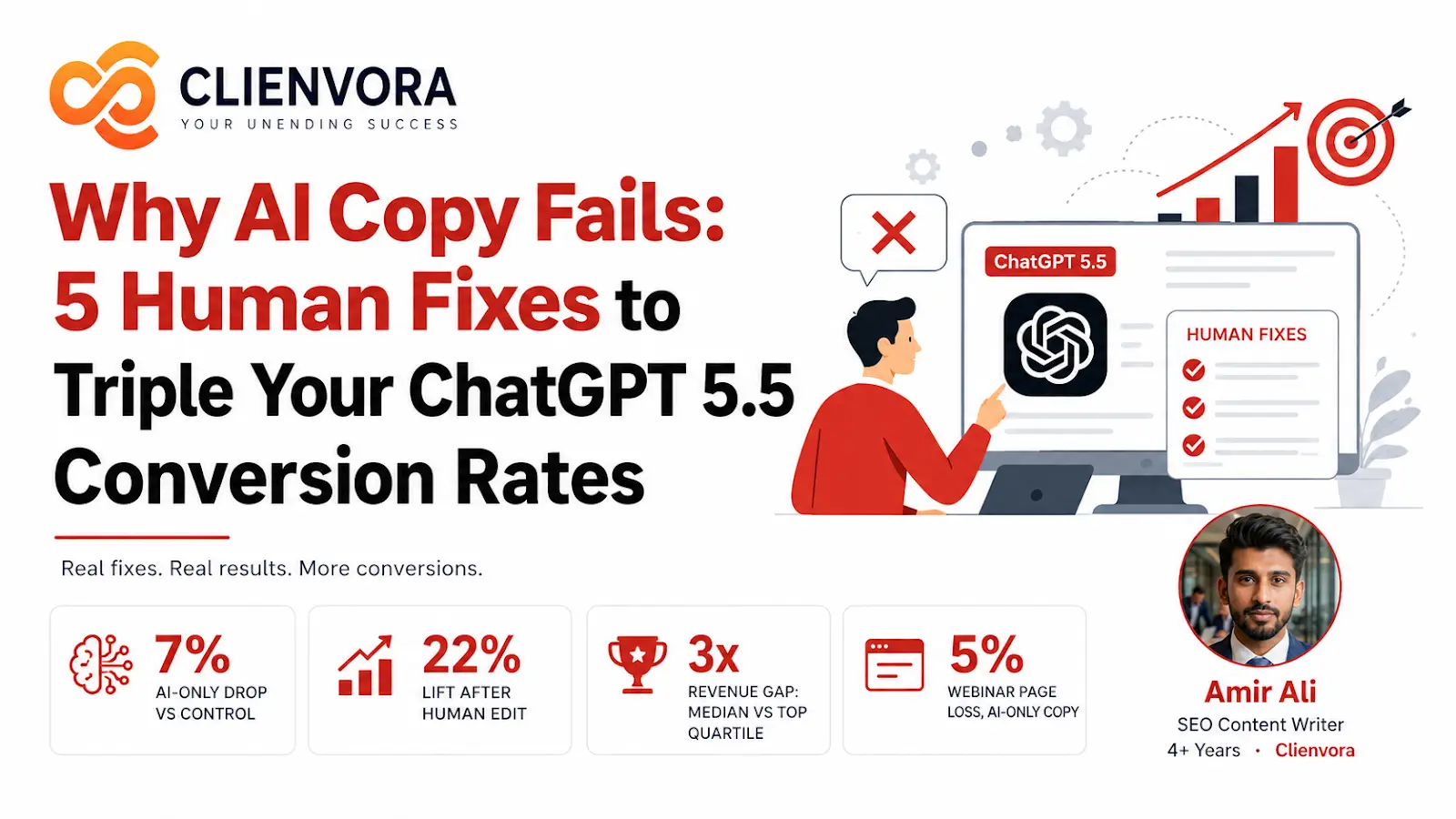
AI drafts structurally sound descriptions at scale, which helps with long catalogs. It does not do the voice-of-customer extraction, objection mapping, and risk analysis that produce conversion lift. Use AI for the first draft of a template, then have a human calibrate the headline, proof placement, and objection blocks. See why AI copy fails for the fix list.
Key Takeaways
Fix the words on your highest-traffic product page first, then measure conversion against the 1.4 percent median for 30 days before judging.
- Mine reviews before writing. Customers already gave you the headline and the objections
- Benchmark honestly. Judge against the 1.4 percent median and 2.7 percent top quintile, not against your last campaign
- Place proof beside the buy button. Five reviews lift purchase likelihood 270 percent (Spiegel)
- Budget with published rates. $80 to $219 per 250-word page, $65 to $75 per hour (Editors' Freelance Association)
- Rewrite in priority order. Take the top 20 traffic pages first, test them, then decide on the rest
Start with one page. Mine, rewrite, test.
Vocabulary will not save a flat page. Architecture and proof will.
For the pages that feed the store, see sales copy that turns warm traffic into buyers.
Get a free product page copy audit from Clienvora. We analyze your highest-traffic page and return a prioritized rewrite plan. See our copywriting services for the full offer, pair the copy with ecommerce SEO services for the traffic side, and read landing page copy that converts for the pages feeding the store.