Professional SEO services average $2,917 per month across 439 surveyed providers. First results typically arrive in three to six months. This guide defines the six disciplines SEO covers, what each costs in 2026, and how to evaluate a provider before you hire.
What Are Professional SEO Services?
Professional SEO services are paid, ongoing work that makes a business visible in Google and AI answers. The market was worth $83.98 billion in 2026.
Professional describes how the work is run, not a certificate. The work is diagnostic first, measured against business outcomes, and maintained month after month.
Four provider types sell this work. An agency fields a team across disciplines. A freelancer covers one or two.
A consultant sets strategy and advises your team. An in-house specialist owns it full time. The right fit depends on how much of the six disciplines you need at once.
- Diagnostics before deliverables. A crawl, a baseline, and a measurement plan come before any content calendar.
- Access you control. Your Google Search Console and analytics accounts stay in your name from day one.
- Intent, not volume. Keywords are chosen for what the searcher is about to do, not for raw search counts.
- Revenue as the scoreboard. Success is tracked in qualified leads and sales, not impressions alone.
The global SEO services market was valued at $74.90 billion in 2025 and is projected to reach $83.98 billion in 2026, then $148.86 billion by 2031 at a 12.12 percent compound annual growth rate. North America holds the largest share today, and Asia Pacific is the fastest growing region (Mordor Intelligence, SEO Market, 2026). Demand keeps rising. Scope still varies by provider.
What Professional SEO Services Actually Include
SEO is not one service. It is a category covering six disciplines, each with its own workflow, timeline, and measurement standard.
Budget services claim all six on paper but skip the diagnostic phase that decides which ones your site needs first. A site with hundreds of indexation errors gets little from a link campaign until the errors are fixed. Foundations come first.
Technical SEO
Technical SEO fixes the infrastructure search engines use to find and understand your site. If Google cannot crawl your pages, nothing else you do moves the needle.
- Site crawlability and indexation fixes
- Core Web Vitals optimization (LCP, INP, CLS)
- Schema markup for rich results
- Canonical tag management for duplicate content
- XML sitemap creation and submission
- Mobile first indexing compliance
When you need it. Traffic is flat, pages are not getting indexed, or the site loads slowly.
Google's published Core Web Vitals thresholds are LCP of 2.5 seconds or less, INP of 200 milliseconds or less, and CLS of 0.1 or less. If you are unsure what an audit covers, what to expect from a technical SEO audit before you pay for one breaks down every deliverable.
On Page SEO
On page SEO optimizes the content and HTML on each page so search engines understand what you are trying to rank for.
- Title tag and meta description optimization
- H1, H2, H3 heading structure improvements
- Keyword placement and search intent alignment
- Image alt text optimization
- Internal linking strategy
- Content rewriting for featured snippet targets
When you need it. You have content but it is not ranking. Titles are weak and pages lack structure.
For the specific factors that move rankings, what on-page SEO factors matter most in 2026 covers the five fixes with the highest impact.
Content SEO
Content SEO produces the compounding returns. A well structured article targeting the right query keeps sending traffic long after publication.
- Keyword research and search intent mapping
- Topic cluster architecture (pillar pages plus cluster content)
- Content gap analysis against competitors
- E-E-A-T optimization (author credentials, experience signals)
- AI Overview ready formatting for citations
When you need it. You are building a new site, entering new keyword categories, or your existing content is thin.
The keywords you choose matter as much as the writing. Buyer intent keywords: rank for buyers, not browsers explains how to spot queries that convert instead of browse.
Off Page SEO and Link Building
Off page SEO builds authority through signals that originate outside your website. Backlinks remain one of Google's strongest ranking signals.
- White hat link acquisition through outreach and digital PR
- Guest posting on authoritative sites
- Competitor backlink analysis and replication
- Brand mention monitoring and unlinked mention conversion
When you need it. Content is strong and technically sound but stuck below page one. You need third party authority signals.
Local SEO
Local SEO helps your business appear in local search results and Google Maps. If you serve customers in a specific area, this is your highest priority.
- Google Business Profile optimization
- NAP consistency across all directories
- Local citation building
- Review management strategy
- Location based keyword targeting
When you need it. You run a physical business or serve clients in a specific city or region.
AI Search Optimization (AEO and GEO)
This is the newest discipline and it is standard work in 2026. AI Overviews now appear on 48 percent of search result pages, up from 34.5 percent five months earlier (Ahrefs, March 2026), and 94 percent of B2B buyers use AI tools during purchase research (6sense 2025 Buyer Experience Report and Forrester Buyers' Journey Survey, 2025). Your content has to be structured for citation, not just ranking.
- Direct answer formatting (answer first, details second)
- Entity optimization for Google's Knowledge Graph
- Structured data and schema for AI consumption
- llms.txt deployment for LLM discovery
- Citation rate tracking across AI platforms
When you need it. Every engagement in 2026 should include it.
Seer Interactive measured a 35 percent click through lift for pages cited in AI Overviews, from 1.3 percent to 2.4 percent (Seer Interactive, 2026). For the full architecture, the 2026 guide to AIO and GEO: how to optimize for AI agents and LLM search walks through it step by step.
How Google's E-E-A-T Framework Affects SEO in 2026
E-E-A-T stands for Experience, Expertise, Authoritativeness, and Trustworthiness. It comes from Google's Quality Rater Guidelines. The first "E" rewards content that shows first hand, lived experience with the topic.
Practically, author bios with verifiable credentials matter. Case studies and personal examples carry more weight than generic explanations. Sites with clear About pages, real contact information, and named authors outperform anonymous sites.
Businesses should also consider how AI models discover content. LLMs.txt explained covers whether your site needs an llms.txt file.
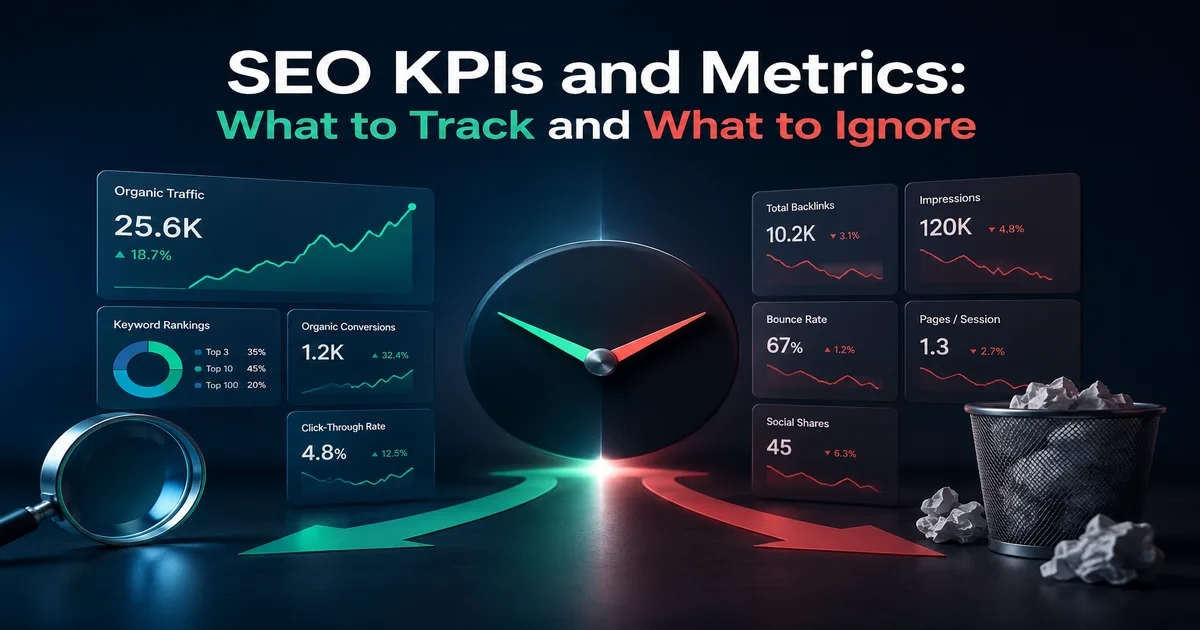
Monthly reports arrive full of green arrows and percentage increases, and those numbers are not always measuring revenue-generating traffic. Impressions can grow while clicks stay flat if you are accumulating rankings for zero-intent informational queries. A real deliverable is a ranking on a keyword with commercial or transactional intent that sends people to a page built to convert.
How SEO Turns Into Business Results
SEO produces outcomes through four channels: rankings that compound, intent-matched clicks, citations inside AI answers, and brand trust. Each channel behaves differently.
Rankings That Compound
A page that reaches the top keeps sending traffic without a media budget behind it. That is the structural difference between SEO and paid advertising. Most pages never rank, which is why the sequence of the work matters so much.
- Across 1 million plus new pages, only 1.74 percent reached the top ten within a year (Ahrefs, May 2025)
- 96.55 percent of the pages studied get zero Google traffic at all (Ahrefs search traffic study)
- Of pages that do reach the top ten, 40.82 percent got there within one month, so winners can win fast
- 72.9 percent of top ten pages are over three years old. Age helps, but age alone proves nothing
High-Intent Clicks
Organic search drives roughly 53 percent of trackable website traffic across channels (BrightEdge), and the top organic result earns about 27.6 percent of clicks (Backlinko). The clicks that matter most arrive with purchase intent attached.
- Buyer stage queries send people to pages built to convert, not just to inform
- Core Web Vitals pass rates shape engagement on landing pages
- Intent alignment beats raw traffic volume every time
A page targeting a commercial query will out-earn an informational page with ten times the traffic. If you have SEO traffic but no sales, the usual cause is intent mismatch, not weak copy. Check the query before you touch the page.
Citations Inside AI Answers
AI Overviews now appear on 48 percent of search result pages (Ahrefs, March 2026). Getting cited inside them is a second, separate placement opportunity above the classic blue links.
- Pages cited in AI Overviews earn a 35 percent higher click through rate on average (Seer Interactive, 2026)
- Informational queries trigger AI Overviews 36 percent of the time, versus 8 percent for commercial and 5 percent for transactional (Seer, 2026)
- 94 percent of B2B buyers use AI tools during purchase research (6sense and Forrester, 2025)
When someone asks ChatGPT which tool fits their team, the brand it references is usually the one already cited by search. Clear headings, FAQ sections, and structured data give AI systems something to retrieve.
Brand Trust
Consistent visibility across search results and AI answers builds recognition before a buyer ever clicks. Backlinks from industry publications reinforce that signal.
Each appearance strengthens the others. A buyer who has seen your name in Google, in an AI answer, and in a trade publication arrives warmer than one who has not. Paid advertising cannot replicate that accumulation.
SEO drives results through four channels: compoundable rankings, high intent clicks, AI answer citations, and brand authority. Most agencies only report traffic. The work gets judged by which channel moves revenue for your business stage.
How Much Professional SEO Services Cost in 2026
SEO pricing depends on provider type, scope, and market. Ahrefs polled 439 providers and found an average retainer of $2,917 per month.
You will see ranges from $200 to $20,000 per month, and the range is useless without context. Here is what the survey data actually says.
Working on a shoestring instead? How to do SEO for free in 2026: rank without backlinks or budget covers the tactics that cost nothing but take time.
Monthly Retainer Tiers
| Tier | Monthly Range | What You Get | Best For |
|---|---|---|---|
| Local Entry | $500 to $1,500 | GBP optimization, local citations, basic reporting | Single location businesses |
| Small Business | $1,000 to $2,500 | Keyword strategy, on page work, content, basic links | National small businesses |
| Growth | $2,500 to $5,000 | Full content program, link building, technical SEO, AI search | Mid market, growing businesses |
| Competitive | $5,000 to $10,000 | Dedicated team, 8 to 12 content pieces, advanced links, GEO | Competitive verticals, ecommerce |
| Enterprise | $10,000 to $50,000+ | Embedded team, multi site, international, custom reporting | Large organizations, Fortune 1000 |
Tiers are planning ranges, not quotes. The distribution below shows where real budgets land.
Where Real Monthly Budgets Land
The headline numbers. The average retainer across all business sizes is $2,917 per month. Agencies average $3,209, consultants $3,250, and freelancers $1,349.
That means agencies charge about 138 percent more than freelancers for the same category of work. About 63 percent of businesses spend between $500 and $5,000 per month.
Where the bulk sits. The most common retainer bracket is $501 to $1,000 per month at 20.4 percent of providers, and 68.8 percent charge $2,000 or less. Clutch puts the average engagement at $3,199 per month, Backlinko's SMB figure is $497 per month, and a SE Ranking plus Duda survey of 260 agencies found roughly 64 percent charge under $1,000 (Ahrefs SEO Pricing, Clutch, SE Ranking).
Local versus national. Local SEO engagements average $1,557 per month, with agencies at $1,819 and freelancers at $1,150. Providers who serve clients worldwide average $3,474, which is 123 percent above the local-only figure.
Scope drives the gap.
Hourly and project work. The average hourly rate is $111, and 90 percent of providers charge $150 per hour or less. On project engagements, the most common bracket is $2,501 to $5,000 at 21.2 percent of providers.
Experience premium. Providers with under two years of experience average $1,541 per month. Two years or more averages $2,023, a 33 percent jump.
Five to ten years of experience averages $3,648. Ask who exactly works on the account, because senior time is what the premium pays for.
Other Pricing Models
- Hourly consulting. Average $111 per hour across the Ahrefs survey. Best for audits, strategy sessions, or one defined problem.
- Project based. $2,501 to $5,000 is the most common bracket. Fits one time needs like a migration or a full audit.
- Retainer. 78.2 percent of providers offer one. The right model when the work is ongoing across several disciplines.
Full service SEO for under $400 per month is either automated content and mass link schemes, or the work is not happening. A single quality backlink outreach email takes a skilled person 20 to 40 minutes to do properly. If the price sounds too good to be true, it is.
Estimate whether your monthly SEO investment is delivering positive ROI based on traffic growth and conversion metrics.
How Long Professional SEO Takes
Most providers report first results in three to six months. Google advises waiting a few weeks to assess each change, and new sites take longer.
Google does not promise a timeline. Its own guidance describes how long changes take to show up in results.
"Some changes might take effect in a few hours, others could take several months. In general, you likely want to wait a few weeks to assess whether your work had beneficial effects in Google Search results."
Source: Google SEO Starter Guide
Provider experience points the same direction. In an Ahrefs poll of 3,680 respondents, the typical answer for first meaningful results was three to six months. John Mueller has said new sites can take up to a year.
Patience is required, but so is a schedule.
What Happens Month by Month
| Period | Work in Progress | What You Can Observe |
|---|---|---|
| Month 1 | Technical audit, baseline tracking, keyword map | Nothing visible yet. Fixes are landing. |
| Months 2 to 3 | Indexation fixes, first content cluster live | Cleaner coverage reports, early impressions |
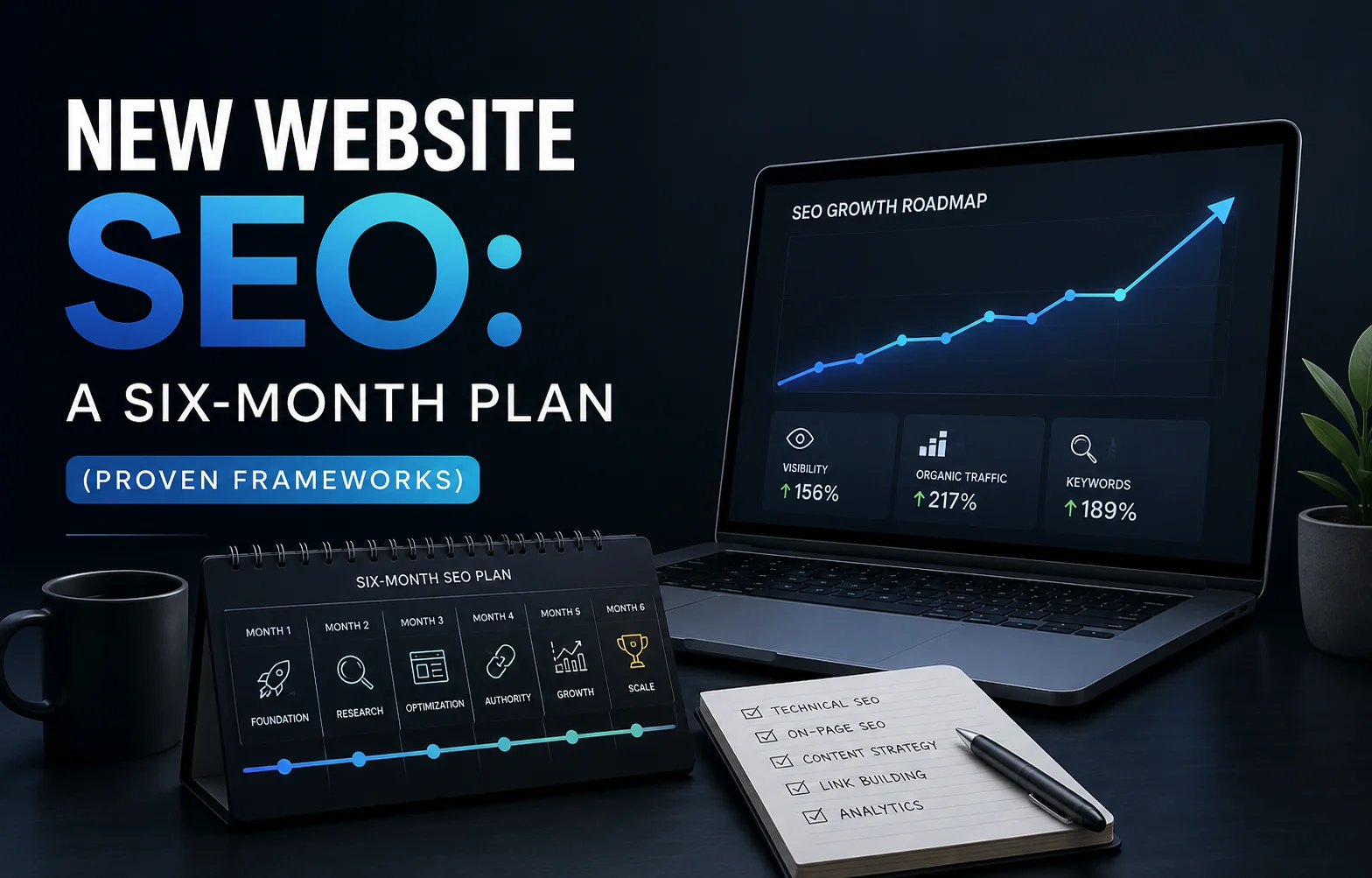
| Months 4 to 6 | Publishing cadence, internal links, first outreach | Movement on low difficulty terms |
| Months 7 to 12 | Authority building, cluster expansion, refreshes | Commercial terms start to climb |
The reason new sites need runway is structural. Only 1.74 percent of new pages reach the top ten within a year, and 72.9 percent of current top ten pages are more than three years old. Competitors' age is not a signal you can buy your way past.
For a full month-by-month breakdown, what to expect from an SEO agency in the first 6 months details the evidence you should see each month, and new website SEO: a six-month plan covers the sequencing from zero.
The most common failure is not a bad provider, it is an impossible timeline. Budget for six months of runway before judging commercial results, and require evidence at each checkpoint instead of waiting for a single verdict. New sites take longer than existing sites. Foundations come first.
Matching the Service to Your Business Stage
Your site's stage, not its budget, determines which service matters first. Match the work to where the business is, then set spend.
If you are deciding between an agency and a consultant, SEO agency vs SEO consultant: real costs, pros, cons and 12-point audit breaks down the actual cost differences and when each makes sense.
New Site with Zero Traffic
Start with a technical audit and keyword research. Fix crawl issues first. Then build one content cluster around low difficulty keywords.
- Budget range: $1,000 to $3,000 per month
- Expected timeline: 4 to 6 months before meaningful traffic
- Red flag to avoid: Agencies promising page one results in 30 days
Existing Site with Traffic Plateau
Run a technical audit to find hidden blockers. Then refresh existing content that is ranking positions 5 to 20.
These are your fastest wins. Fix blockers first.
- Budget range: $1,500 to $4,000 per month
- Expected timeline: 6 to 10 weeks for first ranking movements
- Red flag to avoid: Agencies that recommend new content before fixing existing pages
Existing Site with Good Content but Poor Rankings
You likely need link building and technical fixes. Strong content cannot rank if Google cannot find it or if competitors have stronger authority signals.
- Budget range: $2,000 to $5,000 per month
- Expected timeline: 3 to 6 months to see authority improvements
- Red flag to avoid: Agencies selling bulk cheap links from link farms
Local Business
Google Business Profile optimization is your number one priority. Local citations, review management, and location based content come next. Start narrow.
- Budget range: $500 to $2,000 per month
- Expected timeline: 60 to 90 days for local pack improvements
- Red flag to avoid: Agencies that skip GBP setup and jump straight to content
Scaling Startup (Post PMF)
You need the full sequence: technical SEO as foundation, content clusters for topical authority, link building for competitive keywords, and AI search optimization for the 94 percent of B2B buyers using AI tools.
- Budget range: $5,000 to $10,000 per month
- Expected timeline: 6 to 12 months to build a self sustaining growth engine
- Red flag to avoid: Agencies that cannot show you results from companies at your stage
Duplicate this matrix into your Notion workspace. Fill one row for each business you are evaluating. The service type column maps directly to the six disciplines above.
How SEO Work Differs by Business Model
The same checklist performs differently across SaaS, ecommerce, and local businesses. Each model has its own keyword layers and conversion path.
For SaaS Companies
You need to rank for three keyword layers simultaneously: problem aware queries like "why is my churn rate high", solution aware queries like "best customer retention software", and product aware queries like alternatives to a named competitor. Most SaaS sites skip the problem aware layer and lose the top of the funnel.
The organic channel compounds well for SaaS because that first layer is where buyers form opinions. Competitors rarely invest there because the queries do not look like buyers on paper.
What to prioritize. Technical SEO first, then content clusters covering all three layers. AI search optimization matters more here than in most categories, since 94 percent of B2B buyers research with AI tools.
If organic growth has stalled, why SaaS companies struggle with organic growth and how SaaS SEO fixes it covers the structural problems holding most SaaS sites back.
For Ecommerce
The most common ecommerce mistake is treating individual product pages as the only ranking target. Product pages win transactional queries, but buyers research before they buy. That research happens earlier in the journey than most stores plan for.
Category and collection pages are the most underused asset on most ecommerce sites. One well built category page can rank for dozens of commercial queries at once and route buyers into product pages. Layers matter.
What to prioritize. Fix technical issues first, including faceted navigation duplicates, canonical misconfigurations, and missing product schema.
Then build out category page content. Product pages come third.
For Local Service Businesses
If you run a law firm, dental practice, or plumbing company, local SEO is the highest ROI channel. Google Business Profile optimization alone can drive more leads than the rest of the website.
What to prioritize. Claim and optimize your Google Business Profile. Keep your name, address, and phone number consistent across every directory.
Build citations and manage reviews actively. Research comes early.
For businesses combining SEO with conversion focused copy, an AI powered conversion copywriting guide shows how the two disciplines work together.
Six Mistakes That Waste an SEO Budget
Most wasted SEO budgets come from six repeatable errors. Fixing them costs nothing beyond attention and a willingness to sequence the work.
You found a keyword with 2,000 monthly searches. If the results page is full of product pages and you publish a blog post, you will not rank. Check what format is winning before you write anything. Check intent first.
Ahrefs studied 14 billion pages and found 96.55 percent get zero Google traffic. Short posts that say what everyone else says give search engines no reason to list them. Depth, original data, and first hand experience are what separate the pages that get found. Depth beats volume.
Google advises waiting a few weeks to assess any change, and only 1.74 percent of new pages reach the top ten within a year. Month one is research and technical fixes. Month three is publishing. Month six is when movement shows.
Great content on a site with crawl errors, slow pages, and broken internal links will not rank. Businesses like to spend their budget on visible output, but indexation has to come first. Fix the base first.
Publishing 30 posts with no links to main service pages means authority never flows to revenue pages. Every piece of content should link to at least one other relevant page on your site.
A new site chasing difficulty scores in the 70s will waste months. Start under 30 and build up. Low difficulty keywords first, competitive ones later.
Months 1 to 3 are foundations: audit, tracking, first content. Months 4 to 6 bring movement on easier terms. Months 7 to 12 compound, which is when commercial terms start to climb. Providers reporting first results in three to six months are describing the median, not a guarantee.
A B2B services company signed a $6,000 per month agency retainer with a well known mid-market agency. The agency delivered monthly reports showing consistent traffic growth, keyword ranking improvements, and technical health gains. By month 12, organic traffic had grown 40 percent from baseline.
Pipeline from organic sources: zero. The agency had targeted high volume informational keywords that drove sessions but attracted readers outside the company's ICP. The content was well written, technically optimized, and entirely misaligned with buyer intent.
The total spend including the setup fee was $74,000. The total pipeline generated was zero opportunities. The corrected approach: restructure the content library around buyer-stage keywords, implement pipeline attribution in the CRM, and measure success by SQLs influenced, not sessions generated.
The client rebuilt the program with an intent based content strategy and saw their first organic-sourced SQL within 60 days of the restructuring.
How to Evaluate an SEO Provider
Provider claims are easy to make and hard to verify. Five red flags and a short question list separate real work from theater.
For a detailed look at what happens after you hire, what to expect from an SEO agency in the first 6 months covers the realistic timeline and deliverables at each stage. Ask direct questions early.
Red Flag 1: Guaranteed Rankings
No ethical provider guarantees specific rankings. Anyone promising page one by a date is either naive or planning tactics that will hurt the site later.
"While there's no guarantee that any particular site will be added to Google's index..."
Source: Google SEO Starter Guide
Red Flag 2: The Bait and Switch
The senior strategist who pitches may not be the person writing your content. Ask explicitly: "Who will work on my account in month three? Can I meet them before I sign?"
If they hesitate, walk away.
Red Flag 3: Vanity Metrics Only
If the reporting only covers impressions, page views, and social shares, it is measuring activity, not results. Look for tracking that covers qualified leads, pipeline influence, and closed revenue. Data access matters.
Red Flag 4: No AI Search Strategy
AI Overviews appear on 48 percent of result pages, and 94 percent of B2B buyers use AI tools in research. A provider who cannot explain how they optimize for citations is working with an incomplete playbook.
Red Flag 5: Contracts Longer Than 6 Months
A lock in contract with no exit clause signals that the provider expects underperformance. Standard terms are 30 to 60 day cancellation after an initial 3 to 6 month commitment.
Questions to Ask Before You Hire
- Who will write our content day to day? What is their experience in our industry?
- Can you show me content you produced that influenced pipeline or closed revenue?
- How do you optimize for AI search engines like ChatGPT and Perplexity?
- What does success look like at 90 days? How will we measure it?
- Can we start with a paid pilot before committing to a retainer?
- Will I own my data, analytics accounts, and content at the end of our engagement?
What Toolstack to Look For
A professional SEO operation in 2026 runs on a core toolstack of around 6 to 8 platforms. Here are the essentials and what they cost at their lowest paid tiers.
The three paid subscriptions run about $320 per month at their lowest tiers, before anyone's time. An agency quoting $500 per month for full service SEO is either on free tools only, skipping the platforms that take skill to run, or not doing the work. Prices change, so verify current pricing before budgeting.
Frequently Asked Questions
How long does SEO take to show results?
Most providers report first meaningful results in three to six months. Google advises waiting a few weeks before assessing any change, and John Mueller has said new sites can take up to a year. Existing sites with some authority often move faster on low difficulty terms.
How much do professional SEO services cost?
Ahrefs surveyed 439 providers and found an average retainer of $2,917 per month. Agencies average $3,209 and freelancers $1,349. About 63 percent of businesses spend between $500 and $5,000 per month, local SEO engagements average $1,557, and hourly work averages $111.
What is included in professional SEO services?
Six disciplines: technical SEO, on page optimization, content, link building, local SEO, and AI search optimization. Each covers a different workflow. Which ones you need depends on your site's stage, so a diagnostic should come before any deliverable calendar gets signed.
What is the difference between technical SEO and on page SEO?
Technical SEO fixes the infrastructure search engines use to crawl and index your site: speed, crawlability, schema, and mobile behavior. On page SEO optimizes the content and HTML of individual pages. Technical work comes first because on page improvements underperform on a broken base.
Should I hire an SEO agency or do it in house?
In house work fits when you can hire a full time specialist and give them six to twelve months. An agency fits when you need breadth across several disciplines right now. Many mid stage companies split the two: strategy in house, execution outside.
Can SEO work for a brand new website?
Yes, with a longer runway. Across more than a million new pages, only 1.74 percent reached the top ten within a year. Plan for six to twelve months of technical setup, keyword research, and cluster building before commercial terms start to move.
How do I know if my SEO provider is doing real work?
Ask for live access to Google Search Console, your analytics, and rank tracking from day one. Request backlink source URLs and check them yourself. Providers who resist sharing raw data are measuring their activity, not your results. If Search Console itself is acting up, why Google Search Console could not fetch my sitemap covers the common fixes.
Do I need AI search optimization in 2026?
Yes, as a standard part of the work. AI Overviews now appear on 48 percent of search result pages, and pages that get cited earn a 35 percent higher click through rate. 94 percent of B2B buyers use AI tools during purchase research.
Run these prompts sequentially in Claude or ChatGPT to build a customized SEO service selection strategy for your business.
"I run a [business type] website with [monthly traffic] visitors. My domain is [age] years old. I have [number] pages indexed. My main competitors are [names]. Based on this information, list the three most likely reasons my site is not ranking for [target keywords]. For each reason, specify whether it is a technical, content, or authority problem."
"Based on the diagnosis above and the six SEO service types (technical audit, on-page SEO, content SEO, link building, local SEO, managed full-service), recommend the single most effective service type for my current stage. Explain why the other five are lower priority right now. Include a projected timeline and estimated monthly investment range for the recommended service."
"Create a 10 question evaluation scorecard I can use to interview SEO agencies or specialists. Each question should target one of the six service types. Include what a strong answer sounds like and what a red flag sounds like. Format as a table with columns: Question, What to Listen For, Red Flag, and Weight (1 to 5)."
"Based on the recommended service type and my current situation, produce a week by week 90 day action plan. Include specific deliverables, expected milestone dates, and what success looks like at day 30, day 60, and day 90. Format as a table with Week, Action Item, Deliverable, and Success Metric columns."
Key Takeaways and Next Steps
Sequence matters more than spend. Technical foundations, then intent-matched content, then authority, with measurement running the whole time. Start where your site is today.
There is no best SEO service. There is only the right service for your site's current stage. Technical SEO before content. Content before links. Low difficulty keywords before competitive ones. The order of operations determines the outcome more than the budget does.
Start with a technical SEO audit. Use Google Search Console to check for crawl errors and coverage issues before investing in new content or links. Fix those first.
Spend week one on keyword research. Identify 5 low difficulty commercial keywords (difficulty under 25, 200 to 800 monthly searches) and build your first content cluster around those.
Ask every candidate for a list of their last 5 clients (with permission), their toolstack, and raw Search Console data from a campaign they have run. If they cannot or will not provide these, move on.
Browse the professional SEO services offered at Clienvora, or get in touch directly to discuss your site's specific needs before any commitment.
What Works in 2026
Search now has two surfaces: classic blue links and AI generated answers. Pages written as extractable answers, with clear structure, named entities, and cited statistics, appear on both. Measure pipeline, not vanity.
AI Overviews reached 48 percent of result pages by March 2026, up from 34.5 percent in December 2025, and informational queries trigger them most often at 36 percent. Google rewards first hand experience and discourages scaled low value text, so evidence heavy pages are the safer bet. Then scale what works.
Answer-island content. Every H2 section opens with a 40 to 60 word direct answer that can appear in Google's AI Overviews or Featured Snippets.
Entity optimization. Pages that explicitly connect to high authority entities (named tools, research institutions, named case studies) rank better.
Programmatic SEO for scalable verticals. SaaS tools and large ecommerce sites using structured data to generate thousands of location or feature specific landing pages.
AI Overviews optimization. Clear, structured, cited information is more likely to be sourced when Google assembles an AI answer.
Statistics with sources. Pages that cite named studies are easier for AI engines to quote than pages full of adjectives.
GSC Keyword Research Export Script (Copy-Paste)
This script exports your Google Search Console query data to identify keyword opportunities. Use it to validate your agency's keyword recommendations or build your own initial target list. Requires Python 3.
About the Author's Work
Review the client portfolio and delivery process before reaching out so you can evaluate the work before evaluating the person. About Clienvora.
(Disclosure: author's own service)