Google Business Profile optimization, local keyword targeting, citation building, and review management, plus the new AI visibility layer that decides who gets the call.
Local SEO makes your business the most trusted choice in Google Maps, local packs, and AI answers for nearby customers. This guide covers GBP optimization, local keyword architecture, citation building, review generation, and hyperlocal content strategy for small businesses in 2026.
What Local SEO Means for Small Businesses in 2026
The fastest way to understand local SEO is to see it next to the version most business owners still picture. Traditional SEO chases global keywords, long form articles, and backlinks from anywhere. Local SEO in 2026 is narrower and more commercial: it answers one question for a nearby, ready to buy customer. The table below shows the shift in plain terms.
| Dimension | Traditional SEO | Local SEO in 2026 |
|---|---|---|
| Primary goal | Rank for broad, often national keywords | Appear when a nearby customer searches with intent to act |
| Core unit | The individual webpage | The business entity across Google, site, and citations |
| Top signals | Backlinks and content depth | Google Business Profile, reviews, NAP, and local content |
| Typical content | Long guides and pillar posts | Hyperlocal guides, service pages, and FAQs |
| Success metric | Rankings and session traffic | Calls, direction requests, and booked jobs |
The verdict from the table is simple. Local SEO is not a smaller version of normal SEO. It is a different game with different scoreboards, and the businesses that treat it as its own discipline pull ahead of bigger competitors with bigger websites.
Local SEO for Small Business: What Actually Moves the Needle in 2026
If you only have an hour a week, spend it on the few signals that carry real weight. The 2026 Whitespark survey puts Google Business Profile signals at roughly 32 percent of local pack ranking weight, the single largest controllable factor.
- Accurate, active Google Business Profile. The foundation that feeds Maps, packs, and AI answers.
- Steady review velocity. Fresh reviews signal trust and freshness to both humans and algorithms.
- NAP consistency. Your name, address, and phone must match across every citation and directory.
- Location pages that answer real questions. Pages for each service area that address what customers actually search for.
Bloated blog output and random backlinks move the needle far less. Get those four right and everything else is incremental.
In 2026 Google does not rank your page, it ranks your business as one entity, so every surface must tell the same local story or the signal leaks away.
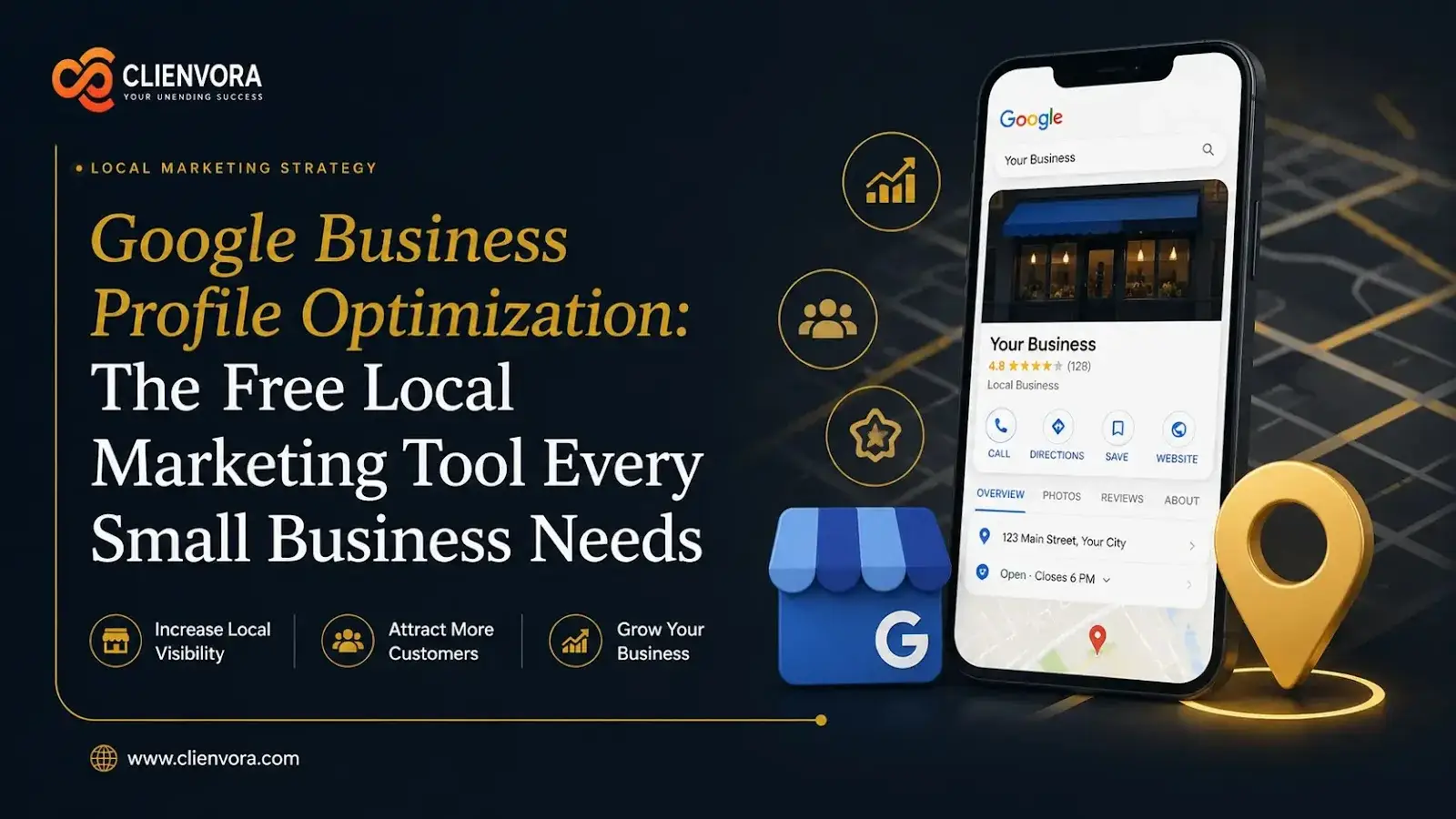
That doctrine explains the rest of this guide. Each step makes one business look like one consistent, trusted, local entity to both humans and AI. Start with the foundation that feeds Maps, packs, and answers at the same time: your Google Business Profile.Read here to learn how to optimize Google Business Profile
Why Local SEO Is Important for Small Business in 2026
Before the how to, it is worth being clear about the why. Why local SEO is important for small business comes down to one reality: your next customer is already searching on their phone with intent to act, and the businesses that show up in the local pack and the map win the call. The same pattern holds for professional practices. A law firm SEO agency or a real estate SEO agency competes for the same map real estate, just with higher ticket values on the other side of the form.
Three forces make this more true in 2026 than ever:
- The local pack dominates. It pushes organic links below the fold for high intent queries.
- "Near me" and "open now" searches keep climbing. People expect instant, location aware answers.
- AI Overviews pull local results into a generated summary. A well structured profile and site can earn a mention even when the user never clicks a traditional link.
Key Benefits of Local SEO for Small Businesses
The upside is concrete, not theoretical. Here are the benefits of local SEO for small businesses that make it the highest leverage marketing channel for most owners.
- More qualified traffic. Local searchers are further down the funnel. Someone querying "emergency plumber in Austin" is ready to pay, not browse.
- Higher conversion rates. Local intent converts far better than broad search because the need is immediate and the distance is short.
- Better ROI than broad SEO. You compete in a smaller geographic pool against fewer, weaker rivals instead of the entire national web.
- Credibility via reviews. A strong profile with fresh reviews signals trust before a word is spoken on the phone.
- Resilience against AI only answers. Owning both your Google Business Profile and your site signals means the AI has to cite you, not just a competitor, when it generates a local summary.
Why 2026 Changed the Local Game
Local search in 2026 is not the local search of 2023. Two forces arrived at once and rewired how nearby customers discover businesses, so the playbook that worked two years ago no longer produces the same results.
When an AI Overview appears, the top organic result loses about 58 percent of its click through rate, and 83 percent of those searches end with no click to any website (Ahrefs and Pew Research, 2025 to 2026).
The danger is not that local SEO stopped working. The danger is that visibility now splits across two fronts: the classic map pack that drives calls, and the AI answer that decides whether you are even mentioned. The comparison below shows how a small business should think about each front.
| Feature | Local Pack (Maps) | AI Overview |
|---|---|---|
| What shows | Three business cards with ratings and buttons | A generated summary pulled from several sources |
| Source of truth | Your Google Business Profile | Your site, reviews, and forums with structured facts |
| Customer action | Tap to call, get directions, book | Reads answer, often no click at all |
| Best for | High intent, ready to buy now | Research, comparisons, and discovery |
| Optimization lever | Profile, reviews, and proximity | Clear, cited, structured local content |
The takeaway is that you need both. A strong profile wins the click when intent is high, and clear structured content earns the mention when the AI answers first. With that framing, the first concrete step is the one asset you fully control and that feeds both fronts.
Step 1: Optimize Your Google Business Profile Like a Local Homepage
Your Google Business Profile is often the first thing a customer sees, and for many small businesses it performs the job of a local homepage. Claim it, verify it, and fill every field with accurate information before anything else.
Use your real business name
Do not add keywords to your name. Google penalizes name stuffing, and the wrong primary category choice is the single most damaging negative ranking factor experts name (Whitespark 2026, score 176).
Choose a precise primary category plus related categories
Pick the most specific match, then add secondary categories. Businesses using four or more secondary categories average the best map rankings in published studies.
Add exact address or a clear service area
Set a stable service area for businesses that visit customers, and keep the map marker correct.
Add a stable phone number and working website link
Use one phone number everywhere. Add a booking or appointment link where relevant, because active booking links lift conversion actions by about 21 percent (New Media 2026).
Set correct hours and keep them updated
Manage holiday hours. Accurate holiday hours cut customer drop off by about 11 percent during peak season (New Media 2026).
Once the fields are filled, the description and media do the persuasive work. Compare the weak and strong versions side by side.
| Element | Weak approach | Strong approach |
|---|---|---|
| Description | We provide professional services and focus on customer satisfaction. | We help small businesses across the United States build local SEO systems so they show up in near me searches, Google Maps, and AI answers when customers are ready to call and book. |
| Photos | Stock images uploaded once | Real geo tagged photos of shop, team, and finished work, added weekly |
| Posts | None for 30 plus days | Tips, offers, and Q and A posted at least twice a month |
| Attributes | Left at default | Family owned, wheelchair accessible, women led, digital payments set where true |
A complete and optimized profile drives about 7x more clicks than an incomplete one, a verified profile is roughly 80 percent more likely to appear in search, and correct categories add about 17 percent local visibility (Google, DirectoryOne, and New Media 2026).
The numbers above are not opinions. They are measured lifts from 2026 benchmark studies, and they show why profile completeness is the cheapest win available. The next step builds on that foundation by telling Google exactly which searches you deserve.
Also Read: Local SEO Content Strategy for Small Businesses: How to Get More Local Clients from Google
Step 2: Build Your Local Keyword and Topical Map
Local keyword research in 2026 now reaches beyond a simple service plus city formula into a three layer map that matches how people actually speak. Keywords answer what you do for whom, and the research has changed because voice and mobile search shifted how queries are phrased.
| Layer | What it captures | Example |
|---|---|---|
| Core | Service plus city or primary area | local SEO agency in Chicago, dentist in Austin |
| Hyperlocal | Neighborhoods, landmarks, and districts | salon near Wicker Park Chicago, accountant near Capitol Hill Seattle |
| Question and pain | Voice and mobile style queries | how much does a plumber cost in Dallas, best emergency plumber open now |
Each layer feeds a different surface. Core terms go on service pages and your profile. Hyperlocal terms go on neighborhood pages. Question terms become FAQ and blog content that AI engines cite. Map one main keyword and two to four close variants to each page, and avoid cramming ten city terms into one page because clarity beats stuffing.
Build a small set of focused pages: a main service page, one page per major area, and FAQ or blog posts for the question layer. Link blog posts to location pages and location pages back to the main service page so search engines and users always know which page matches which query.
With keywords mapped, the business needs consistent proof of where it operates. That proof lives outside your website in the citation and link layer.
Step 3: Fix NAP Citations and Local Link Signals
Name, address, and phone must be identical across your site, profile, social pages, delivery apps, and directories, because mismatched data reads as risk and lowers trust. Citations tell Google where you are and that other trusted sources agree on your business details.
| Platform tier | Examples | Why it matters |
|---|---|---|
| Core | Google Business Profile, Yelp, Apple Maps, Bing Places | These feed Maps and packs directly |
| Industry | Sector specific directories and marketplaces | Relevant citations beat random global listings |
| Community | Chambers of commerce, local blogs, event pages | Source of the strongest local links |
One wrong digit, an old street suffix, or a switched phone format across citations can dilute your prominence signal for months. Search your business name and correct every mismatch on major directories and social pages first.
NA inconsistency is a top negative local ranking factorFor local links, quality beats quantity. Reach out to chambers, neighborhood blogs, and partner businesses with a clear mutual benefit: invite a local blogger to review your shop, offer a joint guide with a partner, or ask event organizers to list you as a sponsor with a link.
Citations build the trust foundation, but the loudest trust signal in 2026 is the one customers write themselves. Reviews deserve their own step.
Step 4: Turn Reviews Into a Ranking and Conversion Engine
Reviews work on two axes at once. They lift local pack rankings through review signals that carry about 16 percent to 20 percent of local pack weight, and they shape the decision of the person comparing you to a competitor. The 2026 data shows both axes getting stronger.
Businesses with active review growth earn about 21 percent more local search appearances than profiles with static reviews, and a 4.0 star rating is the floor Google treats as credible while 4.5 plus is what many consumers now require (New Media and BrightLocal 2026).
Recency and response speed now beat raw volume. A business with a steady stream of two to four new reviews per month and replies to every review looks more alive than one sitting on a hundred old reviews. The table shows the right and wrong ways to run the system.
| Practice | Helps rankings and trust | Hurts both |
|---|---|---|
| Volume | Ask after every successful job or visit | Buy fake reviews or run burst campaigns |
| Recency | Steady 2 to 4 new reviews per month | No new reviews for many months |
| Response | Reply to all reviews within 24 hours by name | Ignore negative reviews or argue publicly |
| Reuse | Quote real reviews on service pages and posts | Leave good feedback buried and unused |
Reviews are the proof layer. The next layer is the content you publish, because AI engines only cite businesses that explain their local expertise in clear, structured language.
Step 5: Create Hyperlocal Content That AI Wants to Cite
Old style city plus service pages stuffed with repeated text no longer rank or get cited. Google and AI systems want content that feels real and local, so turn each location page into a short guide with neighborhood names, common questions, process steps, and local testimonials.
| Content type | Why AI and users pick it | Example format |
|---|---|---|
| Service pages | Clear local intent and benefit led copy | Local SEO services in Chicago with outcomes |
| Best of and comparison | Easy for engines to extract and compare | Top five family dentists in Austin with criteria |
| FAQ and process | Answers short direct questions fast | How to rank in Google Maps in 2026, step by step |
| Pricing and guides | Matches commercial investigation queries | What a plumber costs in Dallas, with ranges |
EEAT is the frame for all of it. Show experience with real case studies, expertise with plain language, authority with local roles and mentions, and trust with reviews and clear policies. The expandable section below covers the part most small businesses skip: aligning content with how answer engines pull it.
How to structure content so AI engines cite it
Write answers in clear 40 to 60 word blocks that directly answer the query, then support them with tables, steps, and real examples. Mirror the exact question in an H2 or H3, add FAQ schema, and cite credible local data where you can.
AI engines favor fresh, structured, and verifiable content, so refresh location guides at least every quarter and keep names, areas, and facts consistent with your profile and citations.
Content earns the citation. The technical layer makes sure engines can read it, which is the step many owners never reach.
Also Read: Website Copywriting for Small Businesses: Pages That Convert (2026 Guide)
Step 6: Technical and On Site Essentials
Most local searches happen on a phone, so speed and clarity are ranking and conversion factors, not polish. A slow or confusing site sends the customer to a competitor even when you rank.
| Area | What to implement | Business effect |
|---|---|---|
| Mobile speed | Fast hosting, compressed images, simple menus | Keeps phone searchers from leaving |
| Click to call | Tap to call buttons on key pages | Turns a search into a direct call |
| Local schema | LocalBusiness, FAQ, and review markup | Supports rich results and AI summaries |
| Site architecture | One service page plus area pages, cross linked | Removes internal competition between pages |
Schema is the quiet winner here. LocalBusiness schema feeds your basic info to engines, FAQ schema helps your answers appear in People Also Ask and AI summaries, and review schema surfaces your ratings. Add schema only to real questions with concise answers, and never spam dozens of weak entries.
With content and technical basics in place, the final management step is to measure the right things and run the work on a timeline.
Step 7: Track, Report, and Run Your 90 Day Plan
Ranks alone do not prove success. Track the actions that turn searches into business: calls from your site and profile, direction requests, bookings tied to local pages, and growth in review count and rating. Below is the original Clienvora Local Visibility Model, a planning frame we use to show small businesses where their signal leaks.
The Clienvora Local Visibility Model scores a business from 0 to 100 across five controllable surfaces: Profile, Proof, Presence, Pages, and Performance. Each surface is weighted by its share of local pack weight. A business scoring below 60 on any single surface leaks rankings to competitors even when the other four are strong, because Google reads the weakest surface as a trust gap.
Calculate Your Local Visibility Score
Rate your business from 1 (not started) to 5 (excellent) on each surface of the Clienvora Local Visibility Model. We score you out of 100 and show the one surface holding you back. Built for small businesses in the United States.
To make the model practical, the table below is an original effort versus impact matrix built from the 2026 benchmark lifts cited earlier. It tells you which moves to do first.
| Tactic | Effort | Impact | Why |
|---|---|---|---|
| Claim and complete GBP | Low | High | Up to 7x more clicks and 80 percent more likely to appear |
| Fix NAP citations | Low | High | Removes the most common trust gap across the web |
| Ask for reviews weekly | Low | High | Active growth adds about 21 percent more appearances |
| Respond to reviews | Low | Medium | 65 percent of consumers prefer responsive businesses |
| Publish GBP posts | Low | Medium | About 13 percent more branded engagement at 2x monthly |
| Add location pages | Medium | High | Captures hyperlocal and question layer searches |
| Local schema markup | Medium | Medium | Feeds rich results and AI answer extraction |
| Local link building | High | Medium | Strong but slow, best after the basics are live |
The matrix and the model both point to the same sequence. Do the low effort, high impact moves first, then build outward. The 90 day plan below applies that order.
| Phase | Weeks | Focus | Expected signal |
|---|---|---|---|
| Foundation | 1 to 4 | Optimize GBP, fix NAP, clean citations | Appear in more map and local pack results |
| Content and proof | 5 to 8 | Build service pages, add FAQs, ask for reviews | More calls, direction requests, and new reviews |
| Authority | 9 to 12 | Local links, refine schema, tune internal links | More stable rankings and AI mentions |
Run the plan, measure the actions not just ranks, and adjust offers and calls to action once visibility stabilizes. The last management question is knowing which mistakes to avoid and when to bring in help.
Mistakes to Avoid and When to Hire Help
A small set of repeated mistakes quietly cancels out even a strong 90 day plan. The failure boxes below cover the most common and most damaging ones in 2026.
Treating your Google Business Profile as done after setup lets impressions decline within 30 plus days. Post, add photos, and update hours on a schedule.
No updates in 30 plus days risks impression declineBuying reviews or running sudden burst campaigns triggers filters and damages trust. A steady, honest ask after each job is safer and more effective long term.
Review velocity beats volume spikesPublishing generic AI text with no human local detail misses nuance and can read as low quality. Use AI for drafts, then add real examples, photos, and facts.
Human edit required for local nuanceYou can handle most basics yourself if you have time: keep the profile updated, request reviews, and publish simple local content. For deeper keyword mapping, technical fixes, structured data, and link strategy, it makes sense to bring in a partner.
Make sure you choose a team that explains clearly, shares useful data, understands AI search, and has real small business experience. Our local SEO services cover everything from GBP optimization to citation building and review management. Before making any choice, read this guide Is a Content Writing Agency Worth It for Small Businesses? to make the right decision.
Local SEO Services for Small Business: What to Expect (and What to Avoid)
If you decide the work is better handled by a partner, it helps to know what good looks like. Local SEO services for small business vary widely in quality, so the section below sets out the typical deliverables, realistic pricing, and the red flags that signal a provider you should walk away from.
| Deliverable | What a solid provider includes |
|---|---|
| Profile and citations | Google Business Profile setup or overhaul, NAP cleanup, and core directory submissions (Yelp, Apple Maps, Bing Places) |
| Content and pages | Location and service pages, FAQ content, and GBP posts written for both humans and AI extraction |
| Reviews and reputation | Review generation workflows, response templates, and sentiment tracking |
| Technical and reporting | Local schema, speed checks, and a monthly report tied to calls, direction requests, and rankings |
At Clienvora we structure local SEO as a monthly system rather than a one off project: a foundation sprint in month one, content and proof building in months two and three, then ongoing authority work. That matches the 90 day plan earlier in this guide.
Watch for red flags such as guarantees of "number one rankings," long lock in contracts with no reporting, fake review generation, or agencies that never ask about your actual service area. A good partner asks more about your business than about your budget.
Average Cost of Local SEO for Small Business in 2026
One of the most common questions owners ask is about price. The average cost of local seo for small business work depends on competition, the number of locations, and scope, but realistic 2026 ranges look like this.
- Basic local SEO: roughly $300 to $800 per month for a single location with profile, citations, and light content
- Growth packages: about $1,000 to $2,500 per month for multi surface content, active review management, and link building
- One time audits or GBP overhauls: around $750 to $3,000 plus, depending on how damaged the starting profile is
US markets and competitive niches such as legal, dental, and home services tend toward the higher end, while a single rural location with low competition can often win on the basic tier. Treat cost as an investment against the value of a steady stream of inbound local calls, not as a flat expense.
Frequently Asked Questions
The fastest win is to fully optimize your Google Business Profile and fix your basic NAP details everywhere online. When your profile is complete with the right category, clear description, real photos, and updated hours you can start showing up in more map and local pack results without spending on ads. Then search your business name and correct wrong address or phone details on major directories and social pages.
Yes it matters more because AI and ads still draw their data from strong local signals. AI answer boxes need reliable sources and validated businesses to highlight. Even if fewer people click traditional links they still tap call buttons, read star ratings, and look at photos. A weak profile and local content will get you skipped when AI summaries show options side by side.
Most small businesses start seeing early movement within four to eight weeks after fixing Google Business Profile data, cleaning NAP, and collecting new reviews. Stronger results often show between three and six months once content, links, and reviews grow together. Time to results depends on how competitive your area is and how messy your starting point is.
Treat Google Maps and your website as parts of one system, but if you must choose a starting point in 2026 begin with Google Maps and your Google Business Profile because that is where most local searches and calls now start. Once your profile is healthy, strengthen your website with clear service pages, location pages, and simple FAQs to convert clicks into leads.
Yes, small businesses can still rank locally with organic signals by relying on quality rather than tricks. Clean data, strong reviews, helpful hyperlocal content, and a well structured Google Business Profile can get you into local packs and AI summaries without paid ads. Paid ads often sit on top of organic results, so a mix can be powerful, but many local businesses grow by owning the organic and map layer first.
For pure local visibility, reviews usually matter more than most backlinks. Reviews directly affect how trusted you look in maps and local packs and they strongly shape user choice. Backlinks still help, especially local links from real organizations, and they signal authority. The best system treats reviews as the core trust engine and local links as supporting strength.
You do not need two separate strategies, but you must design mobile first because most local searches happen on phones. Speed, click to call buttons, simple layouts, and easy maps matter more than complex desktop only designs. Your core strategy is the same, show up, build trust, answer questions, but you test the experience on a small screen.
Use AI tools for ideas and drafting, but always add human editing, local detail, and real examples. Let AI help you find question ideas, outline pages, and suggest keywords, then fill the content with genuine stories, photos, and facts from your business. Avoid publishing raw AI text with no review because that content often feels generic and may miss local nuance.
If you serve several distinct areas it is smart to build a small set of location pages even without walk in branches. Each page can focus on one city or cluster of neighborhoods and explain how you serve clients there. Use local place names, common issues, and a clear service area map so engines connect you to an area.
For a service page it is best to focus on one primary local keyword with two to four close variations. Trying to cram ten or twenty different city plus service terms into one page weakens clarity. Create more focused pages or sections where each has one clear main topic and location.
This usually means your listing is visible but not convincing. Common issues include weak photos, few reviews, unclear category choice, or no strong call to action. Fix your description, add real images, update hours, and ask for more reviews. You can also test offers such as free consultation or same day service to give people a reason to call now.
FAQ schema is not mandatory but it can help your answers appear in People Also Ask boxes and AI summaries more often. Add clear question and answer pairs with schema so search engines find them faster. Only add FAQ schema to real questions with concise answers, and avoid spamming dozens of weak questions.
Local SEO in 2026 is not one trick or one keyword. It is a simple system: accurate data, strong trust signals, and helpful local content, repeated until both humans and AI choose your business.