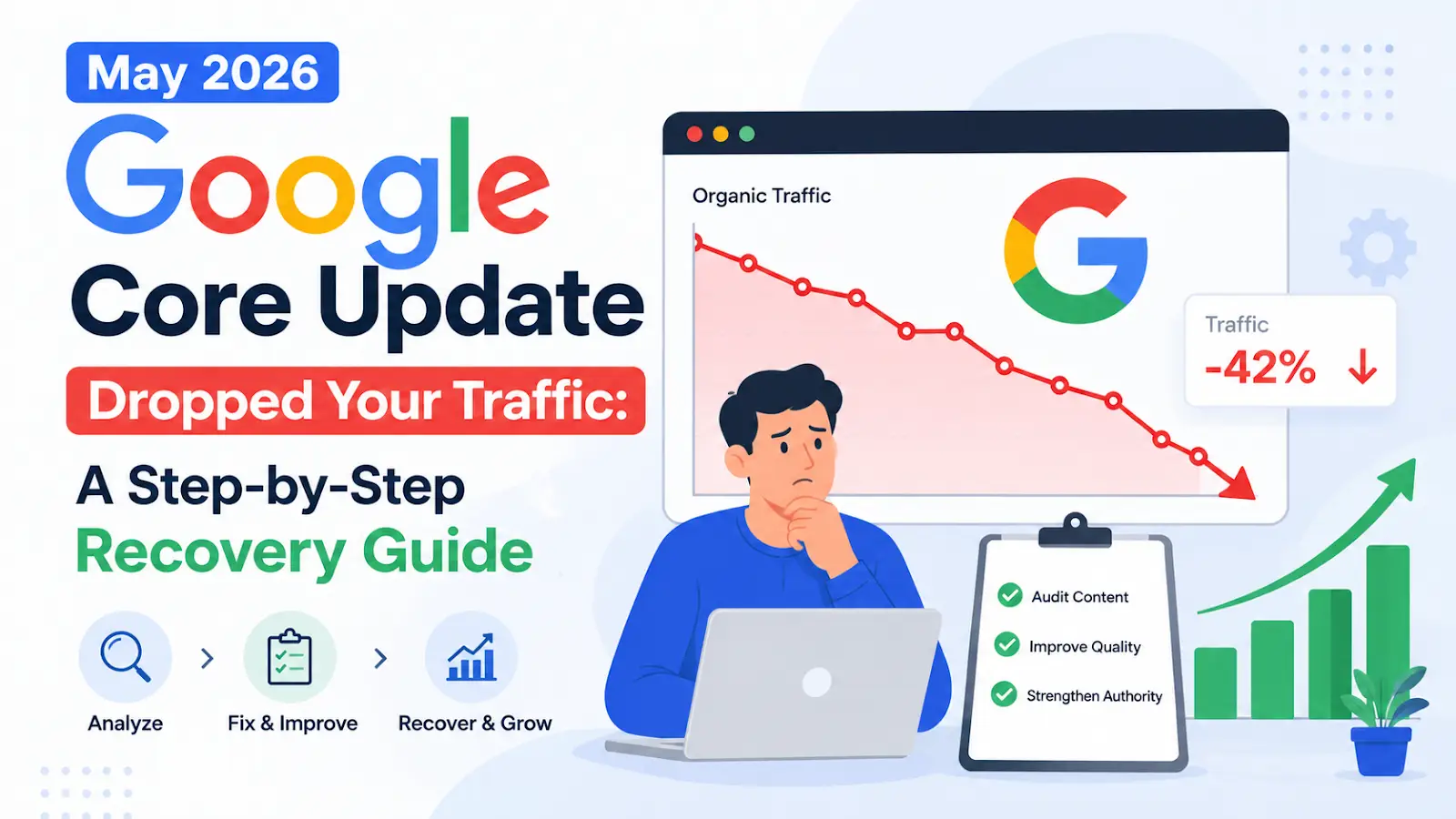
Google has begun rolling out the August 2026 spam update. This is a global rollout that applies to all languages and is expected to take a few days to complete. The update is recorded as an incident impacting ranking on the Google Search Status Dashboard starting August 18, 2026. If your website ranking dropped after August 18, this update is the most likely cause. Spam policy enforcement updates target scaled content abuse, site reputation abuse, and AI manipulation tactics.
This guide explains what the update is about, which spam policies matter most, how to diagnose ranking shifts, and a step-by-step recovery and prevention plan. You will get a clear checklist to audit your site, fix risky content, and protect your rankings from future spam updates.
If your site was also affected by the May 2026 Core Update, you may be dealing with both spam policy violations and core quality issues at the same time. The May 2026 Core Update recovery guide covers the E-E-A-T and content quality side of recovery, while this guide focuses on spam-specific fixes. Address both in sequence for the best results.
Quick Facts: August 2026 Spam Update at a Glance
| Parameter | Detail |
| Type | Spam policy enforcement update (not a core update) |
| Rollout began | August 18, 2026, 9:27 a.m. PDT |
| Release note posted | 9:28 a.m. PDT on the Search Status Dashboard |
| Expected duration | A few days |
| Scope | Global, all languages |
| New policies | None. Enforces existing spam policies. |
| Search Console notification | No. Algorithmic only. No manual action notification. |
| Disavow links helpful? | No. Content-focused spam updates require on-page fixes. |
| Reconsideration request? | No. Algorithmic demotions do not appear in Manual Actions report. |
What the August 2026 Spam Update Is
The August 2026 spam update is a spam policy enforcement update. It is not a new core update. Google has not announced any new spam policy types with this rollout. The existing spam policies remain the rules to check.
Rollout Timing and Scope
- The rollout began at 9:27 a.m. Pacific time on August 18, 2026.
- The release note was posted at 9:28 a.m. PDT on the Search Status Dashboard.
- The update applies globally and to all languages.
- Google says it may take a few days to complete.
Policy Continuity in 2026
Google has not changed its spam policies page since December. This means the same rules from prior updates still apply. The August 2026 spam update is the third spam update of the year after the March and June 2026 spam updates.
In May 2026, Google clarified that its spam policies also cover attempts to manipulate generative AI responses in Search. This includes AI Overviews and AI Mode. Google has not said if the August 2026 update specifically targets that behavior. The update enforces existing spam policies across the board.
2026 Spam Update Trilogy: How August Compares to March and June
The August 2026 spam update is the third enforcement action this year. Google enforced the same spam policies in March and June. The May 2026 policy extension to AI Overviews and AI Mode makes the June and August updates structurally different from all prior spam updates.
| Update | Date | Duration | Focus |
| March 2026 Spam | Mar 19 | ~30 minutes | Scaled content, site reputation abuse |
| June 2026 Spam | Jun 24 | ~2 days 1 hour | Same policies + AI Overviews/AI Mode manipulation |
| August 2026 Spam | Aug 18 | A few days | Aggressive enforcement of all existing policies |
The key context: in May 2026, Google formally extended its spam policies to cover attempts to manipulate generative AI responses in Search. This includes AI Overviews and AI Mode. The June and August updates enforce that extension. Sites using tactics to influence AI-generated answers now face the same penalty exposure as paid link schemes.
Pre-Announcement Volatility: 6 Spikes in 47 Days
Before Google officially announced the August update, the SERPs showed significant unconfirmed volatility from August 1 through August 13. Industry trackers recorded 6 distinct volatility spikes across 47 days starting from late June. This pre-announcement turbulence is consistent with SpamBrain recalibration running in the background before a formal rollout begins.
If your rankings shifted before August 18, the cause may be unconfirmed algorithm adjustments rather than this specific spam update. Check your analytics timestamps carefully against the August 18 official start date.
Which Google Spam Policies Are Most Relevant in 2026
Use this section as your policy checklist. Audit your site against each policy to see where you might be at risk.
Scaled Content Abuse
Scaled content abuse means publishing many pages primarily to manipulate search rankings rather than help users. This applies regardless of how the content is created.
What Counts as Scaled Content Abuse
- AI generated pages created at scale with little human oversight.
- Human written pages that are thin, templated, or duplicated across many URLs.
- Scraped or translated content with minimal transformation or added value.
- Hybrid content that mixes AI and human input but still exists mainly to chase rankings.
Common Patterns That Trigger Scaled Content Abuse
- Templated location or service pages with only city names changed.
- Thin category or tag pages that add no real value beyond a list of links.
- Mass produced programmatic pages with minor variable changes.
- Bulk guest posts with little original insight or expertise.
- Many near duplicate pages targeting slight keyword variations.
The data is clear on what happens at scale. Sites with 50-100 AI articles and real human editing see 30-80% traffic gains. Sites with 500+ unedited AI pages lose 60-80% of traffic. Sites with 1,000+ mass-generated pages face 40-90% drops, with some experiencing full deindexing.
Site Reputation Abuse (Parasite SEO)
Site reputation abuse is often called parasite SEO. It means publishing third party pages on a trusted domain to exploit the host site ranking signals.
Typical Examples of Site Reputation Abuse
- White label sections that exist mainly to borrow domain authority.
- Off topic sponsored content with weak editorial oversight.
- Low quality guest sections that are not aligned with the host site topic.
- Third party content that would not rank on its own without the host domain.
How Site Reputation Abuse Differs From Scaled Content Abuse
- Scaled content abuse focuses on mass volume and thin value.
- Site reputation abuse focuses on low value third party content riding a trusted host.
- A site can be hit for one policy, the other, or both at the same time.
Real-world casualties include Forbes Advisor (lost approximately 90% visibility in 8 weeks), CNN Underscored, and WSJ Buy Side.
Important: as of mid-2026, enforcement of site reputation abuse remains manual-only. Google has not shipped an algorithmic version of this policy. The "starkly different content" algorithm runs continuously but is separate from the manual actions.
Other Spam Behaviors That Still Trigger Enforcement
Google enforces many spam policies beyond scaled content and site reputation abuse. These behaviors can also cause ranking drops during spam updates.
- Thin or auto generated content with little or no added value.
- Doorway style pages and doorway networks designed to funnel users.
- Hidden text or links, cloaking, and sneaky redirects.
- Scraped or copied content without transformation or added value.
- Manipulative link schemes, including bulk guest posting and link networks designed mainly to pass PageRank.
AI Content and the 2026 Spam Policies
A common myth is that Google penalizes AI content by default. This is not true. Google penalizes low value mass produced pages and manipulative intent, regardless of how the content is created. The May 2026 policy extension to AI Overviews and AI Mode makes the distinction between safe and banned AI tactics more important than ever.
Key Principles for AI Content in 2026
- Google does not penalize AI content by default.
- Google penalizes mass produced low value pages and manipulative intent.
- Spam policies also apply to attempts to manipulate generative AI responses in Search, including AI Overviews and AI Mode.
- AI is fine when it helps users and is overseen by humans with real expertise.
- AI becomes risky when used to scale thin pages just to chase rankings.
Safe Ways to Use AI in Your Content Workflow
- Use AI for research, outlines, and first drafts, then add real expertise and original data.
- Require human review and editing on every published page.
- Avoid publishing large volumes of AI content without meaningful human oversight.
- Focus on topics where you have first hand experience or unique insights.
AI Spam Tactics Risk Table
| Tactic | Status | Why |
| AI for research, outlines, first drafts | Safe | Human oversight and editing present |
| AI first drafts + human expertise | Safe | Adds original data, experience, insight |
| Mass-produced AI pages | Banned | Scaled content abuse policy |
| AI citation manipulation | Banned | Since May 15, 2026 policy extension |
| Recommendation poisoning | Banned | Tricking AI into citing your brand |
| Biased listicles for AI Overviews | Banned | Engineered to appear in AI answers |
| Buying or exchanging AI citations | Banned | Equivalent to paid links in traditional SEO |
| Back-button hijacking | Banned | Separate enforcement, June 15, 2026 |
An Ahrefs study of 331,000 pages found that only 5.3% of top-ranking pages are 100% AI-generated. Pages with under 50% AI content account for 82.2% of top-3 rankings. The data confirms that AI as an assistant with human expertise works. AI as a content factory does not.
How the August 2026 Spam Update Affects Rankings and Traffic
This update is recorded as an incident impacting ranking on the Search Status Dashboard. Volatility is expected during the rollout. Some sites will see ranking shifts and traffic changes over the next few days and weeks.
Expected Effects on Rankings
- Some pages will drop in rankings while others may rise.
- Volatility is normal during the rollout and may continue for a short time after.
- A single day of data may not show the full picture.
- Ranking signals can settle over the following weeks.
Recovery Expectations
- Drops tied to spam policies can take months to recover.
- Automated systems need time to see sustained compliance.
- Some sections flagged under site reputation abuse may have limited recovery paths through editorial tweaks alone.
- This is especially true if the section exists mainly to exploit domain authority.
Recovery Timeline Expectations
| Recovery Phase | Timeline | What to Expect |
| Small improvements | 1-4 weeks | Initial ranking stabilisation on fixed pages |
| Medium recovery | 1-3 months | Sustained compliance visible in automated systems |
| Full recovery | 3-6+ months | Domain-level quality reassessment complete |
| Site reputation abuse | Limited | Removal or noindex is often the only safe path |
How to Diagnose If Your Site Was Affected
Use this section to confirm whether your site was impacted by the August 2026 spam update. Follow each step to build a clear picture of what is happening.
Step 1: Confirm Timing Against the Rollout
Start by confirming the timing of your traffic and ranking drops.
- Use the Google Search Status Dashboard to confirm the August 18 start date.
- Watch for completion updates on the Dashboard.
- Compare your traffic and ranking data from August 18 onward to prior weeks.
- Check if your drops align with the rollout window.
Step 2: Diagnostic Table: Spam Update vs Core Update vs Manual Action
Misdiagnosing the cause wastes weeks of effort on the wrong fixes. Use this table to determine which type of hit you experienced.
| Signal | Spam Update | Core Update | Manual Action |
| Search Console notification | No | No | Yes |
| Fix path | Content and technical fixes | Content quality improvements | Specific violation remediation |
| Recovery time | Months | Weeks to months | After reconsideration request |
| Disavow links helpful? | No | No | Sometimes |
| Reconsideration request | Rejected | Rejected | Required |
Step 3: Analyze Search Console and Analytics Data
Google Search Console and your analytics platform are your best friends here.
In Google Search Console
- Review Performance by page and query.
- Identify which URLs and topics lost impressions and clicks.
- Check Indexing and Page Experience reports for any spikes in errors or removals.
- Look for sudden drops in average position for key queries.
In Your Analytics Platform
- Segment organic traffic by landing page.
- Segment by device and country to see if the decline is isolated or site wide.
- Compare the last 28 days to the prior 28 days to spot sharp changes.
- Flag pages with the steepest drops in sessions and conversions.
Step 4: Identify Patterns in Losing Pages
Once you have a list of losing pages, look for common traits.
Common Traits Among Dropping Pages
- Templated structure with minor variable changes.
- Thin word count and shallow coverage of the topic.
- Heavy AI feel with little original insight or expertise.
- Duplicate or near duplicate content across many URLs.
- Off topic third party sections or white label content.
Compare to Pages That Now Rank
- Search for the same queries that dropped.
- Study the pages that now rank in the top positions.
- Note differences in depth, originality, and user value.
- Ask what those pages offer that your pages do not.
Step 5: Check for Manual Actions and Security Issues
Rule out manual penalties and security problems before you assume this is purely algorithmic.
- Review the Manual Actions report in Search Console.
- Check the Security and Manual Actions section for any hacked content or spam injections.
- If you see a manual action, follow the guidance in Search Console to fix and request review.
Step-by-Step Recovery Plan After a Spam Update Hit
This is your core recovery checklist. Work through each step in order. Do not skip steps. Document your changes so you can measure impact over time.
Step 1: Wait for the Rollout to Finish Before Making Broad Changes
- Avoid panic edits in the middle of the rollout.
- Document your baseline rankings, traffic, and key pages.
- Avoid broad site wide changes until the rollout is complete.
- Plan to reassess once the dust settles and the Dashboard shows the rollout is complete.
- Use this time to prepare your audit and recovery plan.
Step 2: Audit Your Content Inventory
You need a full list of indexed pages to work from.
- Export a list of all indexed pages using a crawl tool or the Search Console index coverage report.
- Include key metrics such as impressions, clicks, average position, and organic sessions.
- Flag pages that are templated, thin, duplicated, or created mainly to chase keywords.
- Group pages by topic, intent, and performance tier.
Step 3: Triage Each Thin or Risky Page
Go through your flagged pages one by one.
For Each Candidate Page, Ask
- Can this be meaningfully improved into genuine, expert content.
- Does this page serve real user intent or is it mainly for rankings.
- Would this page still make sense if search did not exist.
Decision Paths
- If yes, plan a rewrite with real expertise, original data, and clear user value.
- If no, remove it or noindex it and set up 301 redirects where appropriate.
- If unsure, test a strong rewrite on a small set of pages before scaling.
| Situation | Action | Priority |
| Thin templated pages | Delete + 301 redirect to best related page | High |
| Pages with some value | Consolidate into one comprehensive pillar page | High |
| Good content, weak E-E-A-T | Rewrite with author expertise, original data, experience | Medium |
| Third-party or white-label content | Noindex or remove entirely | High |
| Strong content, minor issues | Update and refresh with new data | Low |
Step 4: Consolidate Where Possible
Consolidation is often more powerful than rewriting many thin pages.
- Merge many thin city or service pages into one comprehensive regional or topic guide.
- Include local specific insights and real examples in consolidated pages.
- Use 301 redirects from removed thin pages to the consolidated page.
- Update internal links to point to the new consolidated pages.
Step 5: Strengthen Expertise Signals on Surviving Content
Your surviving pages need to look and feel like expert content.
Add Clear Author Attribution
- Show author name, bio, and credentials on each page.
- Link to author profile pages with more background and expertise.
- Use real photos and verifiable credentials where possible.
Add Original Data and Experience
- Include original data, case studies, or first hand experience specific to that topic.
- Add sections that could not have been generated by AI without direct human knowledge of the subject.
- Use screenshots, diagrams, or examples from your own work.
Improve E-E-A-T Signals
- Add clear about, contact, and editorial policy pages.
- Show real business information, addresses, and phone numbers where relevant.
- Highlight awards, certifications, and notable clients or partners.
Step 6: Fix Technical and On-Page Issues
Technical and on page issues can compound spam signals.
Tighten Titles, Intros, and Headings
- Make sure the query, the promise, and the visible proof match.
- Avoid clickbait titles that overpromise and underdeliver.
- Use clear, descriptive headings that reflect the content below.
Remove Spammy Elements
- Remove weak automation, stale claims, and outdated references.
- Fix any hidden text or links, cloaking, or sneaky redirects.
- Ensure Googlebot sees the same content as users.
Improve Page Experience
- Fix slow loading pages and heavy scripts.
- Improve mobile usability and Core Web Vitals where needed.
- Remove intrusive interstitials and annoying popups.
For a complete technical audit framework, follow this technical SEO optimization guide. For the specific on-page factors that still move rankings, see this on-page SEO factors guide.
Step 7: Review Third-Party and White-Label Sections
Third party and white label sections are high risk for site reputation abuse.
Audit Sponsored, Guest, and White-Label Content
- Check if these sections are genuinely useful and on topic.
- Ensure they are under close editorial oversight.
- Remove or noindex sections that exist mainly to borrow authority.
Strengthen Oversight on Surviving Sections
- Add clear editorial guidelines for third party content.
- Require real expertise and original insight in all guest or sponsored posts.
- Label sponsored content clearly and keep it aligned with your core topics.
Step 8: Submit Revised Pages for Crawling and Monitor
Once you have improved your pages, tell Google about them.
- Use the URL Inspection tool in Search Console to request indexing on your most important improved pages.
- Track rankings, impressions, and clicks over the next few months.
- Be ready to iterate based on what you see in the data.
- Document your changes so you can tie improvements to specific actions.
How to Prevent Future Spam Update Hits
Recovery is important. Prevention is better. Build systems that keep you safe from future spam updates.
Build a Strong Editorial Policy
Your editorial policy should prioritize user value over volume.
- Reject thin or templated pages that exist mainly for rankings.
- Require real expertise, original data, or first hand experience on every page.
- Set clear quality standards for length, depth, and originality.
- Train your team on Google spam policies and how to avoid risky patterns.
Use AI as an Assistant, Not a Content Factory
AI can help, but it should not run your content program.
- Use AI for research, outlines, and first drafts.
- Require human review and expertise on every published page.
- Avoid publishing large volumes of AI content without meaningful human oversight.
- Focus on topics where your team has real knowledge and experience.
For a deeper breakdown, see this guide on why AI copy fails and this AI copywriting guide for US businesses.
Limit Risky Link Building Tactics
Link schemes are still a major spam risk.
- Limit bulk guest posting and avoid link networks designed mainly to pass PageRank.
- Focus on earning links through original research, data, and useful content.
- Avoid buying links or participating in link exchanges at scale.
- Monitor your backlink profile and disavow clearly spammy links when needed.
Run Regular Content Audits
Do not wait for the next update to clean up your site.
- Run quarterly content audits to prune or improve aging or underperforming pages.
- Remove or consolidate thin, duplicated, or outdated content.
- Update high value pages with new data, examples, and insights.
- Track the impact of your audits over time.
Monitor the Search Status Dashboard and Industry News
Stay ahead of future updates by paying attention to official signals.
- Monitor the Google Search Status Dashboard for new updates and incidents.
- Follow trusted industry sources for analysis and real world examples.
- Adjust your strategy based on what you learn from each update.
- Keep your team informed and aligned on best practices.
Build Topical Authority the Right Way
Topical authority comes from comprehensive, expert coverage of a subject, not from publishing many thin pages about related keywords. Invest in deep pillar content with supporting cluster articles that add genuine value. Link them together with descriptive anchor text. This approach builds the entity-based content structure that both Google and AI search engines reward.
Special Considerations for Different Site Types
Different site types face different risks under the spam policies. Use this section to tailor your approach.
B2B and SaaS Sites
B2B and SaaS sites often have deep expertise but can still fall into spammy patterns.
Focus Areas for B2B and SaaS
- Focus on deep, original content such as case studies, product teardowns, and data driven guides.
- Avoid thin feature pages that exist mainly to rank for product keywords.
- Be cautious with white label or partner sections that could look like site reputation abuse.
- Use real customer stories, metrics, and outcomes to show expertise.
Common Pitfalls to Avoid
- Mass produced integration or comparison pages with little original insight.
- Thin template pages for every feature, use case, or industry.
- Over optimized copy that reads like it was written only for search.
Publishers and News Sites
Publishers and news sites often have large archives that can hide spammy patterns.
Focus Areas for Publishers
- Audit large archives for thin or auto generated pages and consolidate or remove them.
- Ensure sponsored or native content is clearly labeled, on topic, and under strong editorial oversight.
- Avoid churning out low value listicles or programmatic pages just to chase traffic.
- Invest in original reporting, data, and analysis that sets you apart.
Common Pitfalls to Avoid
- Thin category and tag pages with little beyond a list of links.
- Mass produced articles on trending topics with no real reporting or insight.
- Sponsored sections that look like they exist mainly to borrow authority.
Local and Multi-Location Businesses
Local and multi location businesses often struggle with location page spam.
Focus Areas for Local and Multi-Location Sites
- Replace many thin location pages with fewer, richer regional guides.
- Include real local insights, examples, and case studies in your regional content.
- Avoid doorway style pages that exist only to rank for city plus service keywords.
- Use local schema, reviews, and citations to strengthen local signals.
Common Pitfalls to Avoid
- Templated location pages with only city names changed.
- Thin service pages that repeat the same copy across many locations.
- Over optimized anchor text and internal links that look manipulative.
Tools and Resources to Support Your Audit and Recovery
You do not need every tool under the sun. You do need a core set that helps you audit, fix, and monitor your site.
Core Tools for Spam Update Recovery
- Google Search Status Dashboard for update timing and status.
- Google Search Console for performance, indexing, and manual actions data.
- Crawl tools such as Screaming Frog or Sitebulb to inventory pages and spot templated or thin content.
- Analytics platforms to segment organic traffic and identify landing page level drops.
- Rank tracking tools to monitor changes in positions and visibility over time.
Helpful Resources for Deeper Understanding
- Google spam policies documentation for official rules and examples.
- Industry guides on scaled content abuse and site reputation abuse.
- Case studies and postmortems from other sites that recovered from spam updates.
- Community discussions where SEOs share real world findings and tactics.
You can also run a free audit using our 15-point SEO content audit tool or grade your content quality with our GEO content grader.
Frequently Asked Questions
Is the August 2026 spam update a core update?
No. The August 2026 spam update is a spam policy enforcement update, not a core update. It enforces existing spam policies rather than changing the core ranking algorithm.
Does Google penalize AI content in 2026?
No. Google does not penalize AI content by default in 2026. Google penalizes low value mass produced pages and manipulative intent, regardless of how the content is created. AI content that helps users and is overseen by humans with real expertise can rank well.
How long does it take to recover from a spam update hit?
Recovery can take months. Drops tied to spam policies can take months to recover because automated systems need time to see sustained compliance. Small improvements may appear in 1-4 weeks, medium recovery takes 1-3 months, and full recovery can take 3-6+ months. Some sections flagged under site reputation abuse may have limited recovery paths through editorial tweaks alone.
What is the difference between scaled content abuse and site reputation abuse?
Scaled content abuse focuses on mass volume and thin value. It targets many pages created primarily to manipulate rankings rather than help users. Site reputation abuse focuses on low value third party content riding a trusted host. It targets third party pages published on a trusted domain to exploit the host site ranking signals. A site can be hit for one policy, the other, or both at the same time.
Can I recover if my site was hit for parasite SEO or white label sections?
Recovery is possible but can be limited. Some sections flagged under site reputation abuse may have limited recovery paths through editorial tweaks alone, especially if the section exists mainly to exploit domain authority. In many cases, removing or noindexing those sections and focusing on your own expert content is the safest path.
Does disavowing links help recover from a spam update?
No. Disavowing links will not help recovery from content-focused spam updates. The work belongs on-page and on content quality. Focus on removing thin content, strengthening E-E-A-T signals, and fixing technical issues.
Should I file a reconsideration request?
No. Algorithmic spam demotions do not appear in the Manual Actions report. Filing a reconsideration request for an algorithmic hit will be rejected. Only file a reconsideration request if you see an actual manual action in Search Console.
How is this different from the May 2026 AI Overviews policy change?
The May 2026 change formally extended spam policies to cover AI Overviews and AI Mode manipulation. The August update enforces those existing policies more aggressively across the board, including recommendation citation poisoning and biased listicles.
Conclusion
The August 2026 spam update enforces existing spam policies. The safest path is to focus on user value, expertise, and sustainable content practices. Sites that publish thin, templated, or manipulative content at scale are at highest risk. Sites that invest in real expertise, original data, and helpful content are best positioned to thrive.
Use the checklist in this guide to audit your site, fix risky content, and protect your rankings from future spam updates. Start with the diagnosis steps, then move through the recovery plan in order. Document your changes and measure impact over time.
If you want help, consider a structured SEO audit or a content quality review. Audit your sites using the steps above and share your findings in comments or on LinkedIn. The more we share, the better we all get at navigating these updates.
Related Resources
- On-Page SEO Checklist - Audit titles, meta tags, headings, and content structure after a spam hit.
- Technical SEO Checklist - Fix crawlability, indexation, and page experience issues.
- Schema Markup Checklist - Ensure your structured data is clean and compliant.
- Free SEO Content Audit Tool - Score your content quality and identify thin pages.
Not Sure If Your Site Was Hit?
Get a free content quality audit from Clienvora. We will identify which pages are at risk, what to fix first, and how to protect your rankings going forward.
About the Author's Work
Review the client portfolio and delivery process before reaching out. Every engagement starts with a content and SEO audit, not a pitch.
Copywriting Services | SEO Services | Client Portfolio | Free Content Grader | Start a Conversation
(Disclosure: author's own service)