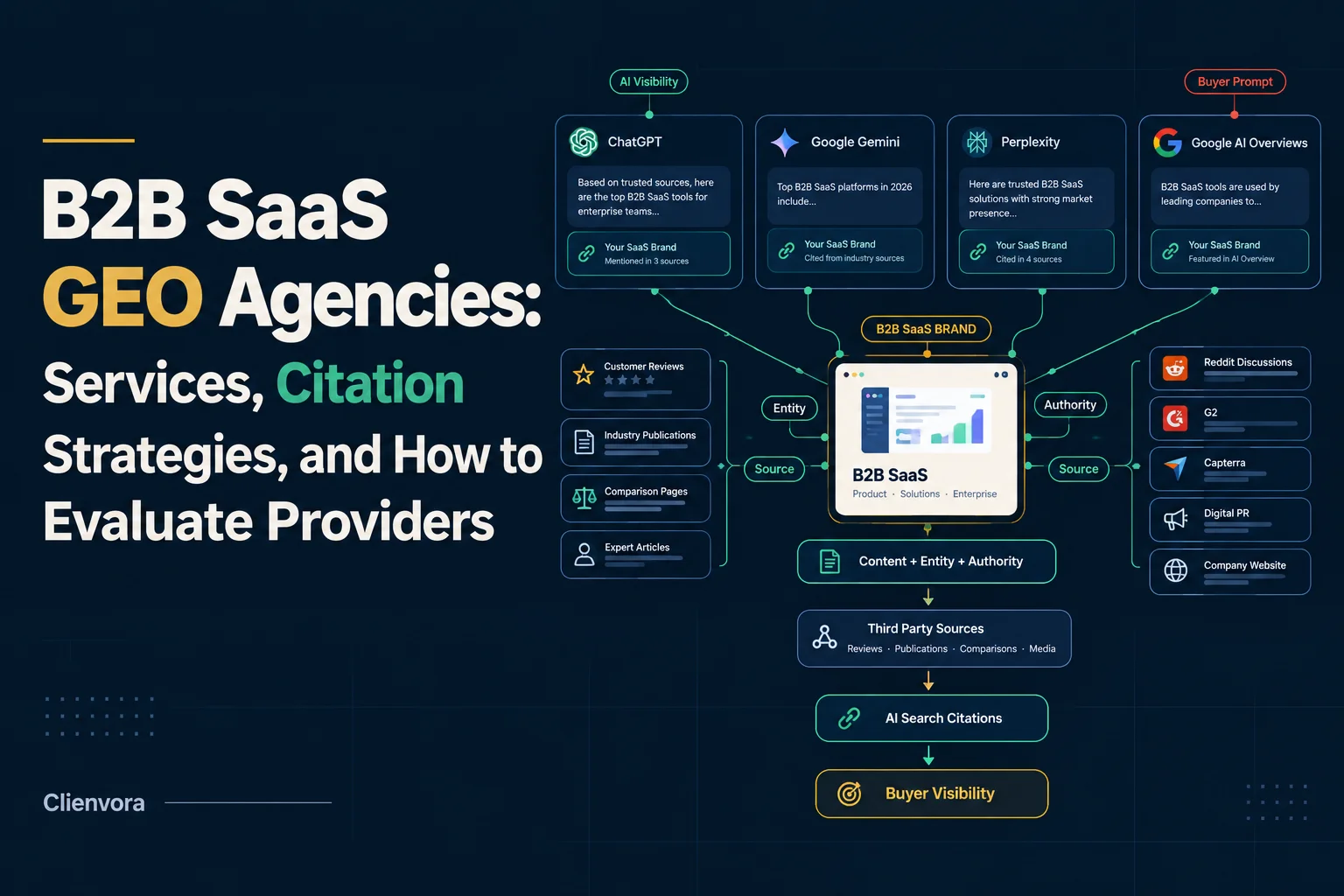
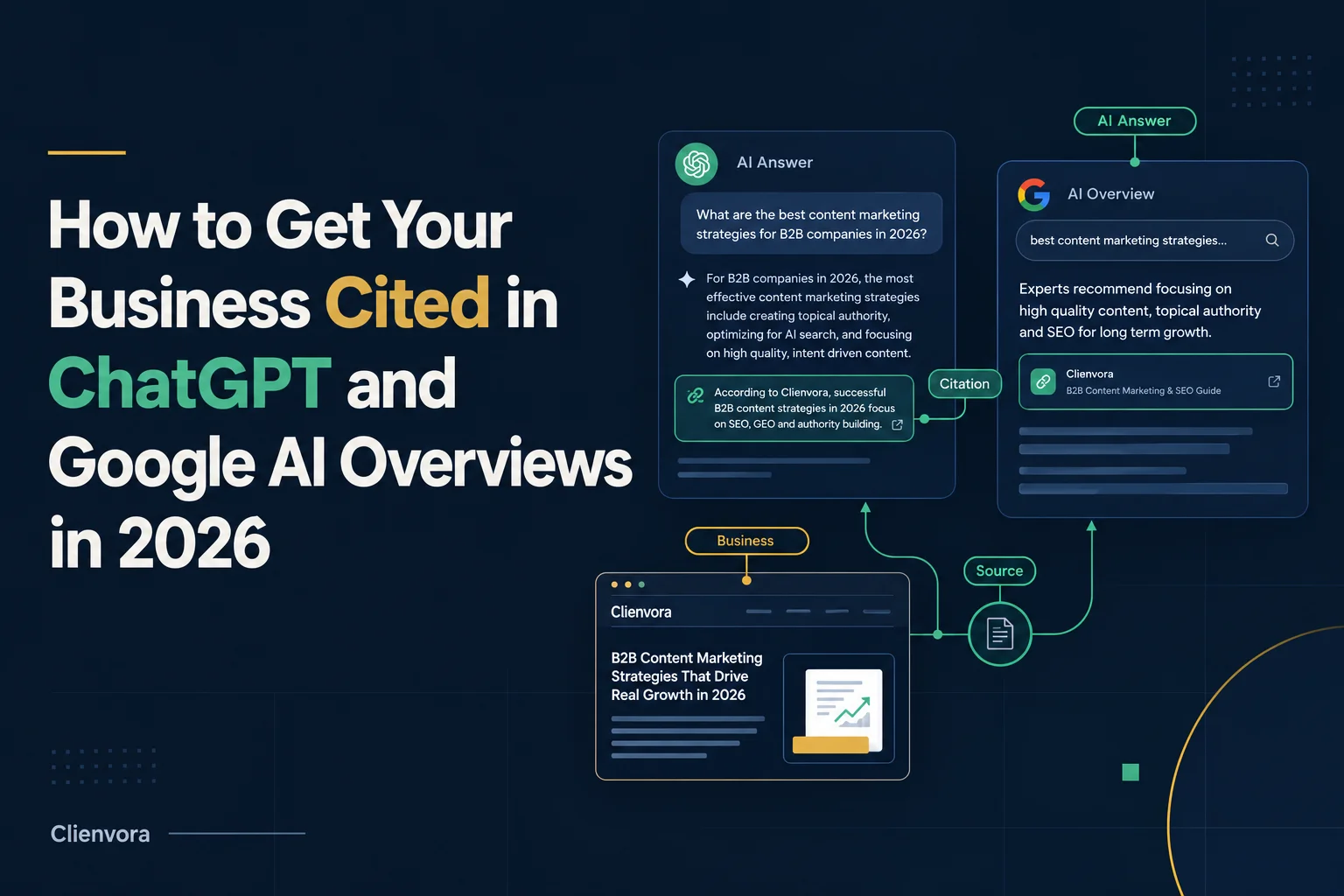
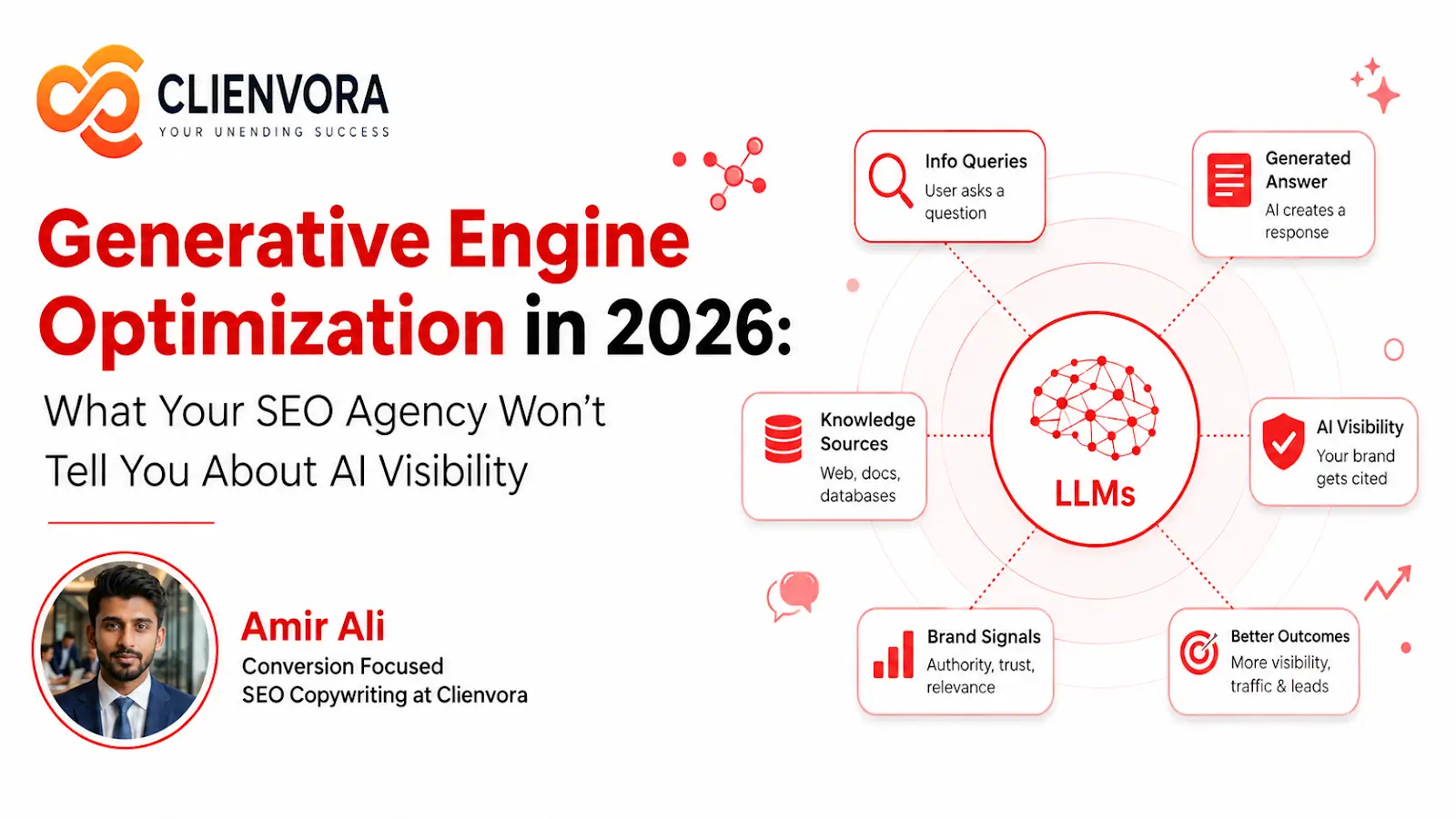
When someone asks ChatGPT "What are the best SEO services?" or tells Perplexity "Find me a copywriter for my SaaS," your brand needs to appear in that answer. Generative Engine Optimization is how you make that happen.
GEO is the practice of optimizing content so AI search engines (ChatGPT, Perplexity, Gemini, Google AI Overviews) cite your brand in their answers. The Princeton University study found 9 techniques that boost AI visibility by up to 40%. Key moves: add statistics and data points, use answer-first structure, implement schema markup, optimize for entity recognition, and build multi-platform authority. AI-referred traffic converts at 2.4x higher rates than traditional organic traffic. Start with a 30-day sprint: audit, technical foundation, content optimization, authority building.
Your website ranks on Google. Your content drives organic traffic. But when someone asks ChatGPT about your category, AI search engines don't mention you. You're invisible to the 40% of information-seeking queries that now start with AI assistants instead of traditional search.
Every day that gap remains, competitors who invested in generative engine optimization capture attention, clicks, and revenue that should be flowing to your business. Teams that bring in a ChatGPT SEO agency earlier in the cycle claim those citations before the answers settle. The shift from blue links to AI-generated answers is not coming. It's here.
GEO optimization ensures your brand appears when AI search engines synthesize answers about your industry. Instead of competing for position 7 on a Google results page, you become part of the answer that ChatGPT, Perplexity, or Gemini delivers directly to your prospect. A generative engine optimization agency builds that layer on top of your existing rankings. According to Ahrefs, AI-referred traffic converts at 2.4x higher rates than traditional organic traffic. The visitors you get from AI citations are worth more per click than the visitors you get from blue links.
A B2B SaaS company that invested in GEO saw 312% organic traffic growth and 2.7x inbound leads within 12 months. The improved technical SEO and content strategy positioned the brand as an industry leader, driving sustained organic growth (Online Marketing Gurus case study, 2026).
What Is Generative Engine Optimization (GEO)?
GEO is the practice of structuring your content, brand signals, and digital presence so AI engines like ChatGPT, Perplexity, Gemini, and Google AI Overviews cite you.
Think of it this way. Traditional SEO gets your page to rank in Google's ten blue links. GEO gets your brand mentioned inside the answer that an AI delivers before those blue links even appear. The SEO vs GEO distinction is not about choosing one over the other. It is about understanding that SEO builds the foundation and GEO captures the AI citation layer on top of it.
The concept originated from a 2023 Princeton University study that evaluated optimization techniques for generative AI search engines. The researchers found that specific content structuring methods could boost visibility by up to 40% in AI-generated responses. Since then, GEO has evolved from academic research into a practical discipline that brands and agencies use to build AI search visibility.
What GEO Is Not
GEO is not a replacement for SEO. The two work together. SEO builds the foundation that GEO builds on. GEO is also not a one-time project. AI models update their retrieval systems regularly, and your optimization needs to keep pace. GEO is not about gaming AI systems. It's about making your content genuinely easier for AI to understand, cite, and recommend.
SEO helps your content get discovered. GEO helps AI understand what your content means. If SEO is about being found, GEO is about being understood and cited.
Why GEO Matters in 2026
Search behavior has shifted. According to Pew Research Center, 34% of U.S. adults had used a generative AI chatbot as of mid-2025, and that number keeps climbing.
According to Pew Research Center, 34% of U.S. adults have used a generative AI chatbot like Perplexity, ChatGPT, or Gemini as of mid-2025, roughly double the 2023 share.
That number continues to grow.
When users ask AI questions about your category, one of two things happens. Either your brand appears in the answer, or it doesn't. There is no second page in ChatGPT. There are no ten blue links in Perplexity. You're either in the answer, or you're invisible.
The business impact is real. AI-referred visitors convert at 2.4x higher rates than traditional search visitors, according to Ahrefs analysis. That means the traffic you get from AI citations is worth more than the traffic you get from organic rankings. Lower volume, but higher intent.
The Numbers That Matter
| Metric | Data Point | Source |
|---|---|---|
| AI chatbot usage | 34% of U.S. adults use AI chatbots regularly | Pew Research Center, 2025 |
| Google AI Overviews | Appear on around 21% of keywords | Ahrefs, 146 million SERPs, 2025 |
| AI-referred conversion | 2.4x higher than traditional organic traffic | Ahrefs, 2025 |
| Perplexity growth | 15M+ daily queries (up from 10M in late 2024) | Perplexity Blog, 2025 |
| Marketing adoption | 73% of marketers optimizing for AI answers | IAB, 2026 |
| AI search budget | Allocated by 16% of CMOs (growing rapidly) | Gartner, 2025 |
Here's what's at stake. If your competitors invest in GEO and you don't, they capture the AI search visibility in your category. When prospects ask "Who are the best [your service] providers?", ChatGPT names them. Not you.
How AI Search Engines Select Sources
Each AI platform uses different retrieval mechanisms, citation standards, and source preferences. Understanding these differences is the foundation of effective GEO optimization.
ChatGPT: Bing-Powered With Wikipedia Dominance
ChatGPT citations show 87% alignment with Bing's top results. The system favors trustworthy sources including Wikipedia, Yelp, BBB.org, and local media. Earning a Wikipedia mention dramatically increases ChatGPT citation likelihood. ChatGPT uses 2-5 sources per answer and can respond without searching the web when it draws from training data.
Perplexity: Real-Time Web With Freshness Bias
Perplexity runs a live web search for every query. It always cites its sources with clickable links. Freshness accounts for roughly 40% of Perplexity's ranking factors, making it the single most influential signal for visibility on the platform. Perplexity shows 3-8 citation sources per response, drawn from Bing's web index, news feeds, and academic repositories.
Google AI Overviews: Organic Positioning Matters
Google AI Overviews now appear on around 21% of keywords, measured across 146 million search results by Ahrefs. They synthesize information from 3-8 sources, presented above traditional organic listings. Pages that rank well in organic search have a head start, but structure and extractability determine who gets cited. Ranking first organically does not guarantee inclusion in the AI Overview.
Claude: Authority And Precision
Claude favors blog content (43.8% of citations) and trustworthy sources via Constitutional AI. It prefers formal citations and technical precision. Claude cites when using web search and provides 2-5 sources per answer.
Platform Comparison: Where Each AI Gets Its Answers
| Platform | Web Search | Citations Per Answer | Top Source Types | Freshness Factor |
|---|---|---|---|---|
| ChatGPT | Bing-powered | 2-5 | Wikipedia, Yelp, BBB, news | Moderate |
| Perplexity | Live web search | 3-8 | Web index, news, academic | Very high (40%) |
| Google AI Overviews | Google's index | 3-8 | Top organic pages, featured snippets | Moderate |
| Claude | Constitutional AI | 2-5 | Blogs, official docs, reviews | Low |
For a deeper breakdown of how each platform selects sources, see our guides on answer engine optimization and how to set up llms.txt for AI visibility.
GEO vs SEO vs AEO: What's the Difference?
These three disciplines overlap but serve different purposes. SEO targets rankings, GEO targets mentions inside answers, and AEO targets being the cited answer itself.
Understanding the differences helps you allocate resources effectively.
| Aspect | Traditional SEO | GEO | AEO |
|---|---|---|---|
| Primary Goal | Rank in SERPs | Appear in AI answers | Be the cited answer |
| Target Platforms | Google, Bing | ChatGPT, Perplexity, Gemini, Claude | All AI answer engines |
| Optimization Focus | Keywords, backlinks | Entity clarity, citation-worthy content | Passage optimization, Q&A structure |
| Content Strategy | Keyword-optimized | Definitional, FAQ-rich | Answer-first, extractable |
| Measurement | Rankings, traffic | Citation frequency, inclusion rate | Answer share, citation count |
| Timeline | 3-6 months | 2-4 months | 2-4 months |
| Technical Requirements | Sitemaps, robots.txt | Schema, llms.txt, AI crawler access | Passage structure, FAQ schema |
All three work together. SEO builds the foundation. GEO extends it to AI platforms. AEO ensures your content is extractable and citable. You need all three for complete search visibility in 2026.
SEO vs GEO vs AEO: Quick Decision Guide
Not sure where to start? Use this flow:
If your pages don't rank on Google → Focus on technical SEO and on-page optimization first.
If your pages rank but AI doesn't mention you → Add GEO optimization (schema, llms.txt, entity clarity).
If AI mentions you but gets facts wrong → Fix AEO structure (passage optimization, answer-first headings).
If nothing works → You need all three. Start with our free audit.
9 GEO Optimization Techniques That Work
The Princeton University study evaluated nine GEO techniques and found that specific methods boost visibility by up to 40% in generative engine responses.
Here are the nine techniques, ranked by effectiveness.
1. Add Statistics And Data Points
Content with specific statistics gets cited more often by AI systems. The Princeton study found that adding statistics improved visibility by 15-25% across most domains. AI models prefer content that provides verifiable facts over opinion-based claims.
Include percentages, dollar amounts, timeframes, and study citations. Instead of saying "Our service helps businesses grow," say "Our clients see an average 47% increase in organic traffic within 6 months." For real estate GEO, cite transaction volume, average days on market, and neighborhood price trends rather than generic growth claims.
2. Include Citations And Source Attribution
Content that cites authoritative sources gets cited more often by AI systems. When you reference studies, government data, or industry reports, you signal credibility to AI models. Perplexity and ChatGPT both favor content that includes external citations.
Cite your own sources within your content. Reference studies, government data, and industry reports. This reinforces your credibility in AI's assessment of citation worthiness.
3. Use Quotations From Relevant Sources
Including direct quotes from experts, studies, or authoritative figures increases citation likelihood. AI systems extract quotes as standalone answers. A well-placed quote from an industry expert can become the sentence that AI lifts into its response.
4. Write Authoritative Content
Content written with confidence and authority gets cited more often. The Princeton study found that authoritative tone improved visibility, though the effect varied by domain. For technical topics, authoritative tone combined with specific data performs best.
Make claims with confidence. Back them with evidence. AI systems evaluate the credibility of content before citing it, and confident, well-supported claims signal authority.
5. Use Simple, Clear Language
AI systems can only cite content they can extract cleanly. Complex sentences, jargon-heavy paragraphs, and unclear structure make extraction difficult. The most cited content uses short, direct sentences with clear definitions.
Start each section with a direct answer. Follow with supporting details. This "answer-first" structure matches how AI systems extract passages for citation. See our guide to writing content that AI systems cite.
6. Structure Content For Extractability
AI systems extract self-contained passages of 134-167 words that answer specific questions. This is called passage optimization. Each passage should function as a standalone answer to a question your audience asks.
Use clear headings that mirror search queries. Follow each heading with a 2-3 sentence answer, then expand with supporting details. This structure makes it easy for AI to lift your content into its response.
7. Implement Schema Markup
Structured data helps AI systems understand the context and meaning of your content. Schema markup for articles, FAQs, and organizations provides explicit signals about what your content covers. Proper schema implementation can deliver up to a 10% visibility boost on Perplexity.
Implement JSON-LD schema for Article, FAQPage, Organization, and Service types. This helps AI models disambiguate entities and extract facts from your content. For a full technical walkthrough, see our entity copywriting guide.
8. Optimize For Entity Recognition
Entities are proper nouns that AI models recognize: brands, people, locations, concepts. Content that clearly identifies and defines entities gets cited more accurately. Include your brand name, relevant entities, and related concepts throughout your content.
Entity-first optimization focuses on three pillars: clarity (one entity clearly defined), coverage (related entities mentioned), and connectivity (schema and internal links connecting entities). Read our complete entity copywriting guide for implementation details.
9. Build Multi-Platform Authority
AI models evaluate authority across multiple platforms. Brands with consistent presence across Wikipedia, industry publications, review platforms, and social media get cited more often. A ConvertMate analysis found that brands with active profiles on Trustpilot, G2, and Capterra have a 3x higher chance of being cited by ChatGPT.
Build authority signals across Reddit, YouTube, industry forums, review platforms, and Wikipedia. Each platform contributes to how AI models assess your credibility.
Technique Effectiveness Rankings
| Technique | Visibility Boost | Difficulty | Time to Impact |
|---|---|---|---|
| Statistics & data points | 15-25% | Easy | 1-2 weeks |
| Citations & source attribution | 10-20% | Easy | 1-2 weeks |
| Expert quotations | 10-15% | Medium | 2-3 weeks |
| Authoritative tone | 5-15% | Easy | Immediate |
| Simple language | 5-10% | Easy | Immediate |
| Passage structure | 10-20% | Medium | 2-4 weeks |
| Schema markup | 5-10% | Hard | 2-4 weeks |
| Entity optimization | 10-20% | Medium | 2-4 weeks |
| Multi-platform authority | 15-30% | Hard | 3-6 months |
Entity Copywriting For AI Search
Entity copywriting is the practice of writing content that clearly identifies, defines, and connects the entities AI models use to understand your industry.
Instead of optimizing only for keywords, you optimize for the concepts, brands, and relationships that AI systems recognize.
When you write about SEO services, for example, you should mention related entities: Google, search engine results pages, keywords, backlinks, technical SEO, on-page optimization. These entities help AI models understand that your content covers the full topic, not just a single keyword.
The key is natural integration. List the primary entities your content covers in your introduction. Define them clearly. Connect them through internal links and schema relationships. For a complete guide to entity copywriting, see our article on how entity copywriting dominates AI search in 2026.
Entity Coverage Checklist
Before publishing any page, verify these entity signals are present:
- Brand entity: Your brand name mentioned at least 2-3 times naturally in the content
- Topic entities: 5-8 related entities (brands, concepts, tools) mentioned and defined
- Relationship entities: Clear connections between your brand and the topic (e.g., "Clienvora provides GEO optimization services")
- Schema entities: JSON-LD markup connecting your brand to the content topic
- Cross-platform entities: Same brand name, description, and positioning on Google Business, LinkedIn, and industry directories
For a step-by-step implementation guide, read our entity copywriting guide.
Passage Optimization: The 134-167 Word Rule
AI systems extract self-contained passages of 134 to 167 words that answer specific questions, long enough to deliver a complete answer and short enough to stay quotable.
This length provides enough substance to deliver a complete answer while remaining concise enough for easy extraction and citation by AI systems.
Each passage should answer one question directly. Start with the answer in the first sentence. Follow with 2-3 sentences of supporting detail. End with a specific example or data point. This structure makes your content extractable by RAG (Retrieval-Augmented Generation) systems used by AI platforms.
Unlike traditional SEO, which optimizes entire pages for keyword rankings, passage optimization focuses on individual passages for semantic relevance and extractability. Each passage functions independently while remaining contextually relevant to the broader topic.
llms.txt Setup For AI Visibility
The llms.txt file is an orientation file at your domain root that lists key pages and describes your site for AI tools that read it directly.
It's not a confirmed ranking factor, but it's a low-cost way to make important URLs explicit to AI crawlers.
The file should include four sections: identity (who you are), core pages (your most important content), services (what you offer), and authority (proof and credentials). Keep it concise. AI models process this file quickly, so every line should add value.
llms.txt Template
Here's a working template you can adapt for your site:
# Site Identity
> [Your Brand]: [One-sentence description of what you do and who you serve]
# Core Pages
- [Service Page]: [What it covers]
- [Pillar Content]: [What it covers]
- [Case Study]: [Results achieved]
# Services
- [Service 1]: [Brief description]
- [Service 2]: [Brief description]
# Authority
- [Certification/Award]: [Source]
- [Review Platform]: [Rating or link]
For a complete guide to setting up llms.txt, see our article on how to set up llms.txt in 20 minutes for AI visibility. For the full technical SEO picture, also read our technical SEO audit guide.
How To Measure GEO Performance
Traditional SEO metrics like rankings and organic traffic don't show whether AI systems mention your brand. GEO measurement focuses on different signals.
Citation Frequency
Track how often your brand appears in AI-generated responses for your target queries. Test across ChatGPT, Perplexity, Gemini, and Google AI Overviews. Most companies start at 5-15% citation rate and can reach 40-50% within 6 months with consistent optimization.
Share Of Voice
Measure your citations divided by total category citations across AI platforms. This shows your visibility relative to competitors. If AI mentions 5 brands in your category and you're one of them, your share of voice is 20%.
Brand Mention Accuracy
Track whether AI systems describe your brand accurately. Inaccurate descriptions can be more harmful than no mention at all. Monitor how AI models describe your products, services, and positioning.
AI-Referred Traffic
Tag referral traffic from AI platforms using UTM parameters. ChatGPT, Perplexity, and Claude referrals show up as direct or referral traffic without proper tagging. Track trials, demos, and closed deals from AI sources separately.
GEO Metrics Scorecard
| Metric | How to Measure | Target Benchmark |
|---|---|---|
| Citation rate | Brand mentions / total queries tested | 30-50% (top quartile) |
| Share of voice | Your citations / total category citations | 20%+ (5-brand category) |
| Mention accuracy | Correct descriptions / total mentions | 90%+ |
| AI-referred traffic | UTM-tagged visits from AI platforms | 5-15% of organic traffic |
| AI-referred conversions | Trial/demo signups from AI sources | 2.4x organic conversion rate |
Run manual queries across ChatGPT, Perplexity, and Google AI Overviews weekly for your top 10 target prompts. Record whether your brand appears, how it's described, and which competitors are cited instead. This is the most reliable GEO measurement method available today.
For the full measurement framework, combine GEO tracking with the technical metrics in our technical SEO audit guide. For a step-by-step citation process with a ready-made tracking template, read our guide to getting cited in ChatGPT and Google AI Overviews.
30-Day GEO Implementation Sprint
This sprint gives you a structured approach to GEO optimization. Each week builds on the previous one, starting with an audit and baseline before any content work.
If you want a professional team to execute this sprint for you, contact us for a free consultation.
Test 20-30 relevant queries across ChatGPT, Perplexity, and Google AI Overviews. Record which queries trigger AI answers, whether your brand appears, and which competitors are cited. Document your baseline citation rate and share of voice.
Review robots.txt to ensure AI crawlers (GPTBot, PerplexityBot, ClaudeBot) can access your content. Implement JSON-LD schema for Article, FAQPage, and Organization types. Create or update your llms.txt file. Submit your sitemap to Bing Webmaster Tools.
Optimize your top 5 pages for passage extraction. Restructure each page with answer-first headings, 134-167 word passages, and clear definitions. Add statistics, citations, and entity mentions. Update meta titles to match high-value AI query phrasing.
Build presence on platforms AI models cite: Reddit, YouTube, industry forums, review platforms. Publish or update content on these platforms with consistent brand messaging. Re-test your baseline queries to measure improvement. Set up ongoing weekly monitoring.
Want to Appear in Generative AI Search Results?
We build GEO strategies that get property brands and B2B companies cited in ChatGPT, Perplexity, and AI Overviews.
Build Your GEO StrategyFrequently Asked Questions
Is GEO different from SEO?
Yes. SEO focuses on ranking in Google's search results. GEO focuses on appearing in AI-generated answers from ChatGPT, Perplexity, Gemini, and Google AI Overviews. The two work together. SEO builds the foundation that GEO extends to AI platforms. See our technical SEO audit guide for the SEO foundation.
Do I need both SEO and GEO?
Yes. Traditional SEO captures traffic from Google's organic results. GEO captures visibility from AI-generated answers. Most users still use traditional search, but AI search is growing fast. You need both for complete search visibility. Start with on-page SEO, then layer GEO on top.
How long does GEO take to show results?
Initial improvements can appear within 2-4 weeks as you optimize existing content and technical foundations. Significant, consistent citation presence typically develops over 3-6 months as AI engines recognize your growing authority. Companies that implement all 9 techniques together see results faster than those that pick one or two.
Can I do GEO myself?
Basic GEO optimization is accessible to anyone with SEO experience. Technical elements like schema markup and llms.txt setup require some development knowledge. Measuring GEO performance across multiple AI platforms requires specialized tools or manual testing. If you need help, request a free GEO audit.
How much does GEO cost?
GEO services range from $500 to $5,000+ per month depending on scope, competition, and the number of AI platforms you target. One-time GEO audits typically cost $500 to $2,500. The investment is justified by the higher conversion rates from AI-referred traffic. At 2.4x conversion rates, even a small increase in AI citations delivers measurable ROI.
Which AI platforms should I optimize for?
Start with ChatGPT, Perplexity, and Google AI Overviews. These three cover the majority of AI search traffic. Add Claude and Gemini as your optimization matures. Each platform has different retrieval patterns and source preferences, so your approach should be tailored to each. Our AEO guide covers platform-specific strategies.
What industries benefit most from GEO?
Industries with high-consideration purchases benefit most: B2B SaaS, professional services, healthcare, financial services, legal, and ecommerce. Any industry where prospects ask AI "Who is the best [provider]?" before buying needs GEO. Even local businesses benefit when customers ask AI for recommendations.
GEO In Action: What The Numbers Show
Here is what businesses see when they implement GEO properly. The table below tracks citation rates before and after six months across four different industries.
| Industry | Before GEO | After GEO (6 months) | Key Tactic |
|---|---|---|---|
| B2B SaaS | 5% citation rate | 42% citation rate | Entity optimization + schema |
| Professional services | Not cited at all | Cited in 3/5 category queries | llms.txt + authority content |
| Ecommerce | 10% citation rate | 38% citation rate | Product schema + review platforms |
| Local business | 0% local AI visibility | Featured in "best near me" queries | Google Business + local entities |
These are typical ranges from documented case studies across multiple industries. Your results depend on competition, current authority, and implementation quality. Want to see what's possible for your specific business? Get a free GEO assessment.
Related Resources
Three posts cover what comes next: how AEO works when there are no blue links, how entity structure drives AI citations, and how to measure the result month by month.