Google ranking no longer decides who gets mentioned in AI answers. Only 37.9 percent of URLs cited in Google AI Overviews appear in the top 10 traditional results (Ahrefs, 4 million URLs). This 15-step guide covers crawl access, question pages, original evidence, entity clarity, external verification, and a monthly prompt test to earn citations in ChatGPT and AI Overviews.
Your business can rank on Google and still be invisible when someone asks ChatGPT which companies they should consider.
You can also appear in Google's traditional search results without being selected as a source in an AI Overview.
That is one of the biggest changes happening in search.
The question is no longer only:
Can Google find my website?
It is also:
Can an AI system find the information, understand it, trust it, and use it when answering a relevant question?
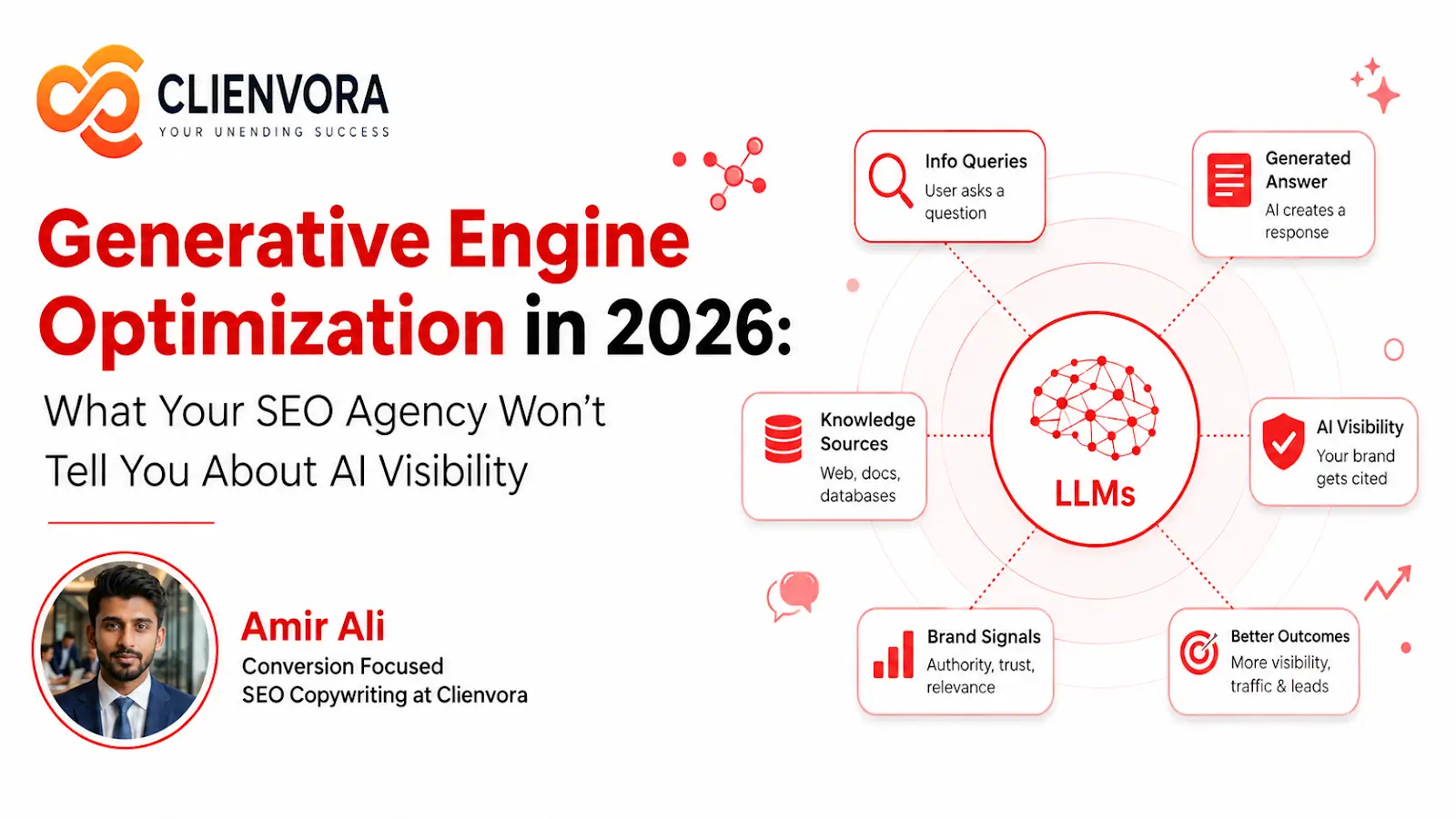
This is where AI search optimization, often called generative engine optimization or GEO, comes into the picture.
But there is a problem.
A lot of GEO advice has turned into a collection of unsupported rules.
Use a certain number of words.
Put the answer in exactly 40 words.
Add FAQ schema.
Create an llms.txt file.
Publish hundreds of AI articles.
Get mentioned on Reddit.
Do all of that and ChatGPT will cite you.
The evidence does not support such a simple formula.
Google says there are no special technical requirements or special schema requirements for appearing in AI Overviews or AI Mode. The same fundamental requirements that make a page eligible for Google Search still matter.
OpenAI also makes an important distinction between its crawlers. OAI SearchBot is used to surface websites in ChatGPT search, while GPTBot is a separate crawler associated with training related use. Website owners can control these independently through robots.txt.
So what actually works?
The better way to think about AI visibility is this:
Discovery → Retrieval → Selection → Citation → Mention → Visit → Conversion
You need to make your website discoverable.
You need useful information that matches real questions.
You need evidence that supports your claims.
You need a business entity that can be understood consistently.
You need external signals that make your claims independently verifiable.
And then you need to measure whether that visibility produces anything valuable for the business.
This guide explains how to build that system.
Why AI citations matter in 2026
AI search is no longer a small experiment.
Google says AI Overviews now have more than 2.5 billion monthly active users, while AI Mode has surpassed 1 billion monthly users.
That does not mean every business will receive billions of impressions.
It means the environment in which people research products, services and companies is changing at a significant scale.
Someone looking for an SEO agency may no longer search only:
SEO agency for SaaS companies
They might ask:
Which SEO agencies understand SaaS companies?
Or:
What should I look for when hiring an SEO content agency?
Or:
SEO agency vs freelance SEO consultant, which is better for a small business?
Those questions create a different search environment.
The user is asking for an answer rather than a list of ten blue links.
AI systems then have to retrieve information from multiple sources and decide what information to use in the response.
That creates a new opportunity for businesses.
It also creates a new problem.
Ranking is not the same thing as being cited.
Ranking on Google does not guarantee an AI citation
This is one of the most important findings businesses should understand.
Ahrefs analyzed 863,000 keyword search results and approximately 4 million URLs appearing in AI Overviews.
Only 37.9% of the URLs cited in AI Overviews also appeared within the first 10 result blocks for the same search. Another 31.2% appeared between positions 11 and 100, while 31% appeared beyond the top 100 result blocks in the dataset.
That does not mean traditional SEO is dead.
Quite the opposite.
It means AI citation selection cannot be explained by traditional rankings alone.
A page can be useful to an AI system for a specific question even when it is not one of the highest ranking traditional results.
That gives us a more useful model.
Traditional SEO asks
Can this page rank for the query?
AI search asks
Can this page help answer the user's question?
Those systems overlap, but they are not identical.
The practical lesson is simple:
Do not abandon SEO for GEO. Build content that works for both.
The AI visibility chain
Before getting into individual tactics, it helps to understand what happens between publishing a page and getting a customer from AI search.
1. Discovery
The search system has to find your page.
If your important content is blocked, poorly linked, inaccessible or not indexed, there is little reason to expect it to become a citation.
2. Retrieval
The system has to retrieve information relevant to the user's question.
A page about your service does not automatically make it useful for every question related to your industry.
3. Selection
The system has to decide which available sources are useful enough to include.
This is where relevance, evidence, clarity, freshness and other signals can matter.
4. Citation
Your URL appears as a source.
This is useful, but it is not the end goal.
5. Mention
The AI actually names your company in the response.
That can be more visible to users than a source link sitting underneath the answer.
6. Visit
The user clicks through to your website.
7. Conversion
The visitor becomes a lead, customer, subscriber, caller or buyer.
This final stage is where many GEO discussions stop too early.
A citation is useful.
A citation that produces qualified business is much more useful.
Step 1: Make your website accessible to search systems
The first GEO tactic is not complicated.
Make sure search systems can actually access the information you want them to use.
For Google, the fundamentals still matter.
Your important pages should be:
- Crawlable
- Indexable
- Internally linked
- Accessible without unnecessary technical barriers
- Useful to visitors
- Written in visible, understandable content
Google's own documentation says there are no additional technical requirements for appearing in AI Overviews or AI Mode. A page needs to meet the normal requirements for Google Search and be indexed.
That matters because it cuts through a lot of unnecessary GEO advice.
You do not need a secret AI sitemap.
You do not need special AI schema.
You do not need to rebuild your entire website around an AI crawler.
Start with technical SEO.
ChatGPT has its own crawler considerations
OpenAI identifies OAI SearchBot as the crawler used to surface websites in ChatGPT search.
If a website opts out of OAI SearchBot, OpenAI says that site will not be shown in ChatGPT search answers, although it may still appear as a navigational link.
OpenAI also separates OAI SearchBot from GPTBot.
That distinction matters.
Allowing OAI SearchBot does not mean you are automatically allowing GPTBot for training related crawling.
Check your robots.txt file and make sure your directives reflect what you actually want.
Do not blindly copy another company's robots.txt configuration.
Step 2: Stop creating content only around keywords
A traditional keyword plan might look like this:
- SEO agency
- SEO services
- SEO company
- SEO consultant
- SEO expert
Those keywords have their place.
But they do not tell you everything your potential customer wants to know.
A buyer might also ask:
- How much does SEO cost for a small business?
- Is an SEO agency worth it?
- SEO agency vs freelancer
- How long does SEO take?
- What should an SEO agency report every month?
- How do I choose an SEO agency?
- What does an SEO content strategy include?
- Can an SEO agency help an ecommerce store?
- What should a SaaS company look for in an SEO agency?
These are not simply keyword variations.
They represent different questions, concerns and stages of the buying process.
That is why question based content is important.
Build around the questions your customers actually ask
Suppose you run a cybersecurity company.
Instead of publishing only:
Cybersecurity Services
You could create useful supporting content such as:
What Does a Managed Security Service Provider Do?
How Much Does Managed Cybersecurity Cost?
MDR vs MSSP: What Is the Difference?
Does a Small Business Need Managed Detection and Response?
What Does a Cybersecurity Assessment Include?
How Long Does a Security Assessment Take?
Now your website covers the subject from several angles.
It also gives search systems more useful information to retrieve when users ask different questions.
Step 3: Give AI something worth citing
This is where content quality becomes much more concrete.
Anyone can write:
Businesses should invest in cybersecurity because cyber threats are increasing.
There is nothing particularly valuable to cite there.
Now compare it with:
In our 2026 security review of 42 small business websites, 17 had at least one publicly visible configuration issue.
That second statement could be much more valuable.
But there is an important condition.
The research must actually exist.
Do not invent statistics because original data looks authoritative.
If you conduct an audit, publish the methodology.
If you survey customers, explain the sample.
If you analyze 500 pages, explain how they were selected.
If you calculate an industry benchmark, show the calculation.
Original information gives your content something that thousands of generic AI generated articles do not have.
Useful evidence can include
- Original research
- Customer surveys
- Industry benchmarks
- Case studies
- First party data
- Experiments
- Pricing research
- Original calculations
- Expert interviews
- Documented processes
- Product comparisons
- Real examples
- Independent sources
The principle is simple:
Create information that another writer or AI system has a reason to reference.
Our SEO copywriting services are built around that standard.
Step 4: Make your business easy to understand as an entity
AI systems need more than isolated mentions of your company.
Your website should make the business understandable.
Consider a fictional company called NorthShield Security.
Its website says:
NorthShield Security provides managed cybersecurity services for small and medium sized businesses.
Its LinkedIn page says:
NorthShield IT Solutions
A directory lists:
North Shield Cyber
Its founder describes it as:
NorthShield
And another website calls it:
NorthShield Security Group
There is no catastrophic problem here.
But the company has created unnecessary ambiguity.
Keep important information consistent.
That includes:
- Company name
- Main services
- Industry
- Location
- Founder information
- Contact information
- Areas served
- Author information
- Company description
Your About page should answer basic questions clearly.
Who are you?
What do you do?
Who do you serve?
Where do you operate?
What evidence supports your expertise?
Who is responsible for the information?
What makes the company different?
This is not only an AI search tactic.
It is good website architecture. Our entity copywriting guide shows how to keep those answers consistent across pages.
Step 5: Build evidence outside your own website
One of the weakest GEO strategies is relying entirely on your own website to tell everyone how authoritative you are.
A company can say:
We are the leading SEO agency for SaaS companies.
That does not make the claim independently verified.
External sources can provide additional context.
Depending on the industry, this might include:
- Industry publications
- Interviews
- Podcasts
- Professional associations
- Reviews
- Relevant directories
- Partner pages
- Conference appearances
- Independent research
- Customer stories
- Expert commentary
- Community discussions
The objective is not to get your company mentioned on every website on the internet.
The objective is to become independently verifiable.
Google's guidance around AI search emphasizes creating unique, valuable content and warns against tactics designed primarily to manipulate visibility.
That distinction matters.
You want genuine reputation, not manufactured noise. Our link building services aim for that kind of genuine reference.
Step 6: Do not ignore commercial questions
A lot of AI search content focuses on informational queries.
That is useful for traffic.
It is not always useful for revenue.
Consider the difference.
Informational
What is technical SEO?
Commercial
How much does technical SEO cost?
Comparison
SEO agency vs freelance consultant
Buyer research
What should I look for when hiring an SEO agency?
High intent
Best SEO agency for a SaaS startup
These queries are much closer to a purchasing decision.
Research from Semrush analyzed 3,981 domain appearances across 115 prompts in 14 countries and four AI search environments. It found that comparative content generated 2.4 times more brand mentions than informational content in its dataset.
That does not mean every business should turn its entire blog into comparison pages.
It means commercial intent deserves a much larger role in your AI visibility strategy.
Create content that helps people make decisions.
Step 7: Build topical authority without creating hundreds of thin pages
There is a dangerous interpretation of topical authority:
Publish everything.
That is not the goal.
A website with 500 weak articles is not automatically more authoritative than one with 50 excellent pages.
Google has repeatedly emphasized the importance of helpful content rather than content created primarily to manipulate search visibility.
Your topic cluster should have a purpose.
For a law firm, the structure might look like this:
Core service
Personal Injury Lawyer
Supporting topics
- What happens after a personal injury?
- How personal injury settlements work
- Settlement vs trial
- How contingency fees work
- Questions to ask a personal injury lawyer
- How long a personal injury case takes
- What evidence can support a claim?
For a SaaS company:
Core topic
SaaS SEO
Supporting topics
- SaaS keyword research
- SaaS content strategy
- SaaS technical SEO
- SaaS link building
- SaaS product led SEO
- SaaS comparison pages
- SaaS pricing page optimization
- SaaS SEO metrics
The pages should connect naturally.
Do not publish a page just because a keyword tool produced the keyword.
Step 8: Make important information easy to extract
You do not need to write for robots.
Write clearly for people.
But clear content also makes important information easier for machines to process.
Use:
- Clear headings
- Short paragraphs
- Specific definitions
- Tables where comparisons genuinely help
- Examples
- Numbered processes
- Relevant statistics
- Source attribution
- Direct explanations
- Consistent terminology
- Useful FAQs
Suppose you have a section explaining your service.
Instead of writing three paragraphs before revealing the answer, make the main point obvious.
What does a technical SEO audit include?
A technical SEO audit examines crawling, indexing, site architecture, internal links, page performance, structured data, canonicalization, redirects, metadata and other technical elements that can affect search visibility.
Then explain the details.
This is better for readers.
It also creates clearly defined information that can potentially be retrieved when someone asks a related question. That extractable structure is what answer engine optimization is built on.
Do not obsess over a magic word count
You will find GEO articles claiming that answers should be exactly a certain number of words.
There is no reliable universal rule like that.
Google does not specify an ideal page length for AI search.
The goal is not to produce a 50 word answer because someone said AI systems prefer 50 words.
The goal is to answer the question completely and clearly.
Step 9: Add original comparisons and decision content
Comparison pages deserve special attention because people often use AI systems for research before buying.
Consider a software company.
A weak content strategy might publish:
What is CRM software?
A stronger commercial strategy might also publish:
HubSpot vs Salesforce
CRM vs marketing automation
Best CRM for small businesses
How much does CRM software cost?
What should a startup look for in a CRM?
The same principle applies to services.
For Clienvora, for example:
SEO agency vs freelance SEO writer
Content writing agency vs in house writer
SEO content vs thought leadership
SEO content agency pricing
How to choose a content writing agency
These pages answer actual buying questions.
Research from Wix Studio's AI Search Lab, reported by Search Engine Land, analyzed 75,000 AI answers and more than 1 million citations. Listicles, articles and product pages together accounted for 52% of citations in that study, while content format varied substantially by query intent.
The lesson is not to turn everything into a listicle.
The lesson is to match the format to the question.
Step 10: Keep important content genuinely fresh
Freshness is another area where the evidence is more interesting than many GEO claims suggest.
Ahrefs analyzed 17 million citations across seven AI search platforms and found that URLs cited by AI assistants were, on average, 25.7% fresher than URLs appearing in traditional organic search results.
But there is a huge difference between updating content and changing a date.
Do not do this:
Published 2025
Change it to:
Updated 2026
and leave everything else untouched.
Instead:
- Replace old statistics
- Update examples
- Replace broken references
- Update screenshots
- Correct outdated claims
- Add new research
- Update pricing
- Remove obsolete sections
- Add new customer questions
- Review internal links
- Recheck external sources
Freshness should mean new information, not a new timestamp.
Step 11: What about llms.txt?
This topic gets far more attention than it deserves.
You may have heard that every website needs an llms.txt file so AI systems can understand it.
Treat that claim carefully.
Google's current AI search guidance does not require llms.txt for AI Overviews or AI Mode. Google says there are no special technical requirements or special schema requirements for appearing in its AI search features.
So if you want to experiment with llms.txt, you can. Our llms.txt guide covers setup and limits.
But it should not become your main AI search strategy.
If your website has:
- Poor internal links
- Important pages blocked from crawling
- Thin content
- Outdated information
- Weak entity information
- No evidence
- No commercial content
then creating an llms.txt file will not solve those fundamental problems.
Fix the website first.
Step 12: Build content that earns citations, not just rankings
A useful way to rethink content planning is to ask one additional question before publishing.
Traditional SEO asks:
Can this page rank?
AI visibility adds:
If an AI system needs to answer this question, why would it use this page?
That question changes how you write.
Instead of:
10 Benefits of SEO
Create:
What SEO Actually Costs Small Businesses in 2026
Include real pricing ranges where you have reliable evidence.
Explain what changes the cost.
Show examples.
Compare agency and freelance models.
Explain what a monthly retainer includes.
Cite your sources.
Update it when the market changes.
Now the page contains information that can help someone make a decision.
That is more useful than another generic list of SEO benefits. Our SEO copywriting services build pages in this format.
Step 13: Measure citations separately from mentions
This is one of the biggest measurement mistakes in AI search.
Being cited does not automatically mean the AI named your company.
Semrush's 2026 research found that 61.7% of domain appearances in its dataset were what it calls "ghost citations." The source was cited, but the brand was not mentioned in the answer. The study covered 3,981 domain appearances from 115 prompts across 14 countries and four AI search engines.
That means you should track different outcomes.
| Metric | What it tells you |
|---|---|
| Citation rate | Whether your pages are being used as sources |
| Brand mention rate | Whether your company is named |
| Citation and mention rate | Whether your content and brand appear together |
| AI referral traffic | Whether users visit your website |
| Conversion rate | Whether those visits produce business results |
Do not combine everything into one meaningless "AI visibility score."
Step 14: Use Bing's AI Performance data where available
Microsoft has also introduced useful AI visibility reporting through Bing Webmaster Tools.
Its AI Performance report can show which pages are cited in AI generated answers across supported Microsoft experiences, along with grounding queries and citation activity.
Bing has also introduced preview capabilities including Intents, Topics, Citation Share and Compare.
Citation Share is particularly interesting because it shows the percentage of citations attributed to your site for a specific grounding query.
But Bing makes an important qualification.
Citation Share is an observational metric.
It is not a ranking score.
It does not represent traffic or a quality score, and changes can be influenced by many factors.
That is exactly how AI visibility data should be interpreted.
Use it to identify patterns.
Do not treat it as a guaranteed ranking formula.
Step 15: Build a monthly AI prompt test
AI answers can change.
That makes occasional manual testing useful.
Create a fixed list of prompts related to your business.
For a content agency, that could include:
Informational
What is SEO content writing?
Commercial
How much does an SEO content agency cost?
Comparison
SEO agency vs freelance SEO writer
Buyer research
What should I look for in an SEO content agency?
Industry
Best SEO content strategy for SaaS companies
Local
Best SEO agencies in Lahore
Problem based
Why is my website getting traffic but no leads?
Run the same prompts regularly.
Record:
- Was the company mentioned?
- Was the website cited?
- Which page was cited?
- Which competitors appeared?
- What sources appeared repeatedly?
- Did the answer change?
- Did the cited page change?
- Did referral traffic change?
- Did conversions change?
Do not treat one ChatGPT response as permanent evidence.
AI search is dynamic.
A better measurement system looks for patterns across time. Our AIO and GEO guide covers the same prompt testing across both Google surfaces.
What should you do if competitors are being cited and you are not?
Do not immediately copy their content.
First, study what they provide that you do not.
Look at:
1. Coverage
Do they answer questions your site ignores?
2. Evidence
Do they have original statistics or research?
3. Commercial content
Do they answer pricing and comparison questions?
4. External presence
Are they mentioned by credible third party sources?
5. Entity clarity
Is their company information more consistent?
6. Freshness
Was their content updated more recently?
7. Structure
Can a user quickly find the answer?
8. Expertise
Do their pages identify real authors and relevant experience?
This creates a much better competitor analysis than simply counting keywords.
A practical example
Imagine NorthShield Security wants more visibility in AI search.
Its current website has one page:
Cybersecurity Services
The page contains a generic description of the service.
There are no pricing explanations.
There are no comparison pages.
There is no original research.
There are very few external references.
The company has limited author information.
Instead of publishing 100 new articles, NorthShield could build a focused information system.
Core service page
Managed Cybersecurity Services for Small Businesses
Commercial content
How Much Does Managed Cybersecurity Cost?
MDR vs MSSP
How to Choose a Managed Security Provider
Problem focused content
How to Know if Your Business Has a Security Gap
What Does a Cybersecurity Assessment Include?
Evidence content
2026 Small Business Cybersecurity Benchmark
Trust content
Meet the NorthShield Security Team
NorthShield Security Case Studies
Now the company has a much stronger information footprint.
There is content for informational searches.
There is content for commercial research.
There is original evidence.
There is clearer company information.
There are more opportunities for third party references.
And there is a logical internal linking structure.
Nothing guarantees that ChatGPT or Google will cite the company.
That is important.
The objective is to build the kind of website that gives search systems strong reasons to use the information.
What GEO tactics should you stop blindly following?
There are several popular claims worth treating cautiously.
"Just add FAQ schema"
FAQ content can be useful.
But Google does not require special schema for AI Overviews or AI Mode.
"Every answer must be 40 words"
There is no reliable universal rule establishing this.
Answer the question clearly instead.
"Create llms.txt and AI will understand your site"
There is no basis for treating this as a universal requirement for Google AI search.
"Publish hundreds of AI generated articles"
More pages do not automatically mean more authority.
Google's guidance emphasizes useful content rather than content produced primarily to manipulate search visibility.
"Get your brand mentioned everywhere"
Quantity is not the same as reputation.
A small number of relevant, credible references can be more meaningful than large volumes of artificial mentions.
"AI citation equals ranking"
It does not.
AI citation and traditional ranking are related but distinct measurements.
"AI citation equals traffic"
It does not.
A source can be cited without producing a visit.
"One citation means your strategy works"
One result is not enough.
Track patterns over time.
The Clienvora AI visibility system
The practical strategy can be reduced to six phases.
Phase 1: Make the site retrievable
Fix crawling, indexing, internal links, technical barriers and important page accessibility.
Phase 2: Make the information useful
Create pages around real questions, commercial decisions and customer problems.
Phase 3: Make the company understandable
Build consistent entity information across your website and credible external profiles.
Phase 4: Make claims independently verifiable
Use original research, case studies, reviews, expert contributions and relevant third party references.
Phase 5: Keep the information current
Update facts, examples, statistics, pricing and references when they actually change.
Phase 6: Measure business impact
Track citations, mentions, visits, leads and conversions separately.
This is a much more sustainable approach than chasing every new GEO tactic.
The biggest mistake businesses can make
The biggest mistake is treating AI search as a completely separate discipline from SEO.
It is not.
Your technical SEO still matters.
Your website architecture still matters.
Your internal links still matter.
Your content quality still matters.
Your reputation still matters.
Your expertise still matters.
Your external presence still matters.
What changes is the way information can be retrieved and presented.
Traditional search often asks:
Which pages should appear for this query?
AI search can instead produce a synthesized answer from multiple sources.
That means your content needs to work at the information level.
A useful page should contain something worth retrieving.
A useful business should have information worth citing.
A useful brand should have enough independent evidence to make its claims believable.
Final checklist
Before trying to improve your AI search visibility, check these areas.
Technical
- ☐ Important pages are indexable
- ☐ Important content is accessible to search crawlers
- ☐ Internal links connect related content
- ☐ Robots.txt does not accidentally block important search crawlers
- ☐ OAI SearchBot settings reflect your ChatGPT search preferences
- ☐ Canonicalization is handled correctly
- ☐ JavaScript is not hiding essential content unnecessarily
Content
- ☐ Pages answer real customer questions
- ☐ Important answers are easy to find
- ☐ Content contains specific information rather than generic filler
- ☐ Commercial questions are covered
- ☐ Comparison questions are covered
- ☐ Supporting topics connect to core pages
Evidence
- ☐ You publish original research where possible
- ☐ Claims have appropriate sources
- ☐ Case studies contain real details
- ☐ Statistics are traceable
- ☐ Expert information identifies real people
Entity
- ☐ Company name is consistent
- ☐ Services are clearly defined
- ☐ Location information is consistent
- ☐ Author information is clear
- ☐ About information explains who operates the business
External presence
- ☐ Relevant third party sources mention the company
- ☐ Reviews are genuine
- ☐ Industry profiles are accurate
- ☐ Partnerships are represented where appropriate
- ☐ External references support important claims
Freshness
- ☐ Statistics are current
- ☐ Old examples are replaced
- ☐ Broken references are removed
- ☐ Important pages are reviewed periodically
- ☐ Updates change the substance of the page rather than only the date
Measurement
- ☐ AI citations are tracked
- ☐ Brand mentions are tracked
- ☐ Referral traffic is tracked
- ☐ Leads are tracked
- ☐ Conversions are tracked
- ☐ Prompts are tested consistently
Frequently asked questions
Start with crawl access, useful content, strong evidence, clear business information and credible external references. For ChatGPT search specifically, check that OAI SearchBot is not blocked if you want your site to be eligible for ChatGPT search results. OpenAI identifies OAI SearchBot as the crawler used to surface websites in ChatGPT search. There is no reliable trick that guarantees a citation.
Do not treat llms.txt as a universal requirement. AI search visibility depends on much more fundamental factors, including accessibility, relevance and useful information. Google's current guidance does not require llms.txt for its AI search features.
No special schema is required specifically for AI Overviews or AI Mode. Google says the normal requirements for Google Search still apply. Structured data can still be useful when it accurately describes the content of a page and follows Google's guidelines.
No. Ahrefs found that 37.9% of cited AI Overview URLs in its study also appeared within the first 10 result blocks. The remaining cited URLs were distributed further down the traditional results. Traditional rankings still matter, but they do not completely explain AI citations.
There is no reliable universal timeline. AI visibility depends on the website, topic, competition, crawl frequency, content quality, freshness, external information and changes in the AI system itself. Anyone promising that every business will receive citations within a fixed number of days is making a much stronger claim than the available evidence supports.
Research suggests that freshness can matter. Ahrefs analyzed 17 million citations across seven AI search platforms and found AI cited URLs were on average 25.7% fresher than URLs appearing in traditional organic results. That does not mean changing the date is enough. Make substantive updates.
They measure different things. Google rankings measure visibility within traditional Search results. AI citations measure whether your content is being used as a source within AI generated answers. For many businesses, both matter.
No. Semrush's 2026 research found that 61.7% of domain appearances in its dataset were ghost citations where the site was cited but the brand was not mentioned in the answer. That is why citation and brand mention should be measured separately.
There is no single winning format. Research has found citations across articles, list content, product pages, reference material, forums and other sources. The strongest format depends on the question. Informational questions may need detailed explanatory content. Commercial questions may benefit from comparison and decision content. Product questions may require detailed product information. The important thing is matching the content to the user's intent.
The real goal is not to "rank in ChatGPT"
There is a better way to think about AI search.
Do not ask only:
How can I get ChatGPT to mention my company?
Ask:
If someone asks an important question about my industry, have I created the clearest, most useful and best supported information available to answer it?
Then ask:
Can search systems access it?
Is the business behind the information clear?
Can the important claims be independently verified?
Is the information current?
Does the page help someone make a decision?
And when people find it, does it produce business?
That changes the strategy completely.
AI search is not an excuse to abandon SEO.
It is a reason to make your SEO, content and brand information more useful.
The businesses that benefit from this shift will not necessarily be the ones that publish the most GEO tricks.
They will be the ones that consistently give search systems something worth finding, understanding and citing.
That is the foundation of AI search visibility in 2026.
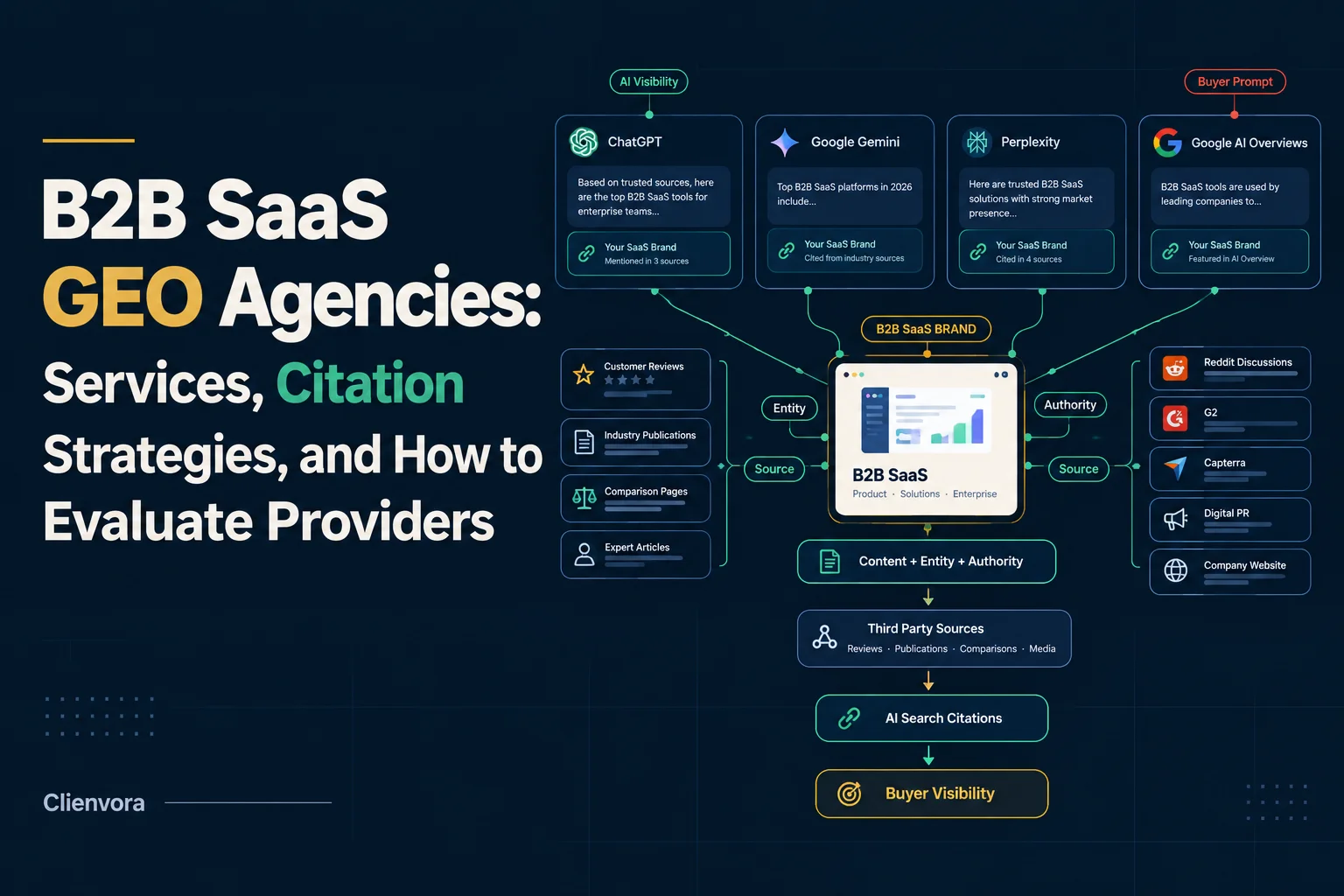
The six phases above are the same sequence Clienvora runs for clients: a retrievable site, useful information, a clear entity, independently verifiable claims, current content, and monthly measurement. See our SEO services or AI search optimization services, start with SEO copywriting services, or book a free AI visibility review. If you are comparing outside providers, our B2B SaaS GEO agencies guide covers services, costs, and evaluation questions.