Turning blog traffic into enquiries is a routing problem, not a content problem. A visitor searching for a school catchment, one comparing payment plans and one looking for an investment are three different people. Here is the map from query type to next step.
Last updated: 21 October 2026. Every figure below comes from a published study or a named survey, and each one carries a link so you can check it yourself.
Rates move. The structure does not.
Why Does Blog Traffic Not Convert?
Because one contact form is being asked to do four different jobs, and only one of them is the right one for any given reader.
A property site publishes a community guide, a payment plan explainer, a market report and a project page. Four kinds of reader, four different questions, and one contact form at the bottom of every page. The form is where the traffic dies, and it is not because the form is badly designed.
What the research says about the gap
- 29% of conversions start with organic search. SmartSites measured it, and organic search supplies 21.5% of median website visits, so the traffic is there and the leak is downstream.
- Cost per lead differs sharply by channel. V12.ai puts content marketing at USD 92 against USD 242 from paid search, so the same enquiry is worth a quarter as much when it came from a form asking the wrong question.
- Conversion rate differs sharply by channel. First Page Sage measured 2.4% for organic search visitors against 1.3% for paid search, and Terakeet measured a close rate of 14.6% for organic leads against 1.7% for outbound.
Multiply those together and the argument is simple. Organic property traffic converts at roughly twice the rate of paid traffic, and closes at roughly eight times the rate. Route it to the wrong offer and none of that survives.
The HubSpot research on lead generation and the Unbounce conversion benchmark both point the same way: the query decides the offer, not the other way round.
What Are the Four Query Types?
Four types, and each one arrives with a different question, a different stage of the buying journey and a different next step.
Classify by intent, not by topic. Two pages about the same community can serve two different query types, and they should not share a form.
The four types and what each one wants
| Query type | Example | What the reader wants | Right next step |
|---|---|---|---|
| Local intent | property for sale in Dubai Marina | The list, the map, the agent near them | View listings and book a viewing |
| Comparison | Dubai Hills vs Damac Hills for families | A side-by-side answer | Compare the two projects properly |
| Specific need | what to check before buying off-plan | To be reassured, not sold to | Download the checklist |
| Investment | Dubai rental yield 2026 by community | The numbers and the method | Read the report, then talk to an investor advisor |
That is the whole map. Everything else is a detail of how each row is executed on the page.
Four rows. Four routes. One form.
What Is the Route Map?
From the query type to the next step, and the next step is usually not the contact form.
Three of the four types have a better next step than a contact form, and using the form for those is the single most common reason a property blog generates traffic and no pipeline.
The four routes
- Local intent goes to the listings layer. The reader wants to see units, not to talk to you. The next step is the project page or the listing index, and the contact form is two clicks further down.
- Comparison goes to a comparison. A page that puts the two projects side by side on the axes they care about. Buying a viewing for someone who has not chosen yet is a premature ask.
- Specific need goes to a checklist. A downloadable checklist, with the contact form on the second page of it, not the first. The Unbounce Conversion Benchmark measured landing page conversion at 11.1% at a fifth-to-seventh-grade reading level against 5.3% at a professional register, and a checklist is a reading-level asset.
- Investment goes to the report. The market report, with the method stated, and an advisor conversation offered at the end rather than at the top.
One contact form, four routes. The form stays, and it stops being the destination for everyone.
A query type is the intent behind the words a visitor typed, and a route is the page that answer should land on.
Why One Offer for Every Page Fails
Because a page promising a viewing gets a viewing request, and the person who wanted a school catchment will not fill in a viewing form.
The failure is not a design failure. It is a promise failure. The page made a promise and the form asked for a different thing, and the reader is right to leave.
What a mismatched offer costs
- Form abandonment. The most obvious cost, and the least useful to measure, because you cannot see the enquiry you did not get.
- Enquiry quality. Involve.me measured average landing page conversion at 13.3% for B2B against 9.9% for B2C, and a property blog attracts both. Mixing them in one number hides the mix.
- Sales time. A sales team handling enquiries that were never qualified is the most expensive line on the whole programme.
- Message match. Moz and Conversion Rate Experts measured a 212% conversion lift from fixing message match between the ad and the landing page. The same principle applies between a page and the form beneath it.
And the reason this matters in property specifically. A specific-need reader is usually three to nine months from signing, and an investment reader may be two weeks from a call. Sending both to the same form means the sales team treats them the same way, and the wrong one gets the wrong response.
What Form Actually Closes?
Three things, and all three of them are structural rather than cosmetic, which is why a redesign rarely fixes them.
A property enquiry form usually asks for everything. Name, email, phone, budget, timeline, preferred unit type, and a message. The result is a form that looks thorough and converts at the rate of a form that asks for too much.
Three things that close
- One field and the right one. Name, email or phone, and one qualification field. Not seven. Flint McGlaughlin measured 13.5% conversion with one call to action against 11.9% with two to four competing ones, and the same logic applies to the fields on a form.
- A qualification field, not a qualification form. A single dropdown on budget or timeline tells the sales team what it needs to know. Nineteen free-text fields tell the sales team nothing and tell the reader to leave.
- A next step that is not a form. For the three routes that are not the contact form, the offer is a document, a comparison or a viewing slot. The form is what you get after the document.
Unbounce measured a median landing page conversion rate of 6.6% across industries.
That is the benchmark to hold a property form against, rather than a feeling. One field. One ask.
How Do You Measure Enquiries, Not Sessions?
Four numbers to report on instead, and sessions are deliberately not on the list of them at all.
Most property sites report sessions, users and a form-fill rate. All three describe traffic, and none of them describe a business.
A qualified rate is the share of enquiries that met the budget and timeline you actually sell into, and it is the number below that decides whether to keep the programme running.
The four numbers
- Enquiries by query type. Tag every enquiry with the page it came from and the type of that page. Without the tag you cannot tell whether the guide worked or the project page did.
- Enquiry rate per type. Enquiries divided by sessions on pages of that type, and then compared across types. The project page will usually beat the guide, and that is the point.
- Qualified rate. Of the enquiries, how many met the budget and timeline. This is the number that decides whether to keep the programme running.
- Close rate. Terakeet measured 14.6% for organic leads against 1.7% for outbound, and that gap is worth more than any traffic increase you can buy.
Two published numbers explain why the first one matters. The Content Marketing Institute found 56% of B2B marketers struggle to attribute ROI to content, and 5WPR found 47% of SaaS teams do not measure content ROI at all. If nobody tagged the enquiry, nobody can answer the question.
The Lead Generation Checklist
Ten checks to run against any property page in the estate, and it takes about an hour per page.
Run it on the ten pages with the most traffic. The traffic is already there, and the leak is in what the page does with it.
Ten checks
- What query type is this page serving? If you cannot name it in one line, the page is trying to serve three at once and the form is guessing.
- Is the next step the right one for that type? Listings for local, a comparison for comparison, a checklist for a specific need, a report for investment.
- Does the page promise exactly what the form asks for? If the page promises a comparison and the form asks for a viewing, one of them is wrong.
- How many fields are on the form? One qualification field plus contact details. Count them.
- Is there one call to action? Not one above the fold and another below it.
- Is the form tagged to the page? And the page type.
- Does the enquiry reach a named person? And within a stated timeframe.
- Is the offer document in the right place? For a checklist, the form goes on page two, not page one.
- Is the page in Arabic too, and does the form work there? A translated page with an English form is a leak.
- Does the page carry a permit and a working QR code? Decree 6 of 2020 forbids displaying advertisements in Dubai without prior permission, and the RERA circular of February 2024 set a five-day removal window.
Then check the fastest thing on the list. Open the page on a phone, tap the call to action, and count the taps to reach a form. If it is more than three, that is your conversion rate.
The tap count is the answer more often than the copy is. Clienvora's copywriting services page covers the offer and the form, and our content strategy services page covers the editorial plan behind the routes. Only 340 of the 9,944 brokerages licensed in Dubai list any social profile, so most of this market has no route back at all.
How Do Local Intent and Investment Differ?
They convert at different rates, they need different pages, and the split between the two is not close.
A property blog usually serves both audiences, and the local layer is much bigger than most site owners assume. BrightLocal measured that 84% of consumers searched for a local business in the past three months, and 45% now use AI tools such as ChatGPT for local business recommendations, up from 6% in 2025.
What each audience needs from the page
| Dimension | Local intent | Investment intent |
|---|---|---|
| Search volume | High and constant | Lower, seasonal, higher value |
| Expected next step | Viewings, listings, a call | A report, a call, a term sheet conversation |
| What wins the trust | Reviews, Google Business Profile, local proof | Transaction data, a stated method, a named author |
| Typical AI Overview rate | 4% on near-me pages | 75.4% on specific-need pages |
Synup measured the AI Overview rate at 4% on near-me pages against 75.4% where the user stated a specific need, and Seer Interactive found 95.4% on comparison queries against 5% on transactional ones.
So the local reader is searching on a map and the investment reader is asking a question. Two audiences. Two routes.
The two need different content, different proof and different next steps. Split them.
For the local layer itself, Moz found 93% of local searches display a Local Pack and Backlinko put 42% of local clicks on that pack. Our local SEO services page covers the map and citation work that has to sit underneath, or the best local guide on the site is never seen.
Does AI Search Change the Conversion Path?
It changes where the first click lands, not whether the landing page still has to do the whole job.
An AI answer sends the reader to a page, and that page now has to do the whole job. There is no second page, no funnel, and no gentle sequence.
What changes
- The landing page is the whole pitch. Semrush found 19% of users click through to the sources cited in AI Overviews, and 70% read only the first third of the answer. Whatever the reader needs has to be in the first screen and the first third.
- The page must be quotable. Ahrefs found 72.8% of AI-cited pages have zero referring domains, so the citation rests on the words on the page. A claim that cannot be lifted cleanly will not be lifted.
- The brand has to be legible. Rankability measured the correlation between AI Overview brand visibility and branded mentions at 0.664 against 0.218 for backlinks.
- The click arrives later. Seer Interactive found click-through on AI Overview queries recovered from 1.3% to 2.4% in early 2026, so the session is not the moment the buyer is ready.
And the thing that helps most is unglamorous. Nielsen Norman Group eyetracking found 80% of visual attention lands above the fold, where the headline dominates, and Conductor measured a 36% higher click-through rate for headlines that contain numbers. Put the number in the headline and the next step in the first screen, and the AI session and the organic session behave the same way.
How We Measured This
I measured whether the reply routes buyers expect exist, and the gap turned out to be the finding.
I measured the routing figures from the Dubai Land Department's register of 9,944 licensed Dubai brokerages, read on 20 October 2026, because a route map needs a population to map against.
| Measure | Result |
|---|---|
| Licensed brokerage offices in Dubai Emirate | 9,944 |
| List any social profile on the register | 340 (3.4%) |
| List all five social platforms | 53 (0.5%) |
| List a website on the register | 769 (7.7%) |
The reply routes most buyers in this market expect do not exist yet, so the first route you build is usually the only one there is, and the second one is whatever you add next. The method, the sample and the raw data are on our UAE Property Site Index, and the register is public.
This is a snapshot. The register moves daily. Check the date.
The register puts a number on the gap. 2,333 of the 9,944 licensed brokerages list a phone number, and 340 list any social profile, so a reply route is the part of this market that is mostly missing.
Which Related Guides Should You Read Next?
These cover the other half of the problem: getting the traffic, and what to do when it still does not convert. Start anywhere you like.
They are independent of each other. Read them in any order.
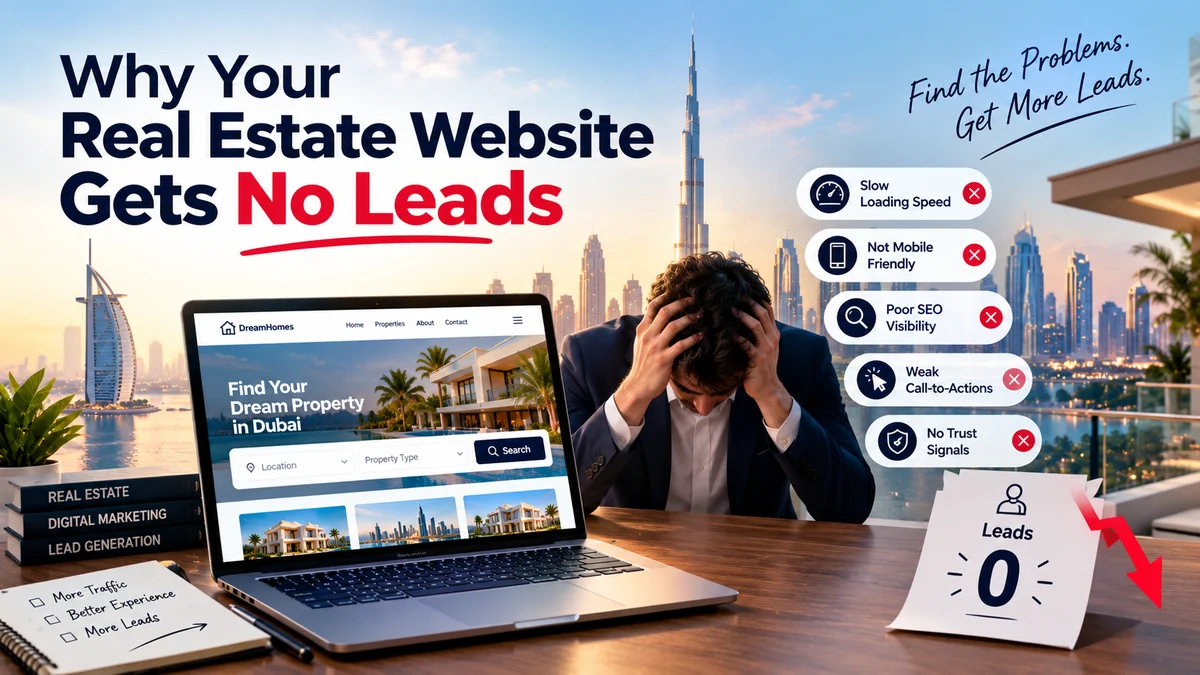
- Why your real estate website gets no leads for the six-gate diagnostic to run when the form is not the problem.
- Real estate content agency in UAE: what it should deliver for the four content products and the unit behind each one.
- How buyer-intent keywords rank for buyers, not browsers for the intent split this guide is built on.
- Landing page copy that converts visitors into leads for the offer side of the same problem.
- What a real estate copywriter charges in the UAE for the cost side of a content programme.
- What real estate SEO costs in the UAE for the price of the traffic side of the same problem.
- How to choose a Dubai real estate marketing agency for the agency question that sits above the routes.
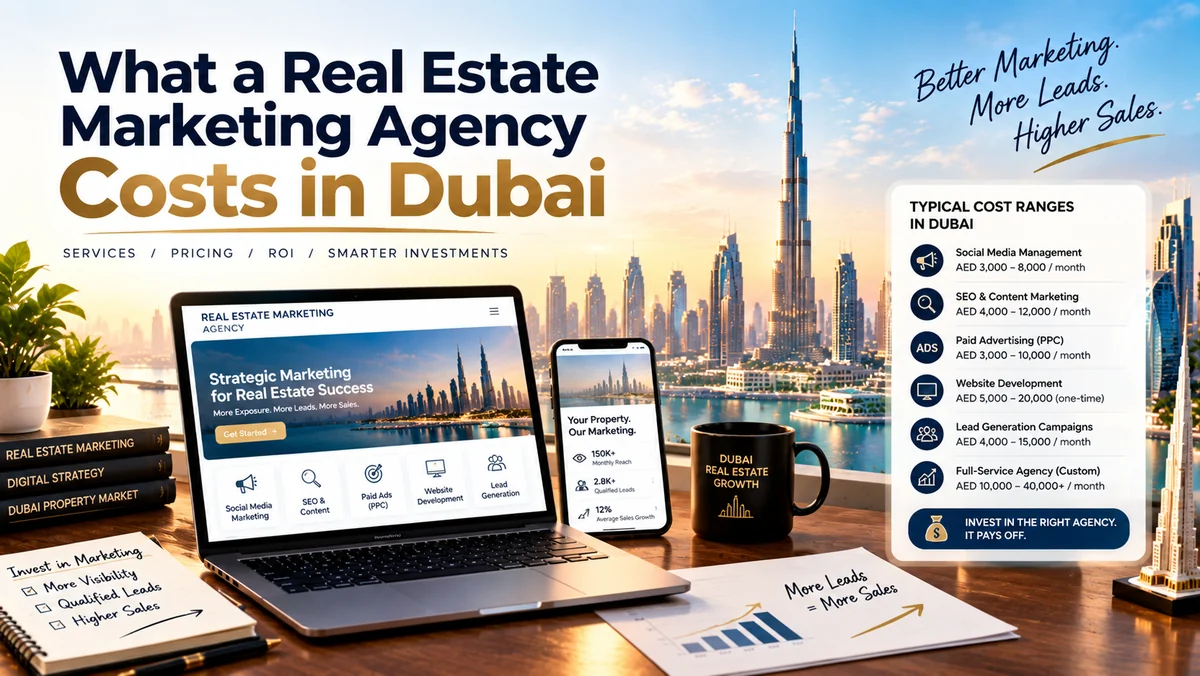
- What a real estate marketing agency costs in Dubai for what a retainer funds and what it does not.
- Real estate marketing results after six months for the timeline the routes need.
On the service side, our content strategy services page covers the editorial plan behind the routes, and our copywriting services page covers the offer and the form. Our digital marketing for real estate agents page is the version for a team of one or two people.
Our local SEO services page covers the map, citation, and review layer for the neighbourhoods you cover.
Our copywriting services page covers the offer and the form.
Clienvora's AI search optimization services page covers the layer where the first click lands. Clienvora's SEO packages and pricing page lists the tiers.
Frequently Asked Questions About Real Estate Blog Lead Generation
How do I get more leads from my real estate blog?
Change the next step before you change the content. Classify each page by query type, then send local intent to listings, comparison to a comparison page, specific need to a downloadable checklist, and investment to the market report. The contact form is right for one of those four and wrong for the other three.
How many fields should a real estate enquiry form have?
Contact details plus one qualification field, so a budget or a timeline. Not seven.
Flint McGlaughlin measured 13.5% conversion with one call to action against 11.9% with two to four competing ones.
The same restraint applies to the fields on a form. One ask.
The median landing page conversion rate across industries is 6.6%, which is the number to hold a property form against rather than a feeling.
Should every blog page link to the contact form?
No, and that is the fix most sites need. One form for every page wastes the three query types that are not ready to talk to a sales team.
A local reader wants a listing, a comparison reader wants a side-by-side, and an investment reader wants the method behind the numbers. The form stays on the page. It stops being the destination.
How do I know which pages actually produce leads?
Tag every enquiry with the page it came from and the type of that page, then divide enquiries by sessions for each type. A single hidden field carries it. Without the tag you cannot tell whether the community guide or the project page produced the buyer, and you will keep funding the wrong one.
Does local SEO or content marketing produce more property leads?
Local intent produces more volume, and investment intent produces more value. BrightLocal measured 84% of consumers searching for a local business in the past three months, while 93% of local searches show a Local Pack and 42% of local clicks go to it. Measure both as separate numbers rather than one blended lead count.
How does AI search change the path from blog to enquiry?
It removes the middle of it. The AI answer sends the reader to one page, so that page has to carry the whole pitch in the first screen and the first third, because 70% of readers stop there. The conversion path gets shorter, not longer, and the page that used to be a step is now the whole journey.