TL;DR: 9,944 brokerages hold a RERA licence in Dubai and 92.3% list no website, so most of a local market is invisible before SEO begins. The eight areas that move a property company from invisible to cited are technical access, location architecture, first-hand content, local signals, schema, AI-search readiness, honest measurement, and the decision rule for what earns its own page.
Why the Old Real Estate SEO Playbook No Longer Works
One page per city worked when Google ranked ten blue links; it fails when an AI reads forty pages that differ only by place name.
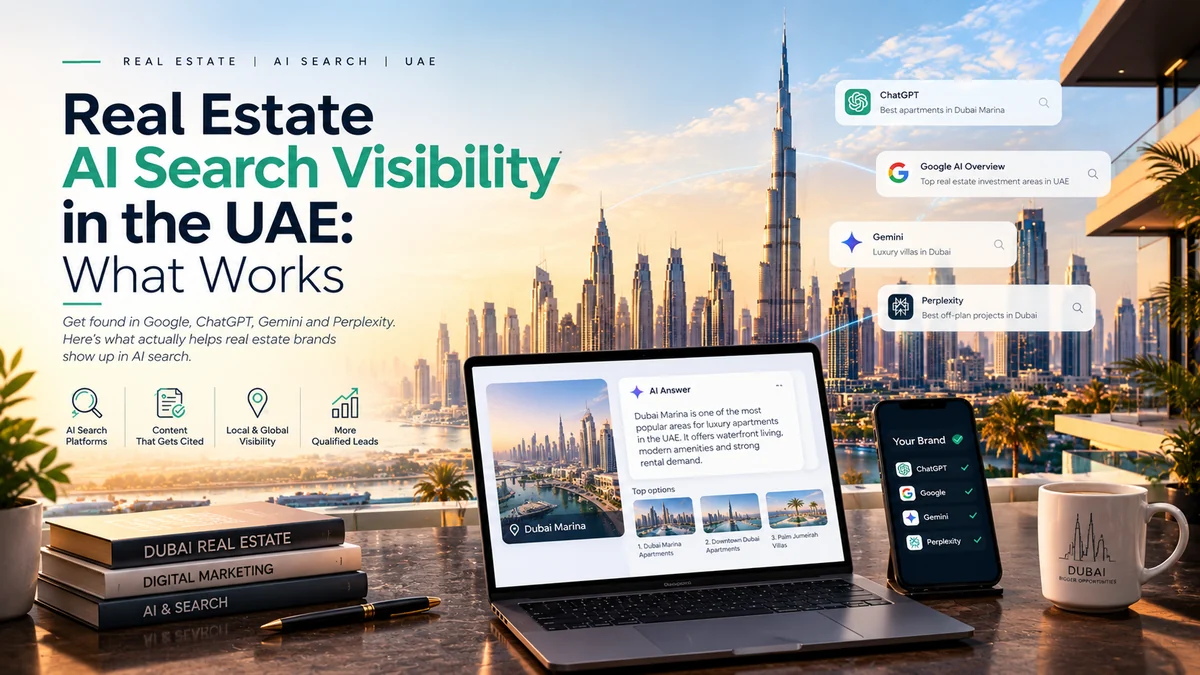
The question that now decides a property company's visibility is not "what ranks" but "what gets cited". Google AI Overviews, ChatGPT, Perplexity and Gemini answer buyer questions by quoting pages, and the pages they quote are the ones with verifiable numbers, first-hand market data, and a structure an answer engine can lift. Google's own documentation says there are no special requirements to appear in AI features; the requirements are the same foundation SEO always demanded, applied more strictly.
The stakes are measurable. Ahrefs tracked that 96.55% of all pages on the web get zero traffic from Google search, and found only 1.74% of new pages reach the top ten within their first year. Publishing more pages is not the answer for real estate; publishing the right pages, with the evidence to be cited, is.
| Then | Now | What changed |
|---|---|---|
| Ten blue links | AI Overviews, AI Mode, chat answers | The answer is synthesized and quoted, not clicked |
| Keyword stuffing | Entity depth and first-hand data | The model checks whether the page can support the claim |
| Backlinks as the main signal | Branded mentions and citability | Mentions correlate with AI visibility at 0.664 against 0.218 for backlinks |
| One page per city | A decision rule per location | Doorway pages are filtered for the same reason as always |
I wrote the eight sections below in the order the evidence says they matter, and I measured the UAE figures myself from the Dubai Land Department register on 20 October 2026, with the method, the sample and a downloadable dataset published on our UAE Property Site Index page. Each section states the rule, gives the number behind it, and links the original source.
What Technical Foundation Does an AI Need to Read?
An AI cannot cite a page it cannot crawl, and Googlebot and the AI crawlers share the same access problem.
A crawlable page is one a bot can fetch and read as text, and a faceted navigation trap is a filter system that generates infinite URL combinations, which wastes the crawl. Real estate sites have a specific weakness here: price, bedrooms, location, property type and sorting filters generate parameter URLs at scale, and Google warns that this "can generate infinite URL spaces" that waste crawl capacity and slow the discovery of genuinely new pages. The fix is a canonical on every filter URL, or a robots rule that keeps useless combinations out of the crawl queue.
The checklist an AI crawler needs
Measured on the Dubai market: 16.6% of licensed Dubai brokerage websites that answer a crawler refuse at least one AI crawler outright, while only 3.3% refuse Googlebot or Bingbot. A further 27.5% serve a different title or heading to an AI crawler than to a browser. The refusal is aimed at AI specifically, not at crawlers in general. Source: our crawl of 603 sites, 20 October 2026.
The technical checklist an AI engine needs from a property site is the same one Google has always required, now applied to a new set of readers:
- Renderable text. If the listing data only exists in JavaScript, an AI crawler sees an empty page. Google's guidance on AI features is explicit: important content must be available in textual form.
- A clean index. Every filter combination either carries a canonical or a 404; none should be a soft 404 that wastes the crawl.
- A current sitemap. New listings, new neighborhood pages and new market reports go in; withdrawn listings come out.
- Working canonicals. One URL per listing, per location, per property type. Semrush found 52% of websites publish duplicate content with no canonical tag.
- Server speed. Portent measured conversion at 3.05% for pages loading in one second against 0.41% for pages loading in five. A slow listing page costs enquiries before SEO even engages.
The deeper diagnostic for how crawl budget leaks through filters is covered in our faceted navigation crawl budget guide, and the wider technical layer in our technical SEO services.
How Do You Structure Location Pages Without Doorway Penalties?
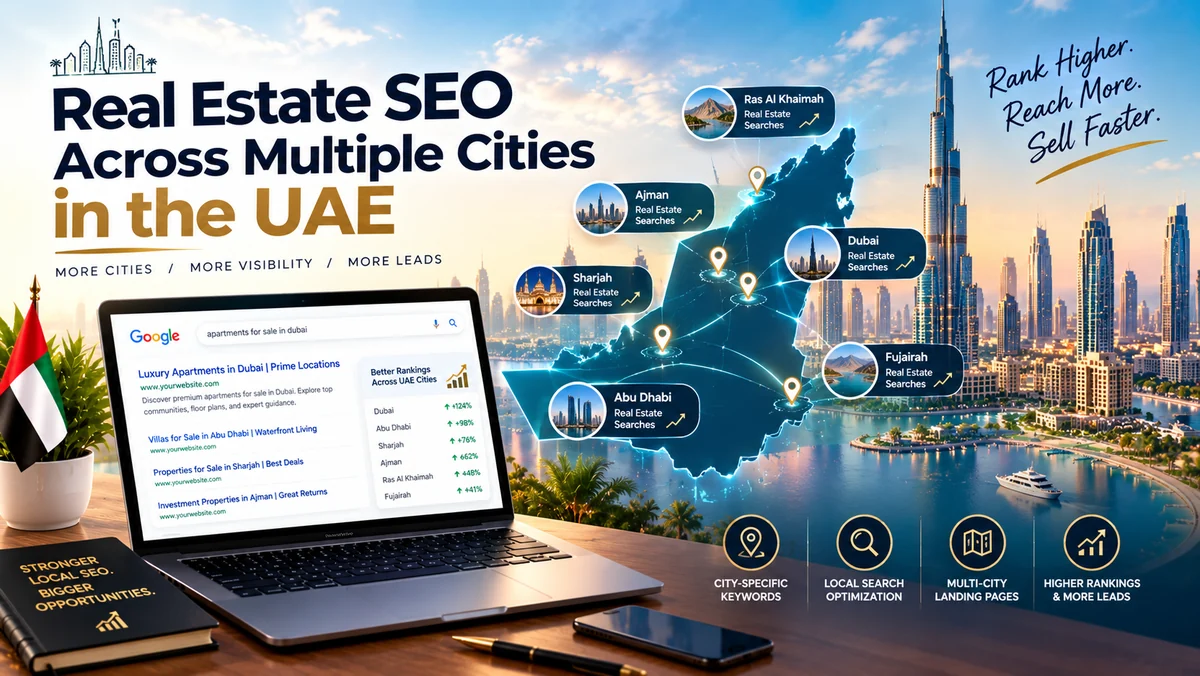
A location earns its own URL only when it passes three questions: real demand, genuinely different content, and a local operation behind it.
A doorway page is a page built to rank for a location rather than to be useful in it, and a hub page is the one strong page that carries every section beneath it. The single biggest real estate SEO mistake is a page per neighborhood with the name swapped in, and Google's doorway policy filters exactly that pattern. The rule that prevents it is the same one that protects your permit position in Dubai, because a page advertising a specific project carries different legal obligations than a page describing a market.
The three-question rule
- Is there real demand? Not "people search for the name", but "people search with intent to buy, sell or rent there". A transaction register shows the demand; a wishlist does not.
- Can the content genuinely differ? Commute, schools, service charges, competing stock and recent transactions. If the answer is the same paragraph with a different name, it is a section, not a page.
- Is there a local operation? A person on the ground, a registered office, a price base the content can cite. Google's local ranking guidance runs on relevance, distance and prominence, and prominence needs a real business behind it.
The four-level structure that survives both the doorway filter and the Dubai permit regime looks like this:
| Level | Unit | What it carries | Permit |
|---|---|---|---|
| Emirate | One page per emirate | Market overview, registries, submarkets, every project | None: a market guide is not an advertisement |
| City | One page per city that passes the three questions | City transactions, pipeline, local team | None: a market guide is not an advertisement |
| Community | One section per community, a page only on three yes answers | Commute, schools, service charges, competing stock, recent transactions | None: a market guide is not an advertisement |
| Project | One page per project | Unit matrix, payment plan, handover, availability, permit reference | Its own: AED 1,000 via Trakheesi |
Clienvora measured what this structure buys in practice: of the 472 licensed Dubai brokerage websites that served a page to our crawl, the median AI search visibility score is 32 out of 100, and the score is 32 for every RERA performance rank alike. A clear location hierarchy is the difference between a site an answer engine can read and one it cannot. The full decision rule, the Dubai permit logic and the checklist live in our multi-location real estate SEO guide.
What Content Earns a Citation From an AI Engine?
Content depth correlates with ranking at 0.62 while raw word count correlates at 0.18, so the four numbers are worth more than four extra paragraphs.
A citable block is a short, answer-first passage an answer engine can lift and credit, and it always carries a number, a named source and a date. The finding comes from a 100,000-page ranking factor study, and it matches what the AI engines actually quote. Perplexity and ChatGPT both cite the page that carries a number with a named source over the page that makes a claim without one. A market report with a transaction figure, a source and a date is quotable; a paragraph of adjectives is not.
Freshness is measurable. A six-month controlled test by ContentPulse, 40 pages against an untouched control group, found 55% more organic sessions on pages updated with fresh facts, and that AI Overviews cited fresh content 25.7% more often than stale content.
The format an AI engine quotes is short, answer-first and self-contained. A neighborhood page should open with a block that reads like this:
Downtown Dubai transacted AED 3.1 billion in the first quarter of 2026 across 1,240 sales, with the median price per square foot up 8.4% on the same quarter of 2025, per the Dubai Land Department register. The supply pipeline adds 1,900 units by handover in 2027. The schools, commute times, service charges and competing stock a buyer actually compares all live below.
Forty to sixty words, one number, one named source, and the scope stated up front. That is the unit an answer engine can lift and credit, and it is the difference between being the source and being the background. A blank page is the other extreme: four of the 92 sites in our deep audit scored a perfect PageSpeed 100 with a page weight under 2 KiB, because there was nothing on them to load. A parked domain is the fastest website in the market, and it is also the least citable.
Local SEO for Real Estate: The Signals Google Checks
Google ranks local results on relevance, distance and prominence, and complete and accurate business information is the precondition for all three.
The Google Business Profile guidance is the primary source for this, and the wording matters: the page summary says "popularity" while the detailed section says "Prominence", and that factor is built partly on links and partly on reviews. More reviews alone do not guarantee a ranking, but a profile that is complete, categorized correctly and consistent with the website is the entry ticket.
The signals that feed that profile
The signals that feed that profile are the same ones an AI answer about a local agent will check:
- Consistent NAP. Name, address and phone identical on the profile, the website and every directory. BrightLocal measured that 84% of consumers searched for a local business in the past three months.
- Accurate categories. "Real Estate Agent" or "Real Estate Agency", not the closest approximation.
- Reviews with responses. The prominence factor responds to volume, velocity and replies. BrightLocal also measured that 45% of consumers now use AI tools such as ChatGPT for local business recommendations.
- A real, verifiable operation. The profile must match the register and the licence. This is where a Dubai brokerage has an advantage that is entirely unclaimed.
The unclaimed local layer: of the 9,944 brokerages licensed by RERA in Dubai Emirate, 92.3% list no website on the regulator's register, 76.5% list no phone, and 96.6% list no social profile at all. Yet 99.7% publish a contact email. The missing website is a choice, not an inability to be reached. Source: Dubai Land Department register, read in full on 20 October 2026.
The practical mapping, citations and review layer sit under every location page you build. Our local SEO services cover that layer directly, and our local SEO content strategy guide shows how the content underneath it earns traffic beyond the map pack.
Real Estate Schema: The Entity Layer AI Engines Read
Schema is the weakest signal in the entire Dubai market, and it is the cheapest to fix, because the entity layer an AI reads is mostly absent.
Google documents what structured data is for in its LocalBusiness documentation: it communicates business details to the systems that read pages, and it must match the visible text on the page. An AI engine reading a listing without schema has to guess which parts are the address, the price and the property type; with schema, it reads them directly.
The market's weakest module: the average structured data score across the 472 licensed Dubai brokerage websites we measured is 9.4 out of 100, the lowest of every module we scored. For comparison, the average llms.txt readiness score is 30.2 and the average citability score is 22.7. The entity layer an AI answer would read is mostly absent. Source: Clienvora crawl, 20 October 2026.
The types that matter, in priority order
- RealEstateAgent or RealEstateOrganization on every page of the site, with the same NAP as the profile.
- SingleFamilyResidence, Apartment or the property subtype on each listing, with offers, price and address as sub-entities.
- FAQPage on location and service pages, synced to the visible questions. Google is explicit that structured data must match what the reader sees.
- BreadcrumbList on every listing, so the path from emirate to city to community is machine-readable.
A minimal agent declaration that follows the schema.org vocabulary and Google's LocalBusiness guidance:
The same entity logic that feeds Google's LocalBusiness types is what an AI engine reads when it answers "who should I trust for a property in this neighborhood". Our llms.txt guide covers the file layer that sits next to schema for AI crawlers.
AI Search Visibility in 2026: What a Citation Is Worth
A citation is mostly a brand impression, not a click, and branded mentions matter more than backlinks for earning it.
Ahrefs measured the correlation between AI Overview brand visibility and branded mentions at 0.664 against 0.218 for backlinks, and Rankability found that 72.8% of AI-cited pages have zero referring domains. The citation rests on the page content, not the link profile. The click that follows arrives later: Seer Interactive tracked click-through on AI Overview queries recovering from 1.3% to 2.4% in early 2026, so a page earns its traffic months after it earns the mention.
This is where the first-party measurement matters most. Web Tonic's widely quoted figure, that only 8.4% of agents are optimized or cited in AI search, is secondhand. Ours is a crawl:
The quotable market: of the 472 licensed Dubai brokerage websites we measured, only 26, or 5.5%, score high enough on citability for an AI engine to quote them. A further 89, or 18.9%, reach the mid-range. Citability here means the page carries a TL;DR or summary, a FAQ block, numbered structure, source links and clear definitions, exactly the format an answer engine lifts. Source: Clienvora measurement, 20 October 2026.
Why only 5.5% of the market is quotable
What that means for a property company is an opening, not a verdict. 94.5% of the measured market is not even quotable, and the fixes are the eight sections in this guide. The entity layer, the location structure, the data-backed content and the technical access are all within reach, and the barrier is effort, not budget.
The UAE-specific picture, including what a citation is actually worth when the portals own the listing layer, is covered in our real estate AI search visibility guide, and the wider GEO method in our AI search optimization services.
How to Measure Real Estate SEO in 2026
SEO is a business strategy with measurable goals, and traffic is a vanity metric when the enquiry source is unknown.
Google's own guidance on evaluating SEO claims is the right frame: treat third-party advice as a claim to verify, and use Search Console as the first-party record. For a property company the KPI set should answer one question, where did the enquiry come from.
| KPI | What it measures | Tool |
|---|---|---|
| Qualified organic enquiries | Forms, calls, viewings from organic landing pages | CRM source tags |
| AI visibility score | Whether a page is quotable and cited | Clienvora crawl or geo-audit |
| Local pack CTR | Profile clicks against impressions | Google Business Profile |
| Listing page conversion | Enquiry rate per listing view | Analytics events |
| Indexed location pages | Which of your location pages exist in the index | Search Console |
The KPI set that survives an audit
The reporting habit that protects the budget is to record the sample and the date next to every number. That is how we treat the figures in this guide, and it is why the UAE Property Site Index publishes the register source, the crawl date, the tool, the exclusions and the limitations rather than a bare claim. A number with a method is evidence; a number without one is a guess that an AI engine will eventually stop quoting.
How to update this guide: the register figures and the crawl scores are refreshed when we re-run the index, and the last-reviewed date changes with each version. The maintenance rule is simple, keep the transaction figures current or the page stops being quotable.
The 2026 Real Estate SEO Checklist
Twelve checks against your property site, each one a citation-relevant fix. Run them on the pages you already have, not the ones you are planning.
The target is measurable: only 26 of the 472 sites we measured, 5.5%, score high enough on citability for an AI engine to quote them.
- Does an AI crawler get the same page a browser gets? 16.6% of UAE brokerage sites refuse an AI crawler and 27.5% serve a different page. If yours does, nothing else matters.
- Is every filter URL canonicalized or blocked? Price, bedrooms, location and property-type filters can generate infinite URL spaces. Google's guidance on faceted navigation is the reference.
- Is the important content available as text? If listings exist only in JavaScript, an AI crawler reads an empty page, per Google's AI features guidance.
- Does each location page pass the three-question rule? Real demand, genuinely different content, a local operation. Everything else is a section.
- Does the page carry a number a competitor cannot copy? A transaction figure with a date and a source beats forty adjectives; content depth correlates with ranking at 0.62 against 0.18 for word count.
- Is there a 40 to 60 word answer block at the top of each money page? One number, one named source. That is the unit an answer engine lifts.
- Is the Google Business Profile complete and consistent? NAP matches the site, category accurate, reviews with responses. Google's local ranking guidance runs on relevance, distance and prominence.
- Is RealEstateAgent schema on every page? The mean schema score across 472 UAE brokerage sites is 9.4 of 100, the weakest signal in the market.
- Is llms.txt published? The mean readiness score is 30.2 of 100, and the file is a ten-minute setup. Our llms.txt guide covers it.
- Does the page have a FAQ block synced to its structured data? Google requires structured data to match the visible text; a synced FAQ is quotable.
- Is the page fast on a phone? Portent measured conversion at 3.05% at one second against 0.41% at five.
- Is the enquiry tagged to the page that produced it? If you cannot say which page earns the lead, you cannot say which check paid off.
Run the checks and re-measure with the method behind the 5.5% figure. A site scoring 50 or above sits in the top 5.5% of its market; the dataset is downloadable on our UAE Property Site Index page.
Which Related Guides Should You Read Next?
The eight sections above each have a specialist guide underneath them, and the hierarchy runs the same direction in every case.
- Real estate SEO across multiple cities in the UAE for the full location decision rule, the permit logic and the checklist.
- Real estate AI search visibility in the UAE for what a citation is actually worth and who owns the listing layer.
- Faceted navigation and crawl budget for the filter URL problem in the technical section.
- Setting up llms.txt for the file layer that sits next to schema.
- Local SEO content strategy for how the local layer earns traffic beyond the map pack.
- Turning real estate blog traffic into enquiries for what a location page should do once it is found.
- What real estate SEO services cost in the UAE for the cost drivers and the four published retainer bands.
On the service side, our commercial real estate SEO services page covers the listing and location structure itself, and SEO services covers the wider engagement, with SEO packages and pricing listing the tiers.
Frequently Asked Questions About Real Estate SEO in 2026
How should a real estate company improve its SEO in 2026?
Fix the technical base an AI can crawl, apply the three-question rule to location pages, publish first-hand market data with linked sources, and add real estate schema. Of 472 Dubai brokerage sites we measured, only 26, or 5.5%, are quotable by an AI engine, so the market is still wide open. Then measure enquiries, not traffic.
Is one page per city a doorway page?
It is when the pages are interchangeable. If the only difference is the location name, it is one page wearing four names, and Google's doorway policy filters it. Three questions decide it: real local demand, genuinely different content, and a local operation behind it. Everything else stays a section on the hub page.
Does real estate SEO still work now that AI answers questions?
Yes, and Google says there are no special requirements for AI features beyond the foundation. The rules tightened, not changed: pages need first-hand data, linked sources, schema that matches the visible text, and a structure an answer engine can quote. Branded mentions now matter more than backlinks for AI visibility.
Do location pages need advertising permits in the UAE?
Different levels, different rules. A project page does, because it advertises a specific property, and the Dubai Land Department issues the permit through Trakheesi at AED 1,000. A city page or community section that only describes a market advertises no unit, so on our reading of the DLD rules it does not trigger a permit. Decree 6 of 2020 prohibits ads in Dubai without prior permission.
How long does real estate SEO take to show results?
Technical fixes show in 4 to 8 weeks because Google re-measures them continuously, while content and authority gains wait for the next core update cycle, typically every 6 to 12 weeks in 2026. A realistic first measurement point is one quarter, and a defensible business case runs on three.
What is the most important SEO factor for a property company?
First-hand data that a reader, a search engine and an AI can all verify. Content depth correlates with ranking at 0.62 against 0.18 for word count, and the same depth is what gets a page quoted. A transaction figure with a named source beats forty paragraphs of adjectives.