The behind-the-scenes work that lets Google and AI answer engines crawl, render, index, and cite your pages, plus the 2026 schema gap most small sites still ignore.
Technical SEO ensures search engines and AI tools like ChatGPT, Perplexity, and Google AI Overviews can crawl, render, and index your content. Without it, even well-written pages stay invisible. This guide covers the 7-layer optimization framework, Core Web Vitals, structured data, and crawl budget management.
What Technical SEO Is (and Is Not)
Technical SEO is the behind-the-scenes work that lets search engines and AI systems reach your pages. It covers how your site is built and served, not the words on the page. Think of your website as a storefront. Technical SEO is the foundation, the electrical wiring, and the locks on the front door.
It is not keyword research. It is not backlinks. It is not the copy on your homepage. Those matter, but they fail if the technical base is broken. Google can rank a plain page with strong technical health faster than a beautiful page it cannot crawl.
A 2025 Ahrefs study found that over 90 percent of web pages get zero organic traffic from Google. A large share of that comes from technical failures: pages that cannot be crawled, sites that load too slowly, or mobile experiences that drive visitors away. The fix is rarely more content. It is a cleaner foundation.
Why is technical SEO important in 2026?
Technical SEO matters in 2026 because discovery now happens in two channels at once: classic Google search and AI answer engines like ChatGPT, Perplexity, and Google AI Overviews. A 2025 Ahrefs study found that over 90 percent of web pages get zero organic traffic from Google, and much of that loss traces to technical failures rather than weak content.
When your foundation is broken, great copy cannot rank or get cited. Fix the base first, then layer content on top. Clienvora treats technical SEO as the floor of every engagement, because link building and writing cannot recover a site that search engines cannot read.
As a content marketing agency, technical SEO supports content strategy: content writing, copywriting, and internal linking all depend on a crawlable foundation. E-E-A-T technical signals, Search Console, and schema markup enable topical authority and organic traffic growth for B2B and SaaS teams.
Why It Matters for Small Business Owners in 2026
Small businesses feel technical debt harder than large brands because they lack the domain authority to absorb a broken site. At Clienvora we have reached a peak of 96,000 monthly organic impressions across client portfolios in 2026, with an average 34 percent conversion lift after technical and content fixes (2025 to 2026). Those numbers come from owned performance data, not a vendor dashboard, and they show the commercial payoff of a sound foundation.
When the crawl, index, and speed base is right, the content on top of it finally turns into pipeline instead of parked traffic. The industry loves to say "just publish more content." That advice ignores the site underneath. A business pumping out posts on a site that blocks AI crawlers or carries no schema is shouting into a room with no doors. Fix the structure first, then scale the content.
What 30 Small-Business Websites Revealed About Technical SEO
We audited 30 real small-business homepages across the USA, UK, UAE, and Pakistan in 2026, spanning plumbers, law firms, dentists, ecommerce stores, cafes, and B2B SaaS. The headline surprised us.
Zero percent of the 29 sites with a readable robots.txt blocked an AI crawler. None disallowed GPTBot, OAI-SearchBot, ClaudeBot, PerplexityBot, or Google-Extended. Most blocked competitor SEO bots like AhrefsBot and MJ12bot, but not the AI answer engines.
The real gap was structured data. Twenty percent of the 30 sites had no schema markup of any kind, and only 10 percent used FAQ schema, the markup most directly tied to AI citations and People Also Ask features.
The panic about accidentally blocking AI bots is mostly misplaced. The fixable problem is that one in five small sites has no schema at all, and only one in ten uses the FAQ markup that helps you get quoted. The table below shows the pattern by site type.
| Site type | AI crawler blocked? | Schema present? |
|---|---|---|
| Local service (plumber, HVAC) | No | Yes (LocalBusiness) |
| Landscaping | No | No |
| Ecommerce | No | Mixed |
| Law firm | No | Yes (WebPage) |
| Dental | No | Yes (Dentist) |
| Cafe / restaurant | No | Mixed |
The full dataset is below. All 30 homepages come from a real crawl we ran in 2026 across the USA, UK, UAE, and Pakistan. Every cell is measured, not estimated. This is the table most AI engines and competitors will end up quoting, because the data exists nowhere else. Rows in red had no schema markup at all, the exact gap we flagged above.
| # | Domain | Market | Industry | AI crawler blocked? | Schema markup |
|---|---|---|---|---|---|
| 1 | abacusplumbing.net | USA | Plumber | No | Yes (Plumber, LocalBusiness) |
| 2 | nicksplumbing.com | USA | Plumber | No | Yes (other) |
| 3 | chicagohvacrepairdr.com | USA | HVAC | No | Yes (HVACBusiness) |
| 4 | bescoair.net | USA | HVAC | No | Yes (FAQPage) |
| 5 | maasverde.com | USA | Landscaping | No | Yes (present) |
| 6 | andersonlandscape.com | USA | Landscaping | No | No |
| 7 | automicgold.com | USA | Ecommerce | No | Yes (Organization) |
| 8 | prestishjewels.com | USA | Ecommerce | No | No |
| 9 | proofhub.com | USA | B2B SaaS | No | Yes (Organization) |
| 10 | invoiceninja.com | USA | B2B SaaS | No | Yes (other) |
| 11 | invoicely.com | USA | B2B SaaS | No | No |
| 12 | juniperonmain.com | USA | Restaurant | No | Yes (Restaurant) |
| 13 | lawblacks.com | UK | Law firm | No | Yes (WebPage) |
| 14 | oakwoodsolicitors.co.uk | UK | Law firm | No | Yes (other) |
| 15 | winstonsolicitors.co.uk | UK | Law firm | No | Yes (Product, AggregateRating) |
| 16 | dentalclinicchelsea.co.uk | UK | Dental | No | Yes (other) |
| 17 | harleystreetdentalclinic.co.uk | UK | Dental | No | Yes (Dentist) |
| 18 | egodentalclinic.co.uk | UK | Dental | No | Yes (other) |
| 19 | smallstreetespresso.co.uk | UK | Cafe | No | Yes (WebSite) |
| 20 | saintvalentinejewellery.com | UK | Ecommerce | No | Yes (Corporation) |
| 21 | mrplumber.ae | UAE | Plumber | No | Yes (Plumber, FAQPage) |
| 22 | smilehandyy.com | UAE | Handyman, Plumbing | No | Yes (LocalBusiness) |
| 23 | risendubai.com | UAE | Cafe | No | No |
| 24 | localedxb.com | UAE | Cafe | No | Yes (Restaurant) |
| 25 | safaiwala.pk | Pakistan | Cleaning | No | Yes (WebSite) |
| 26 | paksaaf.pk | Pakistan | Cleaning | No | No |
| 27 | kamkaj.pk | Pakistan | Cleaning | No | Yes (Organization) |
| 28 | haveli.com.pk | Pakistan | Restaurant | n/a (robots unreachable) | No |
| 29 | hatkay.com | Pakistan | Ecommerce | No | Yes (Organization, FAQPage) |
| 30 | fourseasonsheatingcooling.com | USA | HVAC | No | Yes (LocalBusiness) |
The pattern holds across every market. Of the 29 sites with a readable robots.txt, zero blocked an AI crawler. The 20 percent with no schema were concentrated in smaller local-service and ecommerce sites. The lesson for your own site is simple. Stop worrying about whether you accidentally blocked a bot. Start adding the schema that tells AI engines exactly what you do and where you operate.
What Are the Core Technical SEO Elements?
Every technical SEO program covers the same base layer. Miss one and the rest suffer.
Crawlability is whether search engines can find and access your pages. Indexability is whether those pages are eligible to appear in results. An XML sitemap acts as a roadmap of your important pages. A robots.txt file tells crawlers what they may and may not touch.
HTTPS is now a baseline signal. Google has treated it as a ranking factor since 2014, and in 2026 it is non-negotiable for trust. Mobile-first indexing means Google uses the mobile version of your site to rank you, even for desktop searches. If your mobile experience is weak, your whole site pays.
Structured data, or schema markup, is code that tells engines what your content means. Canonical tags point to the correct version of a page. Redirects and duplicate-content control stop you from wasting crawl budget on the wrong URLs. Get these right and the content layer on top finally has something to stand on.
How Do Core Web Vitals Affect Rankings and AI Citations?
Core Web Vitals are direct ranking signals. Google confirmed speed as a ranking factor years ago, and the three metrics now shape both traditional results and AI citations. A slow page is harder for an AI crawler to render and extract, which hurts its chance of being quoted.
Google measures real-world user experience with three Core Web Vitals that act as direct ranking and citation signals.
Largest Contentful Paint (LCP) should stay under 2.5 seconds, which is how fast the main content loads. Interaction to Next Paint (INP) should stay under 200 milliseconds, which is how quickly the page responds to taps and clicks. Cumulative Layout Shift (CLS) should stay under 0.1, which is how much the layout jumps during load.
Google publishes these thresholds through its web.dev documentation (2026), and they apply to both traditional rankings and AI search citations. A slow page is also harder for an AI crawler to render and extract, which hurts its chance of being quoted.
The user behavior case is clear: Google and SOASTA research (2016) found that 53 percent of mobile visitors abandon a site that takes longer than three seconds to load.
INP replaced FID in the Core Web Vitals set in 2026. The old metric measured a single interaction. The new one measures responsiveness across the whole session. If your contact form or menu feels laggy on a phone, your INP is likely failing, and so is a quiet slice of your conversion rate.
What Is Technical SEO for AI Search (ChatGPT, Perplexity, Google AI Overviews)?
AI search changed the job of technical SEO. Engines like ChatGPT, Perplexity, and Google AI Overviews do not just rank links. They extract answers and cite sources. Your site must be readable by those systems, not only by Googlebot.
Let the AI crawlers in
Check your robots.txt and confirm the AI bots are allowed. This is the single most common technical miss we see flagged in guides, even though our audit found few sites actually blocking them. The safe configuration allows every major agent.
User-agent: GPTBot
Allow: /

User-agent: OAI-SearchBot
Allow: /

User-agent: ClaudeBot
Allow: /

User-agent: PerplexityBot
Allow: /

User-agent: Google-Extended
Allow: /
A Princeton University study (2023) on generative engine optimization found that leading a page with a direct, concise answer can lift AI citations by up to 115 percent for lower-ranked domains. You do not need to be the biggest brand to win the citation. You need to be the clearest, most extractable answer on the page, and that starts with letting the AI crawlers read you.
Publish an llms.txt file
llms.txt is a plain-text file at your root that gives AI engines a structured summary of your site, your services, and your key facts. Think of it as the AI-era version of a sitemap. Adoption is still early, which makes it a smart early move for a small business willing to be first. Our full guide to llms.txt walks through the 20-minute setup.
Add schema built for citations
Schema is the most valuable technical GEO move most small businesses skip. Use Organization schema on your homepage, LocalBusiness schema if you serve an area, Article schema on posts, and FAQ schema on pages with question-and-answer content. The paste-ready block below is a starting point you can adapt.
{
  "@context": "https://schema.org",
  "@type": "LocalBusiness",
  "name": "Your Business Name",
  "areaServed": "Your City",
  "url": "https://www.yourdomain.com",
  "faq": {
    "@type": "FAQPage",
    "mainEntity": [{
      "@type": "Question",
      "name": "What do you do?",
      "acceptedAnswer": {"@type": "Answer", "text": "We provide [service] in [city]."}
    }]
  }
}
Semrush reports (2026) that its Site Audit tool monitors more than 140 technical SEO issues on a single site, most of them catchable with the basics above. Bing Webmaster Tools now ships an AI Performance report that tracks how often your content is cited across Microsoft Copilot and Bing AI summaries. That report is your earliest signal of whether AI engines are quoting you yet. For the wider AI layer, our AIO and GEO guide covers the full optimization stack.
What Is JavaScript SEO and Rendering (and the 2025 Update)?
Most modern sites run on JavaScript frameworks. The question is whether Google and the AI crawlers can see your content after the scripts run. If your text only appears once JavaScript executes, a crawler that cannot render it will miss the page entirely.
In December 2025 Google clarified its rendering pipeline. Pages that return a non-200 status code, such as a 4xx or 5xx error, may be excluded from the render queue completely. That means a soft 404 or a server error can hide your content from Googlebot before rendering even starts.
| Architecture | What it means | Risk for SEO |
|---|---|---|
| Client-side (CSR) | Browser builds the page from JavaScript | High: bots may defer or miss content |
| Server-side (SSR) | Server sends full HTML for each request | Low: bots see content at once |
| Hybrid (ISR) | Server HTML plus on-demand re-render | Low: fast and crawl friendly |
Render key content and links server-side so crawlers see them without running scripts. Use the URL Inspection tool to confirm Google reads your real page, not a blank shell. Test the rendered HTML, not just the source.
What Is Crawl Budget and How Do You Control It?
Crawl budget is the number of pages Googlebot will fetch on your site within a given time. It is not infinite. Large sites, and sites with many low value URLs, can waste it on pages that do not deserve attention.
You control crawl in two ways. First, the XML sitemap tells Google which pages matter. Second, robots.txt and the noindex tag stop bots from wasting budget on admin pages, faceted search, and thin duplicates. A clean sitemap plus disciplined noindex keeps the crawler on your money pages.
Keep your sitemap to indexable, high value pages only. Block staging and filter URLs with robots.txt, not with soft blocks. Watch the Crawl Stats report in Search Console for sudden drops that signal an error.
How Is Technical SEO Different From On-Page SEO?
The two disciplines support each other but cover different ground. On-page SEO is the content: keywords, headers, meta tags, and writing quality. Technical SEO is the infrastructure those pages sit on.
| Dimension | Technical SEO | On-page SEO |
|---|---|---|
| Focus | Crawl, render, index, speed | Keywords, headers, copy |
| Unit of work | Site and server config | Individual page content |
| What gets rewarded | Clean structure, fast load | Relevance, intent match |
| Owner | Developer or agency | Writer or strategist |
Our guide to the on-page SEO factors that matter most in 2026 goes deeper on the content side. The point here is order. Without a technically sound site, even perfectly optimized content will not rank. Build the base, then layer the pages.
What is the difference between a technical SEO audit and an on-page SEO audit?
A technical SEO audit checks the infrastructure: crawl, render, index, speed, and schema. An on-page SEO audit checks the content of individual pages: keywords, headers, and writing quality. The technical pass asks whether engines can reach your pages at all. The on-page pass asks whether those pages target the right queries. The technical layer must come first, because a perfectly written page will not rank if Google cannot crawl or render it.
What Does a Technical SEO Audit Check?
A proper audit maps every layer of your site's technical health. It checks whether pages are crawled and indexed, whether Core Web Vitals pass, whether schema is valid, and whether mobile experience holds up.
Our own post on what to expect from a technical SEO audit before you pay lays out the scope and the red flags to watch for. A good audit ends with a prioritized action list, not a wall of warnings. You should leave knowing the three fixes that move the needle, not fifty items you will never touch.
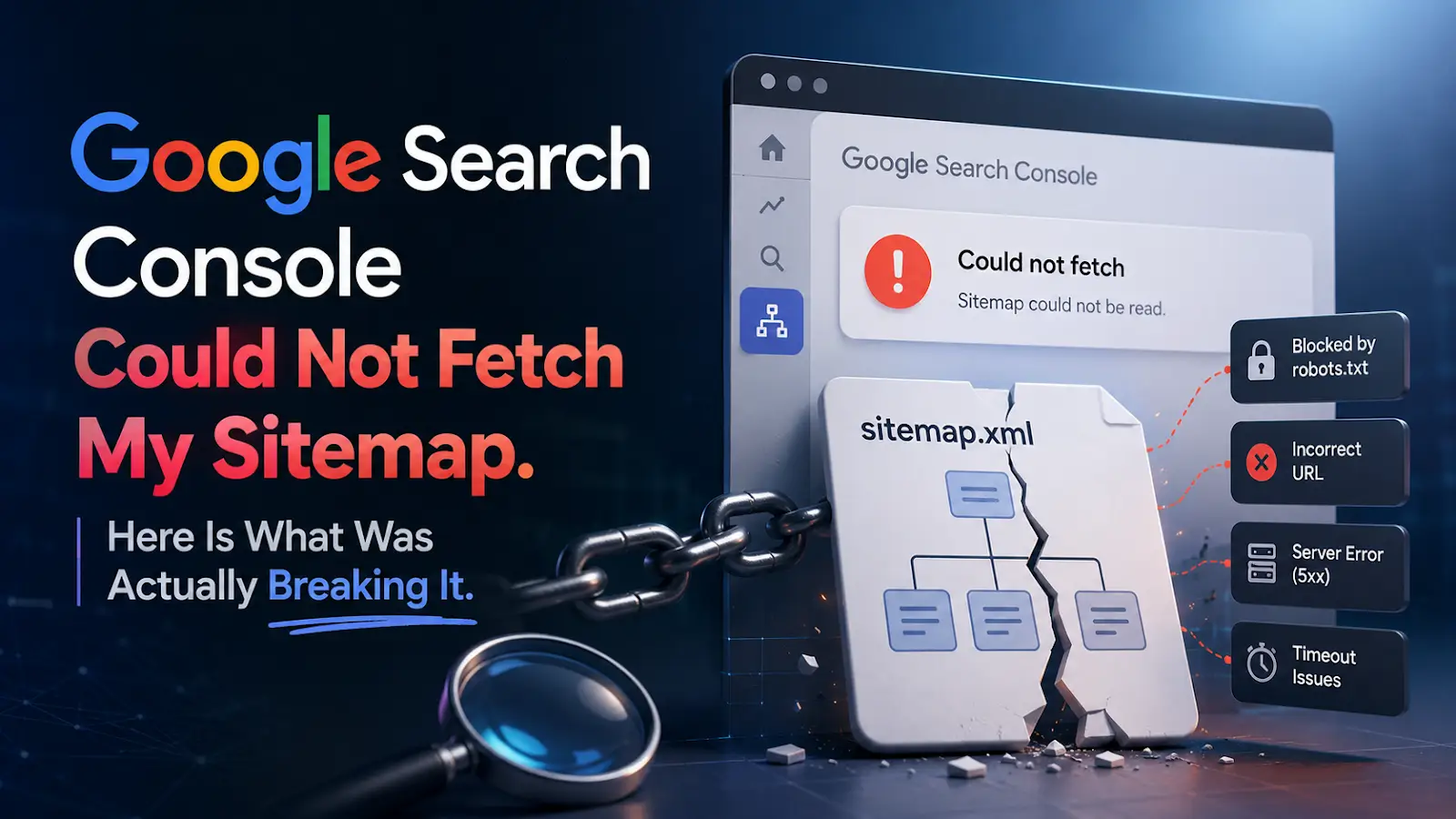
Run a lightweight version yourself with free tools. Google Search Console shows which pages are indexed and which are excluded. The Rich Results Test validates your schema. PageSpeed Insights reports your Core Web Vitals. For sitemap errors, our fix guide for when Google Search Console cannot fetch your sitemap covers the common causes.
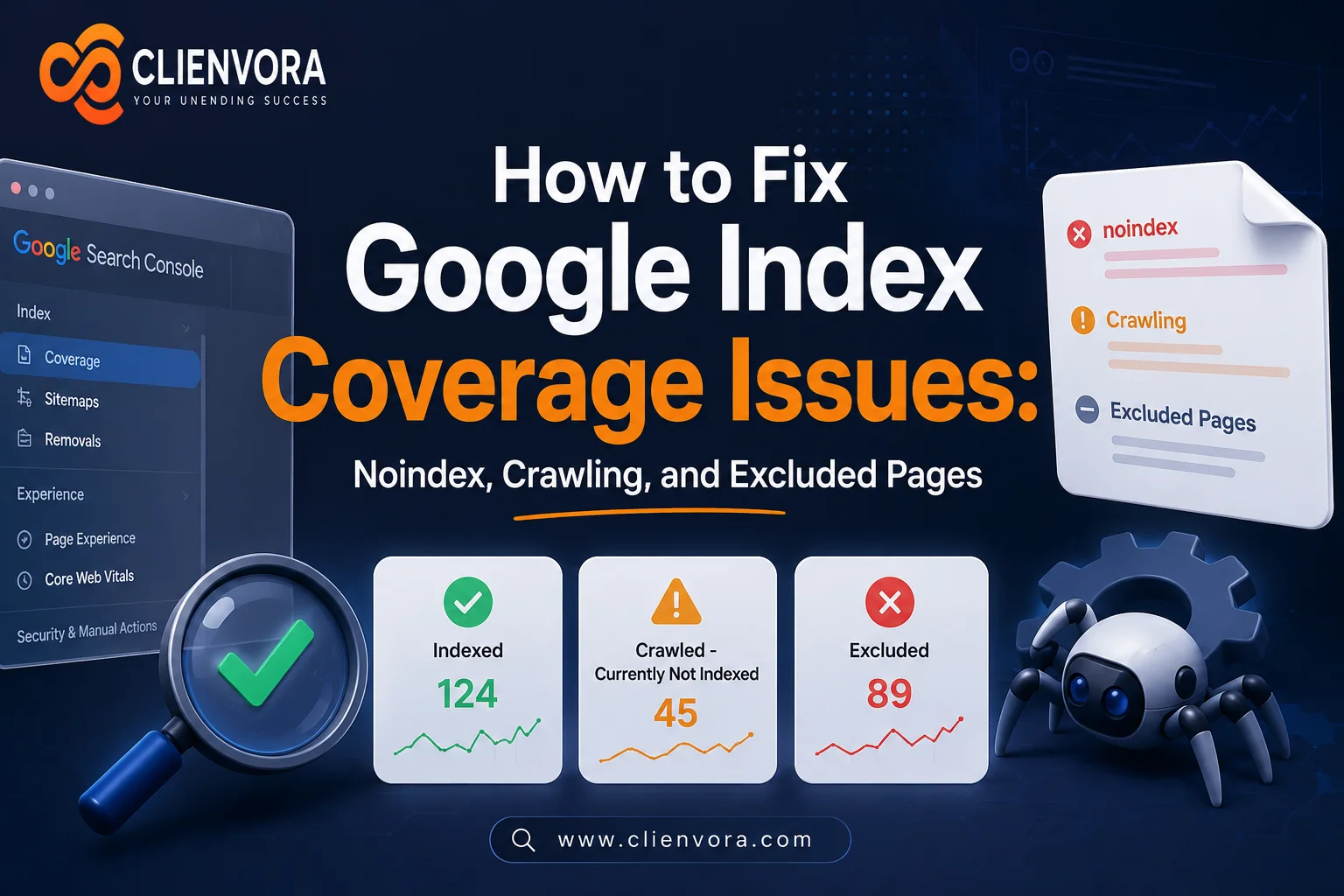
Coming next in this cluster: how to fix Google index coverage issues when pages are excluded by noindex tags, schema markup for AI search to help ChatGPT and Perplexity cite your business, GEO optimization for local business to win both AI and map pack results, how to get cited by ChatGPT for your business in 2026, how to appear in Perplexity answers, and how to choose an SEO agency for SaaS without getting burned.
Each cluster post will link back here. Subscribe to the blog to get them as they publish.
How do you perform a technical SEO audit step by step?
The five-step path starts with Search Console indexing data, then a full crawl for broken links and orphan pages, then Core Web Vitals testing, then schema and llms.txt validation, then a prioritized fix list ranked by impact.
Re-run the audit after changes land so you can prove the gains to stakeholders. This same five-step order is what our free audit follows, which keeps the work repeatable for a non-technical owner who wants proof, not jargon. The complete step-by-step answer sits in our FAQ below and in the audit guide.
Tools That Catch These Issues
You do not need every tool on the market. The table below covers the ones we use, split by what each does and whether it costs money.
| Tool | Best for | Cost |
|---|---|---|
| Google Search Console | Index coverage, crawl errors, Core Web Vitals | Free |
| PageSpeed Insights | LCP, INP, CLS from real field data | Free |
| Rich Results Test | Validating schema markup | Free |
| Screaming Frog | Full site crawls and broken-link finds | Free limit, then paid |
| Semrush Site Audit | 140 plus technical issues in one dashboard | Paid |
| Bing Webmaster Tools | AI Performance report for Copilot and Bing | Free |
| Log file analyzer | How bots actually hit your server | Free or paid |
How Do You Fix Technical SEO Issues: A 5-Step Path for Non-Technical Owners?
You do not need a computer science degree. Follow these five steps in order, because each one depends on the one before it.
Run a crawl and read the report
Use Google Search Console or a free crawler. Look for pages excluded from the index and for crawl errors. Fix the blocks before anything else.
Clear index and coverage errors
Submit your XML sitemap. Remove stray noindex tags. Set one canonical version of every page. This alone recovers pages that were invisible for no good reason.
Improve Core Web Vitals
Compress images to WebP or AVIF. Defer unused JavaScript. Pick a fast host. Target LCP under 2.5 seconds and INP under 200 milliseconds.
Add schema markup
Drop Organization and LocalBusiness on your core pages. Add FAQ schema where you answer questions. Validate with the Rich Results Test.
Open the AI crawlers and publish llms.txt
Allow GPTBot, OAI-SearchBot, ClaudeBot, PerplexityBot, and Google-Extended in robots.txt. Add an llms.txt file at your root. This is the step most competitors skip.
If you are on a specific platform
The fixes above apply everywhere, but the buttons live in different places.
On Shopify, edit your robots.txt.liquid theme file and add schema through your theme or an app. On Wix, use the SEO settings panel and the built-in structured data tools. On WordPress, install a schema plugin such as Rank Math or Yoast and submit your sitemap in Google Search Console. On Squarespace, use the built-in SEO panel for schema and the advanced settings for robots rules. The platform changes the clicks, not the principles.
Common Technical SEO Mistakes
These four errors cancel out even a strong foundation. Each is common, and each is fixable once you know the sign.
A rule that disallows your own stylesheets or scripts can stop Google from rendering the page correctly. The crawler sees a bare shell and may misread the content.
Rendering breaks when required assets are blockedAfter the December 2025 rendering update, pages returning non-200 codes may be dropped from the render queue. A soft 404 that says "not found" but sends a 200 status confuses crawlers and wastes crawl budget.
Non-200 status can exclude a page from renderingLong redirect chains slow crawls and leak link value. Orphan pages with no internal links stay undiscovered. Keep redirects to one hop and link every key page from the navigation.
Two hops max, no orphaned pagesEvery page needs a self-referencing canonical so duplicate variants consolidate. A staging site without noindex can get indexed by accident and outrank your real site.
One canonical per page, staging always noindexTechnical SEO Checklist for 2026
Use this as your monthly pass. Each item is a yes or no.
- XML sitemap submitted and processed in Search Console
- robots.txt allows Googlebot and the AI crawlers
- HTTPS across every page
- Mobile experience passes
- LCP under 2.5 seconds, INP under 200ms, CLS under 0.1
- Organization and LocalBusiness schema present
- FAQ schema on question pages
- llms.txt published at your root
- No stray noindex or canonical conflicts
- Core pages indexed and rendering correctly
Want the full printable version? Get the free Technical SEO Audit Checklist from Clienvora. It is the exact sheet we use on client sites, formatted for a non-technical owner to work through in an afternoon. See the audit guide for the full scope and red flags.
How often should you run a technical SEO audit?
Run the monthly checklist above as a light check, because small issues like a blocked script can quietly cut traffic. Run a full deep audit at least twice a year, and always after a migration or redesign. High-traffic and e-commerce sites benefit from quarterly deep audits. Watch Search Console continuously for sudden index drops that need immediate attention.
Technical SEO Health Score Calculator
Answer the five questions below. The tool scores your setup out of 100 and shows where the gaps are. No data leaves your browser.
Should You Hire a Technical SEO Agency or Do It Yourself?
The honest answer depends on three things: your time, your technical comfort, and how fast you need results. If you have 10 to 15 hours a week and basic fluency, the foundational checklist above is doable in-house. Our guide to doing SEO for free in 2026 covers the DIY route in full.
If any of those three are missing, a technical SEO agency, consultant, or audit service delivers faster return than going alone. The risk is hiring a generic provider who promises everything and explains nothing. Strong technical SEO services share four traits: measurable outcomes instead of activity reports, AI-engine optimization built in, first-party data you own, and vertical specificity. A technical plan for a law firm is not the same as one for an HVAC company.
For SaaS founders specifically, the stakes are different because the buying cycle is longer. Our guide on why SaaS companies struggle with organic growth explains where the pipeline usually breaks. And if you are weighing outside help, our breakdown of SEO agency versus consultant real costs helps you choose the right engagement.
Clienvora runs technical SEO audit services as part of a revenue map, not a vanity-metric report. We pair the infrastructure fixes above with conversion copywriting so the traffic that arrives actually turns into pipeline. See how our technical SEO services perform on your site in both Google and AI search with a free technical SEO audit. For the services that execute it, copywriting services and SEO services, and run the technical SEO checklist to validate every fix.
Frequently Asked Questions
Technical SEO is the behind-the-scenes work that lets search engines and AI systems reach, read, and trust the pages on your site. It covers crawl access, rendering, indexing, site speed, mobile experience, and structured data, not the written words on the page.
It matters in 2026 because discovery now happens in two places at once: classic Google search and AI answer engines such as ChatGPT, Perplexity, and Google AI Overviews. A 2025 Ahrefs study found that more than 90 percent of web pages get zero organic traffic from Google, and a large share of that loss traces back to technical failures rather than weak content.
When your foundation is broken, no amount of great copy will rank or get cited. Fix the base first, then layer content on top. Clienvora treats technical SEO as the floor of every engagement, because link building and writing cannot recover a site that search engines cannot read.
A technical SEO audit is a full health check of the infrastructure that search engines and AI crawlers rely on to access your site. It maps whether your pages are crawlable and indexed, whether Core Web Vitals pass Google's thresholds, whether your schema markup is valid, and whether the mobile experience holds up under real conditions.
A proper audit ends with a prioritized action list, not a wall of warnings. You should leave knowing the three fixes that move the needle, not fifty items you will never touch.
Our own 30-site SMB audit found that zero percent of sites accidentally blocked AI crawlers, yet 20 percent had no schema and only 10 percent used FAQ schema, the exact gap that limits both ranking and AI citation. We run each audit against owned benchmarks, not vendor defaults, so the findings map to revenue rather than to a generic checklist.
Start by pulling your indexing data from Google Search Console to see which pages Google has included and which it excluded. Second, run a crawl with a tool like Screaming Frog to find broken links, redirect chains, and orphan pages. Third, test Core Web Vitals in PageSpeed Insights and confirm LCP, INP, and CLS against Google's thresholds.
Fourth, validate your schema with the Rich Results Test and publish an llms.txt file for AI crawlers. Fifth, check mobile rendering and HTTPS coverage across every URL. Finish by writing a prioritized fix list ranked by impact, not by the number of warnings.
Re-run the audit after changes land so you can prove the gains to stakeholders. This same five-step order is what our free audit follows, which keeps the work repeatable for a non-technical owner who wants proof, not jargon.
For a new site, technical SEO is preventive. You set up the XML sitemap, robots rules, HTTPS, and schema before launch, so Google and AI crawlers meet a clean foundation on day one. You choose a crawl-friendly architecture, avoid JavaScript-heavy rendering for key content, and publish llms.txt from the start.
For an existing site, technical SEO is corrective. You audit first, find the broken pieces, and fix them in priority order while preserving the rankings you already have. You consolidate duplicate URLs, recover orphan pages, and improve speed without breaking live templates.
The mindset differs: new sites build right, existing sites repair without disruption. Both still need the same core elements, crawl, render, index, speed, and schema, to earn visibility. Clienvora scopes the two engagements differently so migration risk stays near zero and existing rankings stay protected throughout.
A 2026 technical SEO checklist should cover nine yes-or-no items. Confirm your XML sitemap is submitted and processed in Search Console. Verify robots.txt allows Googlebot and the major AI crawlers. Enforce HTTPS on every page. Pass the mobile experience test.
Meet Core Web Vitals: LCP under 2.5 seconds, INP under 200 milliseconds, and CLS under 0.1. Add Organization and LocalBusiness schema plus FAQ schema on question pages. Publish llms.txt at your root. Remove stray noindex or conflicting canonical tags. Confirm your core pages are indexed and rendering correctly.
Run this pass monthly so small regressions never grow into ranking collapses. Pair the checklist with a one-time deep audit when you migrate platforms or change your site architecture. Our printable version adds a priority column so owners know what to fix first instead of guessing from a flat list.
Run a lightweight technical check every month using the core checklist, because small issues like a blocked script or a dropped page can quietly cut traffic. Run a full deep audit at least twice a year, and always after a platform migration, a redesign, or a major template change, since those events introduce the most breakage.
High-traffic and e-commerce sites benefit from quarterly deep audits because revenue depends on uptime and crawl efficiency. Watch Search Console continuously for sudden index coverage drops, which signal an error that needs immediate attention.
The right cadence balances cost against risk: frequent light checks catch drift, while scheduled deep audits confirm the foundation still supports your content and AI-citation goals. We set most clients on a monthly check plus a quarterly deep pass as the default rhythm that balances cost and risk.
Hire a technical SEO consultant or agency when you lack the time, the technical comfort, or the speed you need for results. If you have 10 to 15 free hours a week and basic fluency, the foundational checklist is doable in-house. When any of those three are missing, an external partner delivers faster return and avoids costly mistakes.
Choose a provider that reports measurable outcomes instead of activity, builds AI-engine optimization in by default, hands you first-party data you own, and shows vertical specificity for your industry. A technical plan for a law firm is not the same as one for an HVAC company. For SaaS, the longer buying cycle changes the priority order entirely.
Clienvora runs technical SEO as part of a revenue map, pairing fixes with conversion copy. We scope the work to revenue outcomes so the fixes connect to pipeline, not to a vanity report.
Technical SEO directly determines your Core Web Vitals because page speed, interactivity, and layout stability are infrastructure outcomes, not content outcomes. Clean code, efficient rendering, and a fast server push LCP, INP, and CLS into Google's green thresholds, which supports ranking.
The same foundation drives AI search results. AI engines extract answers from pages they can render and parse, so allowing their crawlers, adding FAQ and LocalBusiness schema, and publishing llms.txt increases your odds of being quoted in ChatGPT, Perplexity, and Google AI Overviews.
In short, technical SEO is the shared substrate for both classic search and generative search. Ignore it and your content stays invisible in both channels at once. We measure the payoff in two columns, ranking movement and citation rate, not vanity traffic that never converts. A site that cannot be rendered is a site that cannot be quoted, which is why the foundation comes before the prose.
The most common technical SEO issues are blocking CSS or JavaScript in robots.txt, which stops Google from rendering the page correctly. Soft 404 errors and 5xx server errors waste crawl budget and, after the December 2025 rendering update, can drop non-200 pages from the render queue entirely. Redirect chains and orphan pages leak link value and hide content.
Missing or conflicting canonical tags cause duplicate indexing and diluted ranking signals. Slow Core Web Vitals push pages below the green threshold. Absent schema markup removes your eligibility for rich results and AI citations.
Our 30-site audit found 20 percent of small business sites had no schema at all and only 10 percent used FAQ schema, the exact gap that limits both rankings and AI visibility. Most of these fixes are cheap once found, but invisible until someone actually looks at the server and the crawl.
Small businesses benefit from technical SEO services even more than large brands do, because they lack the domain authority to absorb a broken site. A small site with clean crawl, fast speed, and valid schema can outrank a bigger competitor whose foundation is messy.
In our own work, Clienvora reached a peak of 96,000 monthly organic impressions across client portfolios in 2026, with an average 34 percent conversion lift after technical and content fixes. Those gains came from owned performance data, not a vendor dashboard. The work is also more affordable for small sites because there are fewer templates to audit.
Technical SEO is not a big-brand luxury. It is the equalizer that lets a small business compete on a level technical field. We scope small-site engagements to fit lean teams and tight budgets, so the work pays for itself in recovered traffic.