TL;DR: Property management SEO helps companies attract landlords, real estate investors, and property owners through organic search. A successful strategy goes beyond rankings and website traffic. It targets owner-focused keywords, improves local visibility, builds service-specific landing pages, and tracks qualified enquiries through signed management agreements. The goal is to attract owners who need professional property management, not just people searching for rentals.
A property management company can rank on Google, receive hundreds of website visits, and still struggle to sign new management agreements. The problem often starts with the type of people its website attracts.
Someone searching for an apartment to rent has a different need from a landlord searching for a company to manage five rental properties. Both may visit the same website, but only one represents a potential management contract.
What Is Property Management SEO?
Property management SEO is the process of improving a property management company's website and online presence so potential clients can find its services through search engines.

These potential clients include:
- Landlords who own one or more rental properties.
- Real estate investors with residential portfolios.
- Owners of commercial buildings.
- Out-of-state investors who need local property management.
- Homeowners who want to rent their properties without handling daily operations.
Unlike general real estate SEO, which can target buyers, sellers, renters, and investors, property management SEO focuses on attracting people who need someone to manage their properties.
For example, consider these searches:
| Search query | Searcher's likely need |
|---|---|
| Apartments for rent in Dallas | Find an available rental |
| Property management companies in Dallas | Hire a property manager |
| How much does rent cost in Miami? | Understand rental prices |
| Property management fees in Miami | Compare management costs |
| Best neighborhoods for rental investment | Research an investment |
| Rental property management services | Find professional management |
The difference matters because a property management company's main commercial objective is usually to sign new owners, not simply attract more rental applicants.
A website should reflect that distinction from its homepage to its service pages, blog content, and enquiry forms. Clienvora's real estate SEO guide covers the wider search landscape this distinction sits inside.
Why Property Management Companies Attract the Wrong Search Traffic
One of the biggest problems with property management SEO is that the industry serves two audiences with very different needs.
The first audience consists of property owners. They want to know whether a management company can protect their investment, find reliable tenants, collect rent, handle maintenance, and manage daily operations.
The second audience consists of tenants. They want available properties, rental prices, application instructions, and information about viewing appointments.
Both audiences use Google. Both may search for the same company. But their reasons for visiting are completely different.
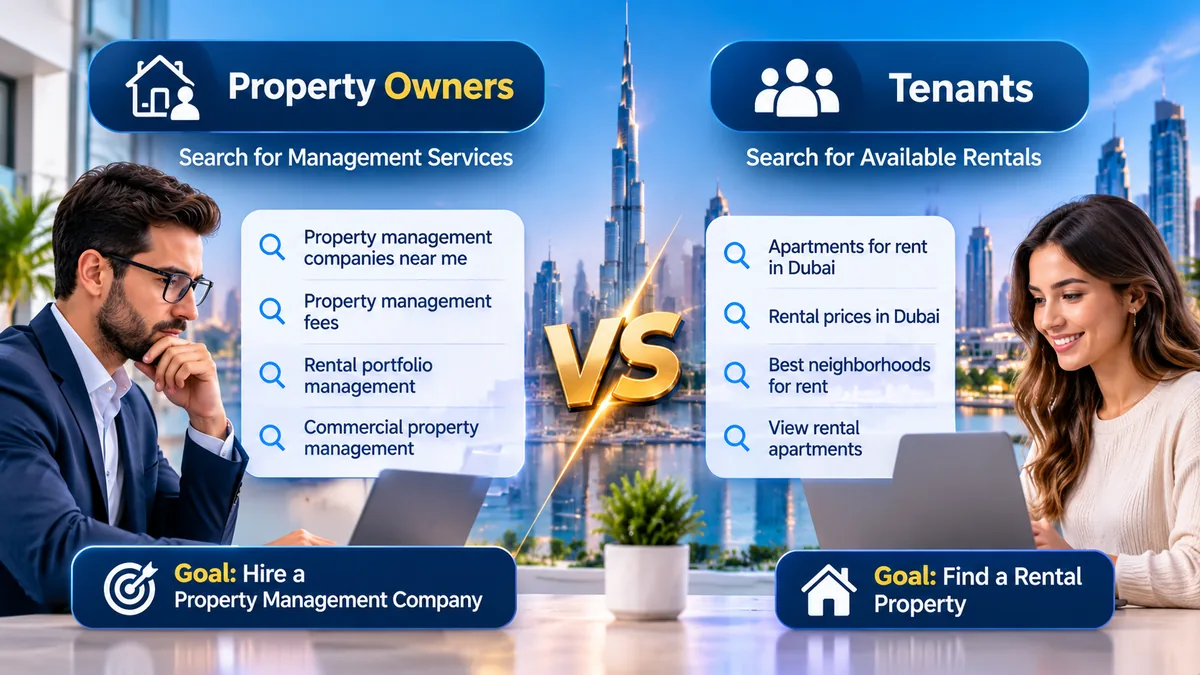
The owner versus tenant search problem
Imagine a property management company in Houston that publishes 30 articles about rental prices, apartment availability, and neighborhood guides.
Those articles might attract visitors. However, they may do very little to convince a landlord to hire the company.
Now imagine another company that publishes content about property management fees, tenant screening, maintenance costs, rental property returns, and the benefits of professional management.
The second company gives property owners more reasons to consider its services.
This does not mean rental content has no value. Tenant enquiries help property managers fill vacancies, which supports the service they sell to owners. The problem starts when tenant traffic dominates the website while owner acquisition receives little attention.
The Property Management SEO Intent Matrix
Use this framework to decide which pages your website needs.
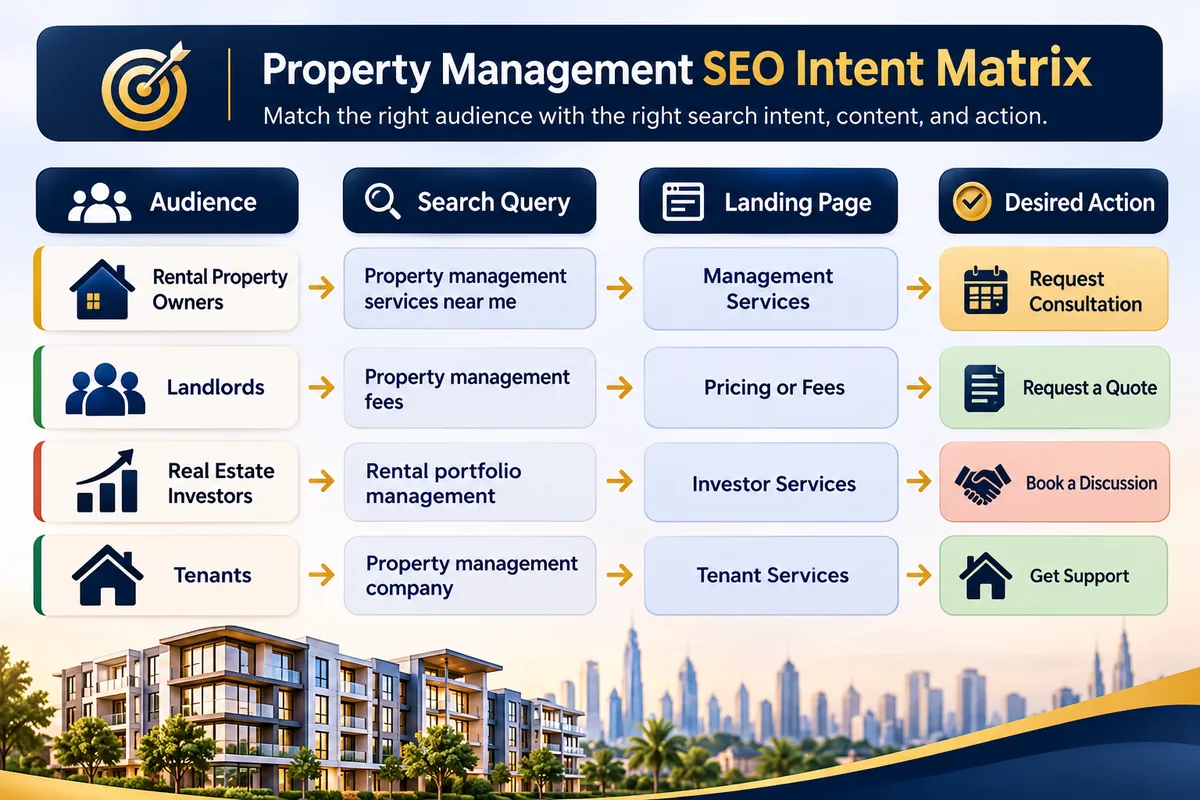
| Audience | Search examples | Recommended page | Desired action |
|---|---|---|---|
| Rental property owners | Property management services near me | Management services | Request consultation |
| Landlords | Property management fees | Pricing or fees | Request a quote |
| Real estate investors | Rental portfolio management | Investor services | Book a discussion |
| Commercial property owners | Commercial property management company | Commercial management | Request proposal |
| Tenants | Apartments for rent | Rental listings | Schedule viewing |
| Existing tenants | Property management tenant portal | Tenant portal | Access account |
The important point is simple: do not make every visitor follow the same conversion path.
A tenant should be able to find available rentals without navigating through owner services. A landlord should see management services, pricing information, and a clear way to discuss their property.
That separation makes the website easier to use and gives the company better information about which visitors generate business.
How Property Owners Search for Management Companies
Property owners rarely make a management decision after reading one page. A landlord might start by searching for property managers in their city.
Later, they may compare management fees, read reviews, check the company's experience, and ask how it handles maintenance.
An investor with properties in another state may care more about reporting, local knowledge, tenant screening, and communication.
This creates several search stages.
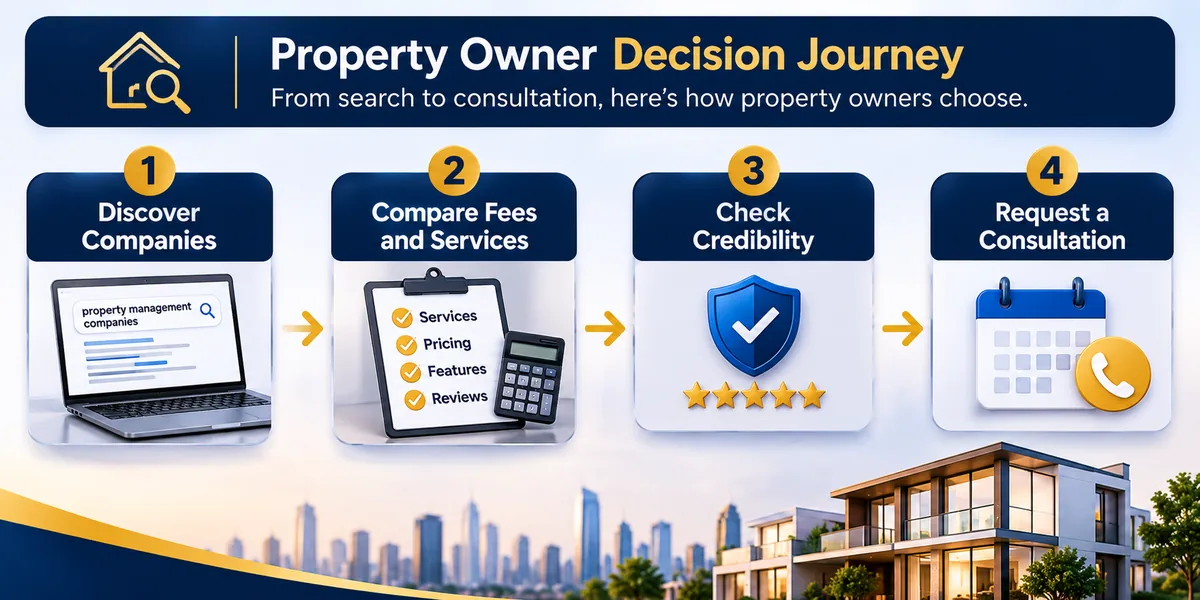
Stage 1: Finding potential companies
At this stage, owners want to identify companies that provide management services in their area.
Examples include:
- Property management companies near me
- Residential property management in Austin
- Rental property managers in Phoenix
- Commercial property management companies
- Property management services in Atlanta
Your homepage and location pages should make your service area and management expertise clear.
Stage 2: Comparing services and costs
Once owners find potential providers, they start comparing what each company offers.
They may search for:
- Property management fees
- Average property management costs
- What do property managers charge?
- Full-service property management
- Property management agreement
- Tenant screening services
A company that hides all pricing information may lose an opportunity to build trust.
You do not have to publish a fixed price if fees depend on the property, portfolio size, or service package. You can still explain how your pricing works, what the management fee includes, and which additional charges owners should expect.
Stage 3: Checking credibility
Before signing an agreement, property owners want evidence that a company can handle their investment.
They may look for:
- Google reviews and customer feedback.
- Years of property management experience.
- Types of properties managed.
- Maintenance response procedures.
- Tenant screening methods.
- Sample owner reports.
- Communication and inspection policies.
Your website should answer these questions rather than force visitors to contact your sales team for every basic detail.
Stage 4: Making contact
At this point, the owner needs a reason to choose your company over another provider.
A clear consultation offer, portfolio review, or management proposal can help move the visitor toward a conversation.
Your call to action should match the decision stage. Someone researching property management fees may not be ready to sign an agreement, but they may be willing to request a management estimate.
How to Find the Right Property Management SEO Keywords
Keyword research should start with the services you want to sell, not simply the words that receive the highest search volume.
A keyword with 10,000 monthly searches may attract people who have no intention of hiring a property manager. Another keyword with 100 searches may attract owners who are actively comparing management companies.
The second keyword could be more valuable to your business.
Property management SEO keyword examples
The following groups provide a starting point for building a keyword strategy.
| Keyword | Search intent | Recommended target |
|---|---|---|
| Property management SEO | Commercial | Industry SEO service |
| Property management companies | Commercial | Homepage |
| Property management services | Commercial | Service page |
| Property managers near me | Local commercial | Local landing page |
| Rental property management | Commercial | Service page |
| Property management fees | Commercial investigation | Pricing guide |
| Property management for investors | Commercial | Investor page |
| Commercial property management | Commercial | Commercial service page |
| How to choose a property manager | Informational | Blog article |
| Benefits of hiring a property manager | Informational | Blog article |
These are keyword examples, not claims about current search volume or ranking difficulty. Check each term against your target location before assigning it to a page.
Build keyword groups around services
A residential property management company should not target exactly the same keywords as a company that manages office buildings, retail centers, or industrial properties.
For example:
Residential property management
- Residential property management services
- Single-family rental management
- Multifamily property management
- Landlord property management services
Commercial property management
- Commercial property management services
- Office building management
- Retail property management
- Industrial property management
Investor-focused management
- Rental portfolio management
- Property management for real estate investors
- Out-of-state rental property management
- Investment property management services
Each group represents a different business need. Create a dedicated page when your company genuinely provides that service and can explain its process.
A practical keyword selection method
Score each keyword using four questions:
- Does the searcher look like a potential client?
- Does your company offer the service?
- Can your website provide a useful answer?
- Is there a realistic opportunity to rank in your target market?
You can assign each question a score from 1 to 5.
Consider this illustrative example for a residential property management company in Dallas.
| Keyword | Owner intent | Service fit | Useful answer | Market opportunity |
|---|---|---|---|---|
| Property management company Dallas | 5 | 5 | 5 | 3 |
| Property management fees Dallas | 5 | 5 | 5 | 4 |
| Apartments for rent Dallas | 1 | 2 | 4 | 2 |
These scores are hypothetical, not measured keyword data.
The example shows why search volume alone cannot determine keyword value. The first two searches are much closer to the company's actual commercial objective.
A keyword that scores highly across all four areas deserves more attention than one that only has a large search volume.
Also, assign each keyword to the most appropriate existing page before creating a new URL. This helps prevent multiple pages from competing for the same search intent.
Build a Property Management Website That Generates Owner Leads
Your website should work like a sales representative. It should explain your services, answer common objections, establish trust, and make it easy for property owners to contact you.
A homepage alone cannot do all that work.
| Signal | Websites | Share |
|---|---|---|
| Publishes a specific management fee | 25 of 111 | 22.5% |
| Has three or more city-level pages | 88 of 111 | 79.3% |
| Uses LocalBusiness or equivalent schema | 65 of 111 | 58.6% |
| Uses FAQPage schema | 8 of 111 | 7.2% |
| Blocks at least one AI crawler | 6 of 111 | 5.4% |
| Enquiry form asks how many units the owner manages | 0 of 59 | 0% |
We audited company sites in Austin, Phoenix, Atlanta, Tampa, Dallas, Miami, Charlotte, Denver, Nashville, and Las Vegas on 4 November 2026, and counted a fee only when it appeared in visible text with a number.
Create dedicated service pages
If your company provides several management services, explain each one separately.
For example:
| Website page | What it should explain |
|---|---|
| Residential property management | Rental operations, tenant communication and maintenance |
| Commercial property management | Building operations, vendor management and reporting |
| Multifamily management | Unit management, occupancy and property operations |
| Investor property management | Portfolio oversight and owner reporting |
| HOA management | Association administration and community operations |
Avoid creating pages simply because a keyword exists. Each page should describe a real service, explain how your team delivers it, and help a potential client decide whether it fits their needs.
Explain your management process
A landlord wants to know what happens after hiring your company.
Your website should explain the process from the first consultation to ongoing management.
For example:
- Property evaluation and management discussion.
- Management agreement and onboarding.
- Rental marketing and tenant screening.
- Lease administration and rent collection.
- Maintenance coordination and inspections.
- Owner reporting and ongoing communication.
This gives visitors a practical understanding of what they are buying.
Make pricing easier to understand
Property management fees can vary based on location, property type, portfolio size, and the services included.
Instead of writing a vague sentence such as "Contact us for competitive pricing," explain the factors that influence the fee.
You could also answer questions such as:
- Is the management fee a percentage of collected rent?
- Do you charge a leasing fee?
- Are there setup or onboarding costs?
- Does the agreement include property inspections?
- Are maintenance coordination fees separate?
A more complete comparison should also explain renewal charges, minimum fees, cancellation terms, owner approval requirements, and any additional charges.
Consider this hypothetical comparison:
| Pricing and service detail | Company A | Company B |
|---|---|---|
| Recurring management fee | Published | Published |
| Leasing fee | Not explained | Explained |
| Renewal charges | Not explained | Explained |
| Maintenance coordination | General promise | Process described |
| Owner approval rules | Unclear | Threshold and exceptions explained |
| Cancellation terms | Available after enquiry | Summary available before enquiry |
This comparison does not prove that Company B converts more visitors. It shows why a single percentage is insufficient for comparing two services.
Your pricing content should help owners ask informed questions.
Where exact pricing depends on the property, explain:
- What information determines the quote.
- Which services are normally included.
- Which services may cost extra.
- Whether minimum charges apply.
- Where the owner can review complete terms.
Avoid presenting a conditional price as though every owner qualifies for it.
Give visitors evidence they can check
A professional-looking website is not enough. Property owners need reasons to trust the company.
Useful evidence includes:
- Verified customer reviews.
- Real team biographies.
- Relevant licenses and professional memberships.
- Genuine case studies.
- Property management experience.
- Sample owner reports with private information removed.
- Clear service agreements and communication policies.
Do not invent testimonials or publish client results without permission. A smaller collection of genuine evidence is more useful than a large collection of questionable claims.
Use the Owner Acquisition Fit Check
A website can attract visitors and still fail to generate suitable management clients. The problem may involve targeting, service clarity, enquiry handling, or the sales process.
The Owner Acquisition Fit Check is a practical editorial framework for diagnosing these gaps. It is not a Google ranking factor, a validated industry scoring model, or a guarantee of results.
| Check | Question to ask | What to inspect |
|---|---|---|
| Audience | Are visitors owners, renters, or existing customers? | Search queries, landing pages, and enquiry categories |
| Service fit | Can you manage the property being discussed? | Location, property type, and requested services |
| Decision clarity | Can an owner understand your offer? | Fees, inclusions, exclusions, and operating processes |
| Enquiry handling | Does the request reach the right person? | Forms, email routing, and response records |
| Business outcome | Does a suitable enquiry become an agreement? | Sales records and signed contracts |
Consider three situations.
Most enquiries concern advertised rentals. First inspect whether your traffic and reporting mix tenant activity with owner acquisition.
Owners ask for services you do not provide. Review keyword targeting, service descriptions, and enquiry form questions.
Suitable owners submit requests, but nobody follows up. Fix the enquiry process before investing more money in traffic acquisition.
The framework helps identify where the actual problem sits. More SEO content will not fix every problem in the acquisition process.
Local SEO for Property Management Companies
Property management is a location-dependent business. An owner searching for a property manager in Tampa generally wants a company that can actually manage properties in Tampa.
A company based hundreds of miles away without local operations may not be a suitable choice.
That makes local SEO an important part of property management marketing.
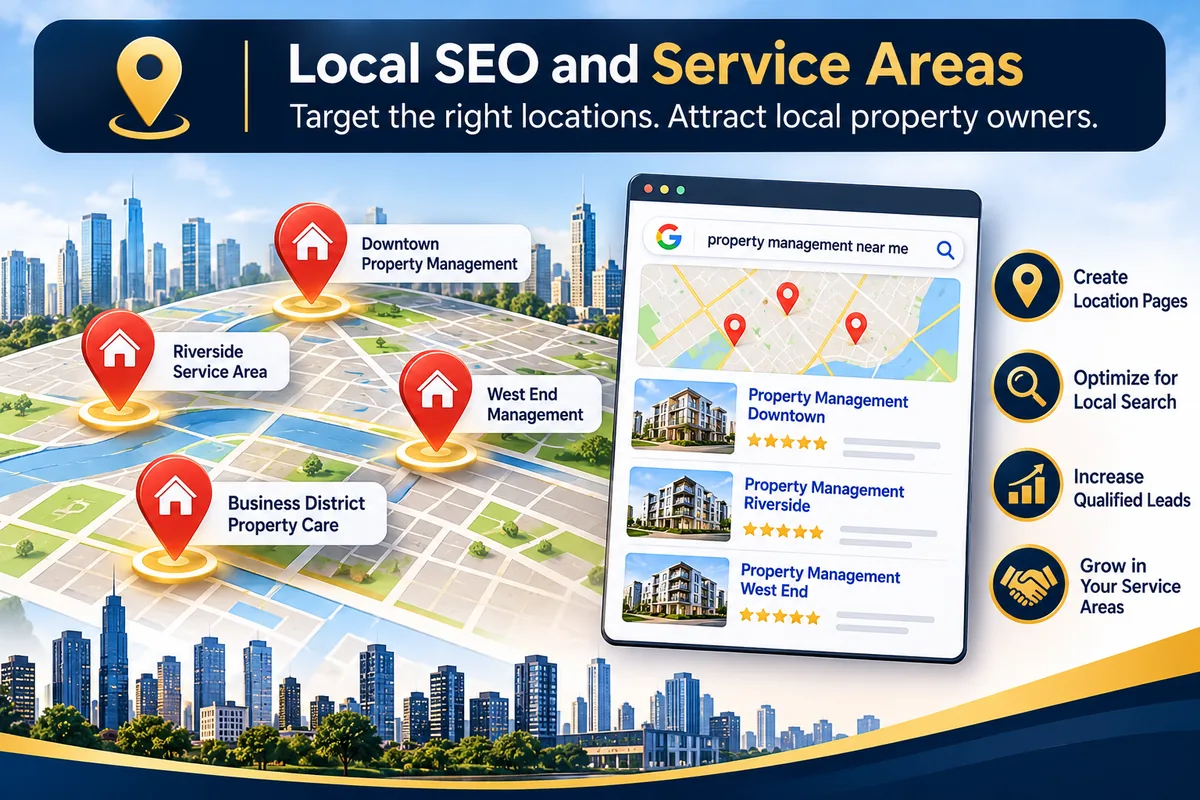
Optimize your Google Business Profile
Start with your Google Business Profile.
Make sure it accurately represents your business, services, contact information, operating hours, and eligible service areas.
Google explains that local search results mainly depend on three factors: relevance, distance, and prominence. Complete business information helps Google understand relevance, while reviews and information across the web contribute to prominence. Distance also affects which businesses appear for a local search.
Source: Google Business Profile local ranking guidance.
Practical steps include:
- Select the most accurate primary business category.
- Add relevant secondary categories when appropriate.
- Describe your actual property management services.
- Keep your phone number and website accurate.
- Add genuine business photographs.
- Ask actual clients for honest reviews.
- Respond to positive and negative feedback professionally.
Do not add keywords to your business name unless they are part of its real-world name. Do not create multiple profiles for locations where you have no eligible business presence.
A company that serves clients remotely or travels to properties should also check Google's service-area business requirements. A service area is not permission to create a profile for every city you target.
Build location pages that provide local value
A property management company serving several cities may need location-specific pages.
But creating a page for every nearby city does not automatically improve rankings.
Structured data is part of the same local signal. In Clienvora's audit, 65 of 111 property management websites (58.6%) emitted LocalBusiness or a close equivalent, which helps a search engine connect the page to a real service area.
Consider a company serving Dallas, Fort Worth, and Arlington. Each market may have different property types, rental demand, owner concerns, and management requirements.
A useful location page should explain:
- Which properties the company manages in that area.
- What services it provides there.
- How its local management process works.
- What property owners should know about the local rental market.
- Who handles enquiries and management operations.
Use the following location page test before publishing.
| Question | If the answer is no |
|---|---|
| Is there real search demand or business demand in this location? | Do not create a separate page yet |
| Can you provide genuinely different local information? | Add a section to a broader page |
| Do you have a credible service operation there? | Explain your actual service coverage instead |
This is a practical editorial test, not a formal Google ranking formula.
Google's spam policies identify doorway abuse as a problem when businesses create similar city pages mainly to rank for different locations and funnel visitors toward the same destination.
Source: Google Search spam policies.
For a deeper explanation of this issue, read Clienvora's guide to real estate SEO across multiple cities.
Build a local reputation beyond Google
Google is not the only place where property owners research management companies.
Depending on your market, relevant sources may include:
- Property management directories.
- Local real estate associations.
- Investor communities.
- Business directories.
- Local news publications.
- Professional referral partners.
A consistent business identity across these sources makes it easier for prospective clients to verify your company.
Focus on relevant, legitimate mentions rather than submitting your website to hundreds of unrelated directories.
For help with the local layer, see Clienvora's local SEO services.
Why More Location Pages and Blog Posts Can Hurt Your Strategy
Publishing more content is not always the answer to weak organic performance. Why? Because page count does not tell you whether the content serves a real search need.
City pages are now the default. In Clienvora's audit, 88 of 111 property management websites (79.3%) had at least three city-level URLs, and the median site had five. A new page has to answer a question the existing set does not.
A property management website may have 50 city pages and 100 blog posts but still struggle to generate owner enquiries.
Google's spam policies specifically warn against creating large numbers of unoriginal pages to manipulate search rankings. Its people-first content guidance also asks publishers whether their pages provide original information, useful analysis, and meaningful value beyond other search results.
Sources: Google helpful content guidance and Google spam policies.
A better way to decide what deserves a page
Before creating a new page, ask:
- Does this page answer a different question? A page about residential property management should explain different services from a page about commercial building management.
- Does the page help someone make a decision? A pricing guide should help owners understand costs. A maintenance article should explain how property managers coordinate repairs.
- Can you provide something competitors cannot easily copy? This could include your management process, original market analysis, a real example, a documented service comparison, or insights from your team's experience.
- Does the page have a clear place in your website structure? A new article should connect to relevant service pages and related resources. It should not exist as an isolated URL with no meaningful internal links.
If you cannot answer these questions, the page may not deserve its own URL.
Turn Property Management SEO Traffic Into Owner Enquiries
Getting a visitor to your website is only the first step. The next challenge is helping that visitor take action.
A property owner may spend several minutes reviewing your website and leave without contacting you. Sometimes the problem is not the traffic. It is the next step.
This is why website conversion matters as much as search visibility.
Match your calls to action with search intent
Different visitors need different reasons to contact your business.
| Visitor's interest | Useful call to action |
|---|---|
| Property management fees | Request a management estimate |
| Residential management | Discuss your rental property |
| Investor services | Request a portfolio review |
| Commercial management | Request a management proposal |
| General research | Speak with a property management specialist |
Avoid using the same generic "Contact Us" message on every page.
A specific call to action explains what happens next and reduces uncertainty.
Ask useful questions in enquiry forms
A property management enquiry form should collect enough information to qualify a potential client without making the process difficult.
Most forms stop at a name and a phone number. In Clienvora's audit of 59 inspectable contact forms, none asked how many properties or units the owner manages.
We consistently find that portfolio size is the first thing a property manager asks on a call, yet it is usually missing from the form.
Useful fields include:
- Property location.
- Property type.
- Number of units.
- Whether the property is currently occupied.
- Whether the owner needs full-service management.
- Preferred contact details.
You can use conditional fields to show relevant questions based on the property type.
For example, an owner with one rental home may need a different consultation from an investor with 40 multifamily units.
Do not turn the form into a long application. Ask only for information your team needs to determine whether the enquiry fits your services.
Make it easy to contact your team
Check your website on mobile devices.
Can someone find your phone number without scrolling through several sections? Does the enquiry form work? Are the service pages easy to navigate?
A broken form can waste the traffic your SEO campaign worked hard to attract.
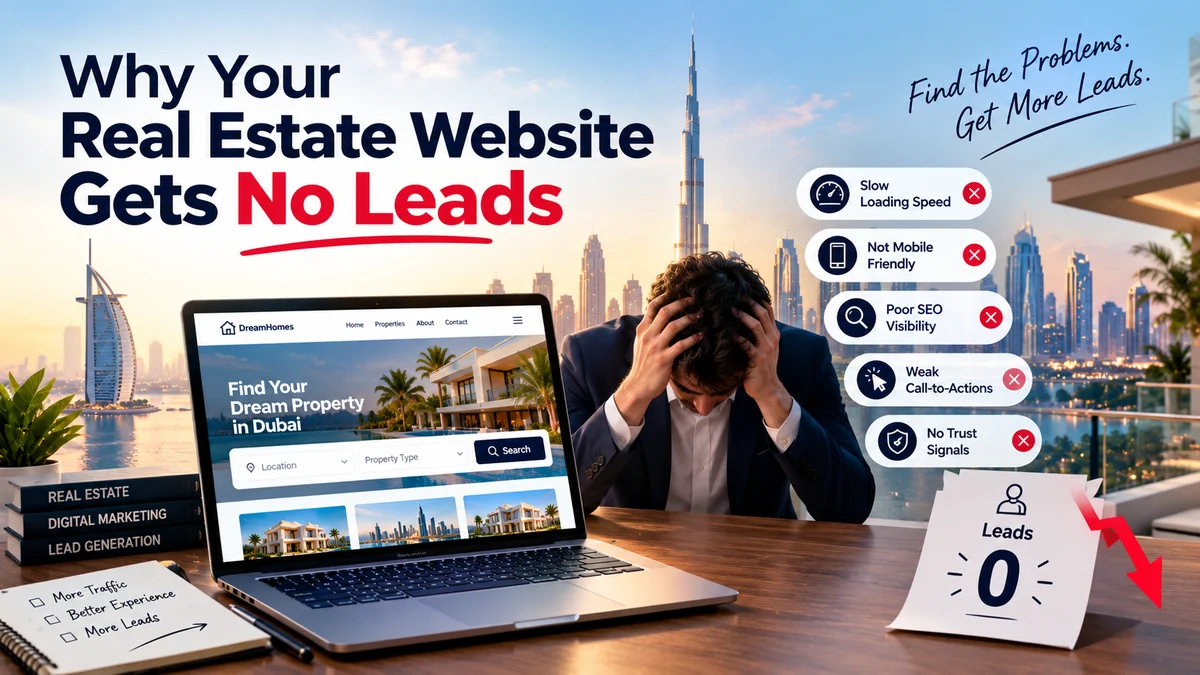
For more ideas on this topic, see Why Your Real Estate Website Gets No Leads and Turning Real Estate Blog Traffic Into Enquiries.
Measure Property Management SEO by Signed Clients, Not Just Rankings
A report showing higher rankings and more website visitors can look impressive. But can it tell you how many new property owners signed management agreements?
That is the number that matters most to the business.
What industry research says about property management leads
Goodjuju Marketing published a 2026 study comparing lead sources across 35 property management companies during spring and fall measurement periods.
Its fall analysis covered 141,908 website visitors and 1,262 owner leads. Google Search and the Map Pack accounted for 50.6% of owner leads. AI tools accounted for 3.4% of leads while representing 0.8% of website traffic.
The study also reported a 3.9% conversion rate for AI-referred visitors, compared with 1.2% for Google Search and Map Pack visitors.
These findings come from one agency's client sample. The participating businesses worked with the same marketing agency, and the results should not be treated as universal industry benchmarks. The lead figures also count owner form submissions, not every phone call or enquiry.
Source: Goodjuju's 2026 property management lead source study.
The figures illustrate why traffic and lead contribution should be measured separately. A channel that sends fewer visitors can still produce a meaningful share of enquiries.
The owner lead attribution problem
There is another measurement issue.
An owner may discover a company through Google, return directly to the website later, and finally submit an enquiry. Another owner may discover the company through ChatGPT but visit its Google Business Profile before making contact.
Google Analytics 4 may not identify the original discovery source in every case.
Goodjuju's research discusses this problem, including untagged Google Business Profile visits and AI-assisted enquiries that appear as direct traffic.
This means companies should not rely on one analytics report to understand every lead source.
A useful improvement is to add a simple question to the enquiry form:
How did you first hear about our company?
Possible answers can include Google Search, Google Maps, ChatGPT or another AI tool, referral, social media, and other.
This information can help identify discovery sources that analytics tools miss.
Track the complete conversion funnel
Consider this illustrative example:
| Funnel stage | Monthly result |
|---|---|
| Organic website visitors | 500 |
| Owner enquiries | 20 |
| Qualified owner prospects | 5 |
| Signed management agreements | 1 |
The calculation assumes a 4% visitor-to-enquiry rate, a 25% enquiry qualification rate, and a 20% qualified prospect-to-client rate.
These are example assumptions, not industry averages.
The important lesson is that 500 visitors and one signed client tell a more useful business story than 500 visitors alone.
The SEO metrics worth tracking
| Metric | What it tells you |
|---|---|
| Non-branded organic clicks | Whether people find you without searching your company name |
| Owner-focused landing page traffic | Whether your content attracts the right audience |
| Qualified owner enquiries | Whether visitors have real management needs |
| Consultation bookings | Whether prospects take the next step |
| Signed management agreements | Whether SEO contributes to new business |
| Cost per acquired client | Whether the acquisition investment makes financial sense |
| Revenue from new contracts | Whether those clients create business value |
Connect Google Search Console, Google Analytics 4, call tracking, and your CRM where possible.
Record the original source, landing page, enquiry date, prospect status, and final outcome. Also ask new clients how they first heard about your company.
That last question can reveal information that analytics tools miss.
Do not confuse revenue with contribution
A recurring management fee creates revenue, but serving the account also costs money.
When evaluating acquisition spending, distinguish:
- Management fee revenue collected.
- Direct costs of delivering the service.
- Contribution remaining after those costs.
- Acquisition spending.
- How long the agreement remains active.
For example, a company might sign a property owner with a large portfolio and collect higher monthly fees. But if that account requires substantial maintenance coordination, reporting, and staff time, the actual contribution may be lower than the revenue suggests.
This is why acquisition decisions should consider both the value of the contract and the cost of serving it.
Do not estimate customer lifetime value using unsupported retention assumptions. Start with figures your business can document.
Does AI Search Matter for Property Management SEO?
Property owners increasingly have another way to research service providers. They might ask ChatGPT or Perplexity to compare property managers.
Instead of searching only for "property management companies in Denver," someone might ask ChatGPT or Perplexity to compare property managers, explain management fees, or recommend companies for an investment property.
That creates another reason to publish clear, verifiable information.
Access is the first test. In Clienvora's audit, only 6 of 111 sites (5.4%) blocked at least one AI crawler and 5 (4.5%) blocked GPTBot. Yet 47 (42.3%) published an llms.txt file, so most sites are inviting AI systems in rather than shutting them out.
However, AI search should complement your SEO strategy, not replace it.
Make your website easier to understand and reference
Start with the basics:
- Explain your services in direct language.
- Publish accurate business information.
- Identify the markets and property types you serve.
- Include genuine examples and relevant evidence.
- Answer specific owner questions.
- Link important claims to reliable sources.
- Keep business information consistent across your website and public profiles.
There is another important consideration: AI systems may use information from sources beyond your own website.
A property management company can describe itself as an experienced provider, but independent reviews, professional directories, local associations, industry publications, and genuine customer references give prospective clients additional ways to verify that claim.
Focus on earning relevant mentions through real business relationships and useful contributions. Do not manufacture reviews or publish misleading third-party endorsements.
Build content that answers specific owner questions
A generic article about property management may repeat information that appears on hundreds of other websites.
A more useful article answers a specific question with practical detail.
For example, instead of writing another general article about maintenance management, explain how your company receives repair requests, obtains owner approval, selects contractors, records expenses, and reports completed work.
Where appropriate, support the explanation with genuine examples, documented procedures, and authoritative references.
This gives both readers and search systems more meaningful information to interpret.
Use structured data correctly
You can also use structured data where it accurately describes visible website information. For example, relevant LocalBusiness or Organization properties can help search engines interpret your business details.
Do not treat schema markup as a guarantee of AI citations or higher rankings.
The same principle applies to llms.txt files and other AI search techniques. They should not distract you from the fundamentals: accessible pages, useful content, accurate information, and a clear business identity.
Google's guidance on helpful content emphasizes original information, reliable evidence, and satisfying the reader's actual needs. Those principles remain relevant whether a visitor arrives through a traditional search result or an AI recommendation.
Measure AI visibility instead of assuming it
If AI search matters to your business, track it separately.
You can periodically test relevant questions in ChatGPT, Perplexity, and other AI search tools. For example:
- Which property management companies are recommended in Dallas?
- What should landlords compare before hiring a property manager?
- Which companies manage multifamily properties in Phoenix?
Record whether your company appears, which sources the answer references, and whether those sources contain accurate business information.
These checks are directional observations, not a standardized ranking measurement. AI answers can change based on the question, location, and session.
Also monitor AI referral traffic where analytics tools identify it, and compare those visits with enquiries and signed agreements.
A Practical 90-Day Property Management SEO Plan
A property management company does not need to publish dozens of articles in its first month. Here is a practical starting plan.
It needs to fix the pages that matter, identify its most valuable customers, and build a system that measures actual enquiries.
Days 1 to 30: Fix the foundation
Focus on understanding your current website.
- Audit existing service pages.
- Review Google Search Console performance.
- Separate owner and tenant keywords.
- Check Google Business Profile accuracy.
- Test website speed and mobile usability.
- Review enquiry forms and phone tracking.
- Identify duplicate or unnecessary location pages.
- Review whether the main owner enquiry route works correctly.
What should be complete by day 30?
You should have a documented list of technical issues, an owner-focused keyword map, a list of unnecessary or overlapping pages, and a clear picture of how your website currently receives and records enquiries.
Days 31 to 60: Build the right content
Focus on the pages that support business acquisition.
- Improve the homepage's owner-focused messaging.
- Create dedicated service pages.
- Publish clear management fee information.
- Build useful location pages where justified.
- Add genuine reviews and business evidence.
- Publish articles answering real landlord questions.
- Add internal links between related articles and services.
- Introduce the Owner Acquisition Fit Check to review the main conversion path.
What should be complete by day 60?
Your important services should have clear landing pages. Owners should be able to understand your fees, service boundaries, and management process. Each priority article should link to an appropriate service page.
Teams that need help with this layer can review Clienvora's content strategy services.
Days 61 to 90: Improve conversion and measurement
Now evaluate what happens after visitors arrive.
- Review landing page performance.
- Identify which pages attract owner enquiries.
- Improve weak calls to action.
- Test enquiry forms.
- Track qualified prospects in your CRM.
- Ask new clients how they found your company.
- Review local visibility and customer feedback.
- Update content based on actual search and sales data.
What should be complete by day 90?
You should have a working reporting process that connects organic search activity with owner enquiries, qualified prospects, proposals, and signed management agreements.
At the end of 90 days, you should have a clearer picture of which pages attract owners and which ones need improvement.
This is an execution plan, not a promise that every company will reach a particular ranking or lead target within three months.
Make Your Property Management Website Bring in More Owners
Your website should do more than display a list of services and rental listings. It should help property owners understand what you manage and how you operate.
It should also explain where you operate, how your process works, and why they should trust your company. That requires more than adding keywords to existing pages.
You need an SEO strategy that connects local visibility, useful content, service-specific landing pages, conversion-focused copywriting, and accurate lead tracking.
Clienvora helps real estate and property businesses improve organic visibility through SEO, content strategy, conversion copywriting, and AI search optimization.
If your property management website attracts visitors but struggles to generate qualified owner enquiries, start by examining the pages that receive traffic and the actions visitors take afterward. Explore Clienvora's SEO services and discuss a strategy built around your business goals.
Which Related Guides Should You Read Next?
These guides cover the local, technical, and conversion layers this article only introduces. Start with the one closest to your current bottleneck.
- Local SEO content strategy for the page architecture and content mix behind local visibility.
- Real estate AI search visibility for how property businesses earn citations in AI answers.
- Commercial real estate content marketing for the commercial property side of the same audience problem.
- What a real estate content agency should deliver for the content products and production model behind a program.
Frequently Asked Questions About Property Management SEO
These questions reflect common concerns among property management businesses and real estate investors. The answers focus on the practical decisions behind those concerns.
How do property management companies get their first clients?
New property management companies can build their first client base through local referrals, real estate investor relationships, realtor partnerships, Google visibility, and direct outreach. A website should explain the company's services, management process, service area, and reasons an owner should trust it. A new company should also make it easy for potential clients to request a consultation.
Should a property management company spend more on Google or Facebook marketing?
The answer depends on the audience and business objective. Google Search can reach owners who are actively looking for management services, while Facebook can help introduce a company to people who may not be searching yet.
A discussion in the PropertyManagement community highlights this difference, although individual experiences are not universal performance data. Read the discussion. For long-term visibility, organic SEO can support both discovery and comparison searches.
How can a property management company attract owners with larger portfolios?
Focus on the services and operational capabilities that larger investors care about. Explain portfolio reporting, maintenance coordination, financial transparency, vacancy management, and communication processes.
Publish relevant evidence and build relationships with real estate professionals and investor networks. Do not assume that more website traffic will automatically attract higher-value clients.
A discussion among property managers also highlights how portfolio size and client expectations can differ significantly. Read the community discussion.
What should property owners check before hiring a property management company?
Owners should compare management fees, service agreements, tenant screening, maintenance procedures, reporting, communication, and experience with similar properties. They should also review customer feedback and speak with more than one provider before making a decision.
A real estate investor discussion provides an example of how owners evaluate management companies beyond their advertised prices. Read the discussion.
How much should a property management company spend on SEO?
There is no single budget that works for every company. Costs depend on the number of service areas, website condition, competition, content requirements, technical work, and the amount of ongoing support needed. Start by identifying the value of a new management contract and the number of qualified enquiries your company needs to reach its acquisition goals.
How long does property management SEO take to produce results?
SEO timelines vary by market, website history, competition, and the quality of implementation. Technical improvements can help search engines access and understand pages sooner, but meaningful ranking and lead growth often require sustained work. Measure progress through impressions, qualified enquiries, signed contracts, and revenue rather than relying on a fixed ranking deadline.
Is local SEO important for property management companies?
Yes. Property owners usually want a management company that serves their property's location.
An accurate Google Business Profile, useful local service pages, genuine reviews, and consistent business information can help a company compete in relevant local searches. Google identifies relevance, distance, and prominence as the main factors behind local results.
Ready to Attract More Property Owners?
Clienvora builds SEO strategies for property management companies that connect local visibility, owner-focused content, and lead tracking to signed management agreements.
Explore Our SEO Services